duke
Old Oak
Spotted this one in the village down the road.


The gear rack.out back could offset that Adrian.It looks very unbalanced - front heavy. But admirable for people to make their own.


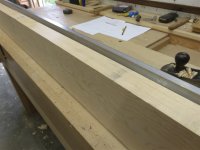

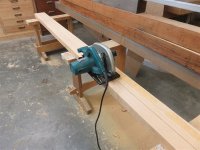


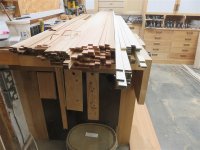


Did you plane that lot by hand?
Did you consider an alternative insulation, a wood fibre such as pavatex isolair?
The fir and cedar look to be good quality Mike.
Your hatch on the gable end wall is a great way to expand your shop.
Are you bonding the outer inner and insulatiin? Would make it much stronger. End grain balsa would work too.No, no. I pushed it over the planer, and fed it through the thicknesser. The only hand planing was getting the initial lumps of cedar square.
No. Celotex is the right material in this circumstance. There is no breathability required (it's fibreglassed on the outside), and I have a board and some off-cuts left after doing my house.
Are you bonding the outer inner and insulatiin? Would make it much stronger. ....
Just a thought, questioning the reliability of glueing to the foil layer, I’ve never tried it, does it give as good a grip compared to Polyiso without a surface covering?
Looks like you are creating a structuall insulated panel which I find fascinating. I have visited a factory that produced these panels by basically filling the void between two OSB panels with a close cell insulation. Incredible strong!View attachment 35007
That's the reason I will be using PU glue on this build, and why the insulation will be glued in place both sides. I've never seen anyone do that, in the hundreds of videos on the subject on Youtube.
Looks like you are creating a structuall insulated panel
Edit, just wondering if the odd deep score to the foil paper might help the pu adhere to the foam core
Yes it is a sip.....Looks like you are creating a structuall insulated panel which I find fascinating. I have visited a factory that produced these panels by basically filling the void between two OSB panels with a close cell insulation. Incredible strong!
If the foil paper doesn't break this should work very well.
Interesting write up as always Mike.
Edit, just wondering if the odd deep score to the foil paper might help the pu adhere to the foam core
Well if you haven’t already bought the boards it might be as well to find out, be a real shame if the foil/wood joint failed, or even if the foil/polyiso joint failed.I've no idea, Ian, I'm afraid.
I think you want the boards without foil...Well if you haven’t already bought the boards it might be as well to find out, be a real shame if the foil/wood joint failed, or even if the foil/polyiso joint failed.
Oooooh, I can feel another experiment coming on! I'll set something up this afternoon.Well if you haven’t already bought the boards it might be as well to find out, be a real shame if the foil/wood joint failed, or even if the foil/polyiso joint failed.
Experiment done. Make your predictions now, and I'll post photos this evening. Where did it fail under load?Oooooh, I can feel another experiment coming on! I'll set something up this afternoon.

At the edge of what you clamped the test piece toExperiment done. Make your predictions now, and I'll post photos this evening. Where did it fail under load?


Mike
I'm sure you've factored it into your plans but when the panels are made up for modern caravans and motorhomes there are timber frames and sections incorporated in the sandwich around door openings and where you need fixing points for bed frames, kitchen units etc.
As an aside, James awoke a long forgotten memory when he mentions Alutech. whilst not the same company we used to sell Alucobond in thin sheets I think mainly 6mm from memory to the construction industry so you probably came across it. We spent a fair amount of effort persuading architects to specify it for commercial projects. That was back in the eighties so long long ago.

.....Which make of glue are you using Mike, and does it come in a tube you fit to a gun?

Good stuff and it's waterproof!Soudal 30 minute "Lumberjack" PU, and no, it's in a normal plastic bottle. I bought a box of disposable gloves at the same time as I bought the glue, as I can see things getting messy. I hate PU, but it's the glue recommended for sticking Celotex, and it's waterproof.
View attachment 35045
Why the capping? Just several layers of fibreglass?Don't forget how small this thing is, Mark.
In principle, the whole thing is a torsion box/ monocoque. I'm going to be fibreglassing the joint, with lapped sheets of glass fibre, and an additional strip, then the entire joint is going to be covered by a cover moulding (made of laminated bog oak), which again will be glassed over. It's going to be enormously strong. I'm very much aware that this wouldn't work on a caravan-sized project, but this thing is tiny in comparison. Also, the chassis is very stiff .
I guess you have given enough pre-design thought into it before setting out on the construction Mike, it was just a thought that sprang to mind regarding my own experience. It's an amazing project to add to the woohaven2 site which is interesting to follow, good thread!Don't forget how small this thing is, Mark.
In principle, the whole thing is a torsion box/ monocoque. I'm going to be fibreglassing the joint, with lapped sheets of glass fibre, and an additional strip, then the entire joint is going to be covered by a cover moulding (made of laminated bog oak), which again will be glassed over. It's going to be enormously strong. I'm very much aware that this wouldn't work on a caravan-sized project, but this thing is tiny in comparison. Also, the chassis is very stiff .
Why the capping? Just several layers of fibreglass?
Either it's a monocoque or it's not. Mixing building styles is a recipe for failing (in a boat building world anyway!)
