kirkpoore1
Old Oak
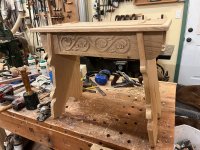
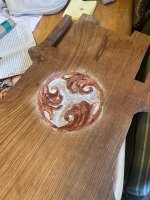
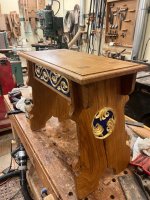
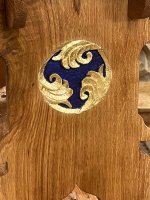
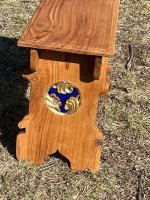
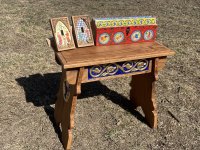
In the medieval group that my GF Lisa and I belong to we are sponsoring a competition to make an item with a team of at least three people using at least three different skill sets. Our group has the unfortunate inclination to "do it all yourself" when making things. This was frequently not the case--for example, in making a book, the parchment maker, scribe, and bookbinder were almost always different people. It is common for contests like this to give prizes to the winner, and so we have begun making items which could be entered if we weren't the sponsors. In our case, the three prizes will be a game box, board, and pieces; a pair of carved and painted light switch covers (yes, not medieval but certainly in that style), and an oak bench that will be carved and painted. Lisa will be doing most of the painting, so I had to get started on the woodworking and carving portions so that she had something to do.
We started off with material preparation. The box and switch covers will be covered in gesso before painting, and we determined to make "gesso sottile" for the final coats of gesso. Traditional gesso is made of hide glue and a powder like plaster of paris or whiting. Plaster of paris is somewhat coarse and is used for "gesso grosso", which builds the thick underlayer. The powder for gesso sottile is much finer, and we are making it by slaking plaster of paris in water and stirring regularly. Using the medieval artist Cennino Cennini's instructions, this takes 3 months. For our first batch, we let it soak for a week before drying it out and got a much, much finer powder to work with.


The first picture shows jars of the slaking plaster after stirring. The particles are settling out. We're going to let these go the distance to see if make must difference. The second pic is the jar that we're using. After a week, we poured it into a collander covered in cloth and let it drain. Once the dripping had almost stopped Lisa squeezed and twisted the cloth to get as much water out as possible, forming a thick paste. We spread that out on a baking sheet as thinly as we could and put it in my bread proofer to dry out. It was about dry today, but will need to be broken up to make it into fine particles before we use it.
Next, I started on the switch covers. I carefully measured and cut holes for the switch itself and the screws to hold the cover in place. I had to route the backs out to make room for some protruding switch parts. Then I cut arch out of the tracery fronts and glued them in place. Saturday I was at one of our medieval events and spent the day carving one of the covers. Only the flat recessed area will get the gesso and paint--the rest will get home made boiled linseed oil (to be done in a few days).


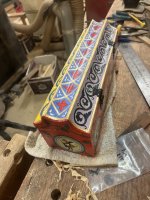
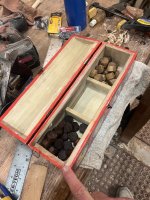
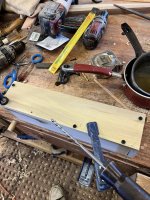
Finally, I went on to the game box. The original is 14th century and apparently German, and resides in the Metropolitan Museum of Art in New York. It's fairly small, a little over 10" long. Ours will be 13-1/2" long, giving more room for the cloth game board. I cut out and thicknessed the poplar parts, including cutting slots for interior dividers. Each piece is half an inch thick. I used a combination of hide glue and cut nails for the assembly. I started with hide glue, then temporarily used screws in place of nails to keep things solid while I nailed it together. Each nail head is covered in foil to prevent any rust from bleeding through the gesso. All the heads are countersunk so that the gesso will present a smooth surface for painting. The top is glued up from two boards, but I haven't done anything else on that yet.




Things need to progress rapidly, since the contest is at the end of February and Lisa will need time to paint. I'll start on the box lid tomorrow, then move to carving the other switch cover. After that I'll get to the bench. I also have to build a cart by the end of the month, so I'm kind of pressed for time.
Kirk
We started off with material preparation. The box and switch covers will be covered in gesso before painting, and we determined to make "gesso sottile" for the final coats of gesso. Traditional gesso is made of hide glue and a powder like plaster of paris or whiting. Plaster of paris is somewhat coarse and is used for "gesso grosso", which builds the thick underlayer. The powder for gesso sottile is much finer, and we are making it by slaking plaster of paris in water and stirring regularly. Using the medieval artist Cennino Cennini's instructions, this takes 3 months. For our first batch, we let it soak for a week before drying it out and got a much, much finer powder to work with.
The first picture shows jars of the slaking plaster after stirring. The particles are settling out. We're going to let these go the distance to see if make must difference. The second pic is the jar that we're using. After a week, we poured it into a collander covered in cloth and let it drain. Once the dripping had almost stopped Lisa squeezed and twisted the cloth to get as much water out as possible, forming a thick paste. We spread that out on a baking sheet as thinly as we could and put it in my bread proofer to dry out. It was about dry today, but will need to be broken up to make it into fine particles before we use it.
Next, I started on the switch covers. I carefully measured and cut holes for the switch itself and the screws to hold the cover in place. I had to route the backs out to make room for some protruding switch parts. Then I cut arch out of the tracery fronts and glued them in place. Saturday I was at one of our medieval events and spent the day carving one of the covers. Only the flat recessed area will get the gesso and paint--the rest will get home made boiled linseed oil (to be done in a few days).
Finally, I went on to the game box. The original is 14th century and apparently German, and resides in the Metropolitan Museum of Art in New York. It's fairly small, a little over 10" long. Ours will be 13-1/2" long, giving more room for the cloth game board. I cut out and thicknessed the poplar parts, including cutting slots for interior dividers. Each piece is half an inch thick. I used a combination of hide glue and cut nails for the assembly. I started with hide glue, then temporarily used screws in place of nails to keep things solid while I nailed it together. Each nail head is covered in foil to prevent any rust from bleeding through the gesso. All the heads are countersunk so that the gesso will present a smooth surface for painting. The top is glued up from two boards, but I haven't done anything else on that yet.
Things need to progress rapidly, since the contest is at the end of February and Lisa will need time to paint. I'll start on the box lid tomorrow, then move to carving the other switch cover. After that I'll get to the bench. I also have to build a cart by the end of the month, so I'm kind of pressed for time.
Kirk