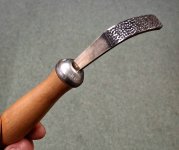
Whilst doing family history research I was interested to find an ancestor who was a file cutter., presumably a man who made files by hammering a punch to cut the teeth in steel blanks held by leather straps to a bed of lead. Apparently, such workers were highly skilled and well paid but the tended to die young owing to inhalation of steel and lead particles.
Anyone who uses a machine-made rasp quickly discovers that their regular tooth spacing tends to cause irritating “tramlines” to form in the workpiece. The slight irregularity in the tooth spacing of hand stitched rasps avoids this problem.
I found a couple of videos online showing the process of making hand stitched rasps and learned that it takes two years to become proficient at stitching. Well, I had no intention of devoting two years to acquiring this art but I thought it might be fun to have a go.
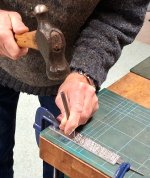
I started by making a punch of silver steel and a couple of blanks from O1 steel. Then I set to work. I found it best to use quite a big hammer. I quickly discovered that hand stitching is a tedious operation …..


After cutting the teeth I heat treated the rasps. I was reluctant to quench in oil owing to the difficulty there would be in removing the black scale that would form (I believe that commercially made rasps are sand blasted after quenching but I do not have such a facility). Instead, I used a saturated solution of common salt. Even so, the rasps came out a bit blackened. I made and fitted handles, then gave them a try.

I can report that they do work fairly well but are not the best rasps I have used. Anyway, it was an interesting exercise.
Anyone who uses a machine-made rasp quickly discovers that their regular tooth spacing tends to cause irritating “tramlines” to form in the workpiece. The slight irregularity in the tooth spacing of hand stitched rasps avoids this problem.
I found a couple of videos online showing the process of making hand stitched rasps and learned that it takes two years to become proficient at stitching. Well, I had no intention of devoting two years to acquiring this art but I thought it might be fun to have a go.
I started by making a punch of silver steel and a couple of blanks from O1 steel. Then I set to work. I found it best to use quite a big hammer. I quickly discovered that hand stitching is a tedious operation …..
After cutting the teeth I heat treated the rasps. I was reluctant to quench in oil owing to the difficulty there would be in removing the black scale that would form (I believe that commercially made rasps are sand blasted after quenching but I do not have such a facility). Instead, I used a saturated solution of common salt. Even so, the rasps came out a bit blackened. I made and fitted handles, then gave them a try.
I can report that they do work fairly well but are not the best rasps I have used. Anyway, it was an interesting exercise.