• Hi all and welcome to TheWoodHaven2 brought into the 21st Century, kicking and screaming! We all have Alasdair to thank for the vast bulk of the heavy lifting to get us here, no more so than me because he's taken away a huge burden of responsibility from my shoulders and brought us to this new shiny home, with all your previous content (hopefully) still intact! Please peruse and feed back. There is still plenty to do, like changing the colour scheme, adding the banner graphic, tweaking the odd setting here and there so I have added a new thread in the 'Technical Issues, Bugs and Feature Requests' forum for you to add any issues you find, any missing settings or just anything you'd like to see added/removed from the feature set that Xenforo offers. We will get to everything over the coming weeks so please be patient, but add anything at all to the thread I mention above and we promise to get to them over the next few days/weeks/months. In the meantime, please enjoy!

Curved or arched rebate with hand tools

Planeiron

New Shoots
Joined
Mar 3, 2025
Messages
66
Reaction score
216
Location
Co. Down
Name
Dave
LOCATION
Co. Down
I am in the process of making the top rail of a door that needs a rebate cut for glass. The trick is that it is arched and therefore needs an curved/arched rebate. I don't have a powered router but I realise this would be this quickest and simplist way.

Any tips on how to do this with hand tools. I reckon I would chisel out most of the waste and when close to the marks finish with a scratch stock. Has anyone any experience of doing this or advice about a better way? I saw Doug's unfortunate compass plane post: first time I've seen one of those. Maybe that's something to consider.

In doing a bit of research about cutting curves etc I found this video which might be of interest:

 
A wooden rebate plane of no discernible worth could easily be adapted by curving the sole in front and behind the mouth.
It will, at a pinch, serve to shape the arch shape before the rebate is to be cut.
Because you will need to work in both directions of the curve a straight iron will be beneficial instead of a skewed iron.
Cheers, Andy
 
Also, if it's a one off and you don't want an excuse to buy another tool, a suitably shaped block of scrap wood with some coarse abrasive paper would clean up after your chiselling.
 
Thanks for the suggestions. I've never seen that type of router before. Google tells me its a preston 1386.
 
Roy Underhill definitely did something like this in a Woodwright's shop episode, but I can't find it. His had a bead, and was quite a tight radius. IIRC, he began saying he had assumed some clever tool was needed, but the answer is you just carve it. But not without aids - sharpened divider / trammels or similar to mark/cut the arc(s), and router plane to finish to depth. In-cannel gouge to round the bead.

If you are talking one more gentle curve, yes, a variety of coachmaker's shaves or even a humble scratch stock with a bit of patience might do.
 
This is great. Arc is gentle enough. Router plane and gouge might be the answer for the rebate from the tools I have
 
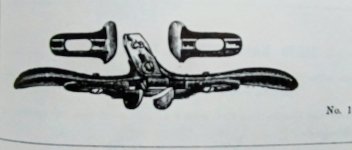
As well as Andy's suggestion, if you can find a router like this, it should be ideal. Preston made them but this one is unmarked.

View attachment 39062

View attachment 39063

They were a metal version of a similar wooden tool.
I'm curious about the fences. Clearly, you only use one fence at a time, and you put that one fence on whichever side it is needed. The thing I am curious about, though, is why one fence can only abut the cutter, and the other one extends over it as needed. I can't think of any circumstance where you'd need the left hand fence (from the lower photo) in preference to the RH fence...given that the RH fence can also be set at the very edge of the iron. Can anyone enlighten me?

I can see this being a tool which requires quite some skill to use, and maybe even a scratched groove first, to set the line of the edge of the rebate.
 
If you are making a plain edged semicircle from a single flat board, you'll need to cut 'downhill' (with the grain) at each end. You could do this by flipping a symmetrical tool (such as a spokeshave) over.

But if you are using the fence on a router like this one to define a rebate, when you flip the tool, the fence will be on the wrong side.

The answer is to have two adjustable fences. Each can be set back from the blade by the same amount. Then the tool is reversible without disturbing the setting.

The tool in my photo is not set up for anything in particular.
 
But if you are using the fence on a router like this one to define a rebate, when you flip the tool, the fence will be on the wrong side.

The answer is to have two adjustable fences. Each can be set back from the blade by the same amount. Then the tool is reversible without disturbing the setting.

If it's a board you're working on, you'd have to remove the inboard fence when you flip the tool over. If it's a curved glazing bar, or something similar, then yes, there might be a circumstance in which the un-used inboard fence isn't in the way.

There's also the question of why the fences aren't identical.
 
I'm imagining that you are working on the edge of the board, so there's space either side.

But that's a good point about the fences. It looks like one is for a rebate on the near edge, but the other would work on the far edge.
 
If it's a board you're working on, you'd have to remove the inboard fence when you flip the tool over. If it's a curved glazing bar, or something similar, then yes, there might be a circumstance in which the un-used inboard fence isn't in the way.

There's also the question of why the fences aren't identical.
Andy may be unaware the it should have two stepped fences.
EDIT to say two of each of those fences present....
 
Last edited:
Andy may be unaware the it should have two stepped fences.
What! I've been sold a pup... a veritable mongrel!

(Actually it was given to me, from a distant family member's tool collection. He would have used it in the 40s or 50s probably.)

Perhaps you have just given me an excuse for not having made any curved sashes!
 
Perhaps you have just given me an excuse for not having made any curved sashes!

No, no, no.....you don't get away with it that easily! You only need one fence at a time......so you'll just have to take it off and swap to the other side when you work on the other "hand".
 
Oh, hadn't realised this, it had two pairs of fences.
One pair for rabbeting and one pair for moving fillister work.
20260206_143447.jpg
 
I agree! (But I should have looked 🙁)

IMG_20260206_144553745.jpg

IMG_20260206_144538914~2.jpg

I wonder if I missed the vital bits in my ignorance... But it was probably 30 years ago...
 
Back
Top