• Hi all and welcome to TheWoodHaven2 brought into the 21st Century, kicking and screaming! We all have Alasdair to thank for the vast bulk of the heavy lifting to get us here, no more so than me because he's taken away a huge burden of responsibility from my shoulders and brought us to this new shiny home, with all your previous content (hopefully) still intact! Please peruse and feed back. There is still plenty to do, like changing the colour scheme, adding the banner graphic, tweaking the odd setting here and there so I have added a new thread in the 'Technical Issues, Bugs and Feature Requests' forum for you to add any issues you find, any missing settings or just anything you'd like to see added/removed from the feature set that Xenforo offers. We will get to everything over the coming weeks so please be patient, but add anything at all to the thread I mention above and we promise to get to them over the next few days/weeks/months. In the meantime, please enjoy!

Peter Follansbee (and other) carving

Blackswanwood

Old Oak
Joined
Jun 27, 2020
Messages
1,426
Reaction score
883
Location
North Yorkshire
Name
Robert
Has anyone else had a go at a Follansbee type carving and found it’s A LOT harder than it looks or is it just me?

My first attempt was in oak but it seemed to be very unforgiving and brittle. It was kiln dried and had been sat in the workshop for some time. I am wondering if it was “too dry” (reading off the meter is 10%) and if PF uses “greener” timber.

I’ve repeated the exercise using cherry and it’s much easier … but still not as easy as he makes it look.

IMG_6462.jpeg
 

Attachments

  • IMG_6459.jpeg
    IMG_6459.jpeg
    223.5 KB · Views: 5
Last edited:
I haven't got past watching the videos and thinking "I ought to have a go at that..."

I think you are right that he does use relatively green wood - which he gets in the round and rives himself. That way, he's in control of the moisture content.

I've got some bits of very old, dry oak that I don't think would be suitable at all for carving.

I do think your piece looks brilliant. I expect that you are still very aware of every slight imperfection, but to anyone else, it's the overall impression that counts.

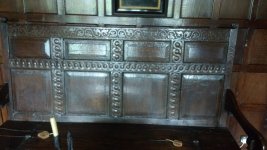
There are some great examples from the 17th century locally and looking at them, I've noticed that old work definitely has places on it that look rough or careless, but we see them now as giving part of its charm. It's also clear how closely the patterns are linked to using a small number of gouges, making cuts that directly match their shape, thus making production relatively efficient.
 
Yes, i have tried it. Dry oak is very difficult. It is easy enough to carve the shapes but getting a smooth base in anything that is not a V shape variant is a right pain. I ended up making a small scraping tool to deal with the depths and cursing my folly.
 
Andy - you mention that there are some great examples from the 17th century locally. I'd be interested to know where they are so I can have a look.
 
That last pic Andy, reminded me that I went there 30 odd years ago with my children, and the old guide had such a thick Yorkshire accent that when I asked him what that chest was for I couldn’t work out whether he said it was for oats or ought, didn’t have the heart to ask lol.
Just west of Leeds in case you were wondering.
 
Thanks Andy. Although we have lived in Bristol for over 40 years, we’ve only rarely visited Red Lodge. For some years, we used to go to what was then the annual Savages exhibitions in The Wigwam but have probably only been to see the rest of the museum once in all the time we’ve been here. However, as it happens, I’ve got an appointment at the Eye Hospital next Monday so will try and pay the museum a visit on the way home.
 
Has anyone else had a go at a Follansbee type carving and found it’s A LOT harder than it looks or is it just me?

My first attempt was in oak but it seemed to be very unforgiving and brittle. It was kiln dried and had been sat in the workshop for some time. I am wondering if it was “too dry” (reading off the meter is 10%) and if PF uses “greener” timber.

I’ve repeated the exercise using cherry and it’s much easier … but still not as easy as he makes it look.

View attachment 36506
Looks pretty bloody good to my eyes mate!!
 
Delayed by other commitments but finally got the lid carving done …

IMG_7092.jpeg

I need to put a bevel on the face of the lid before fitting it. I need to decide which hinges to use as I don’t want to follow Follansbee’s method of crafting hinges from nails.
 
I also surprised myself with these.

IMG_7153.jpeg

They are the ends for a shelf commissioned by my daughter in law. The original plan was to keep them plain but I suggested adding some carving… and then had a sense of dread when she liked the idea.

I didn’t over think it (which I often do) and just drew the outline on graph paper and cracked on. It’s the first time that I have done an inlaid rose. They were carved side by side taking about two hours to complete excluding the drawing and a bit of tuition I had on how to do the anthers.

I’m not entirely happy with the anthers (if that’s the right term) in the centre, but I’ll do them better next time!
 
I also surprised myself with these.

View attachment 37666

They are the ends for a shelf commissioned by my daughter in law. The original plan was to keep them plain but I suggested adding some carving… and then had a sense of dread when she liked the idea.

I didn’t over think it (which I often do) and just drew the outline on graph paper and cracked on. It’s the first time that I have done an inlaid rose. They were carved side by side taking about two hours to complete excluding the drawing and a bit of tuition I had on how to do the anthers.

I’m not entirely happy with the anthers (if that’s the right term) in the centre, but I’ll do them better next time!
Wow, very impressive.
 
They look really good.

Yes, Follansbee does a lot of green wood carving, but I think what you may be seeing is the 30 or 40 years of experience that he has too. :)

I've carved a lot in oak, almost all of it fully dried, and it goes ok though cleaning up the details is harder. I always use a mallet except when cleaning up fine details. That being said, cherry is much nicer to carve as you found out.

Kirk
 
Just grabbed an hour in the workshop to finish my latest carving …

IMG_7626.jpeg
It’s based on the sign from when our house was a pub (last orders were in 1958) and will form the front of a chest I’m making.

I didn’t want to carve across jointed boards and so had to contend with some “interesting” grain.
 
Did you make that little stippling tool yourself? It really helps, because lowering the general background, as you've done here, to produce a relief carving.......well, that's quite difficult to get neat.
 
Did you make that little stippling tool yourself? It really helps, because lowering the general background, as you've done here, to produce a relief carving.......well, that's quite difficult to get neat.
I got it second hand from the Old Tools Store stall at Harrogate Mike (I think it’s made by Pfeil) … and it does cover up any blemishes!
 
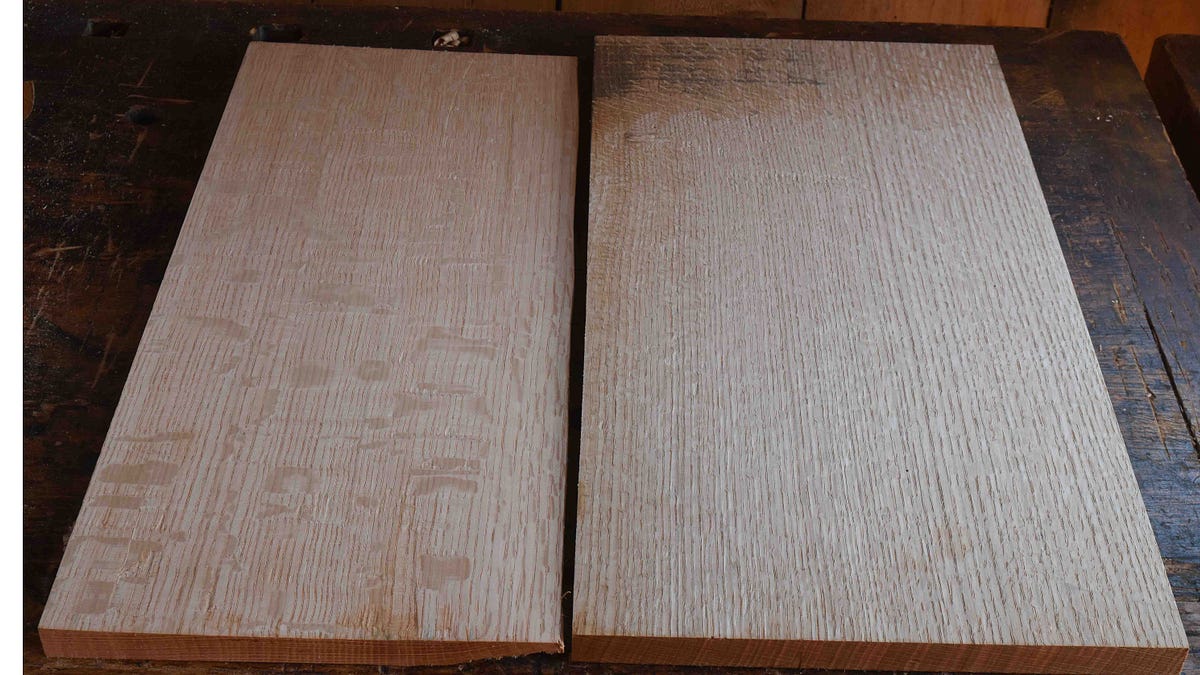
Peter Rives (splits) Green Oak, so it's more like quartersawn than flatsawn. I'd like to have a go at this myself one day to see how much of a difference it makes!

 
Peter Rives (splits) Green Oak, so it's more like quartersawn than flatsawn. I'd like to have a go at this myself one day to see how much of a difference it makes!

Yes - I’ve now got a copy of his book Joiners Work which is as interesting about how he prepares timber as it is about his carvings.

I wonder if the trade off of using riven boards is what you gain in terms of stability is balanced by a reduced chance of interesting grain pattern.
 
I got it second hand from the Old Tools Store stall at Harrogate Mike (I think it’s made by Pfeil) … and it does cover up any blemishes!

:ROFLMAO: I picked up a couple of those at Harrogate, put them back and later had second thoughts but they were gone. Now I know where at least one of them went. I have some home made ones though, not difficult to make.

Your carvings are excellent Robert and as said difficult to do unless you're using something like lime. I love the look of that style but tried it many years ago and didn't enjoy it at all. I have a low boredom threshold and found it too repetitive for me which is why most of my projects are in the round.
 
Thanks Bob.

You did a post (possibly on the other place) some time ago of a bear that you had carved (for your granddaughter?) which was one of the things that piqued my interest in carving.
 
Thanks Bob.

You did a post (possibly on the other place) some time ago of a bear that you had carved (for your granddaughter?) which was one of the things that piqued my interest in carving.

It's very therapeutic Robert.
I haven't done any carving for a couple of years apart from picking one up chopping off a few shavings and sticking it back in the box. I menioned my low threshold, I have a box full of part carved pieces, probably 15 or 20 some of which have been in the making for 10 years or more.
 
Yes - I’ve now got a copy of his book Joiners Work which is as interesting about how he prepares timber as it is about his carvings.

I wonder if the trade off of using riven boards is what you gain in terms of stability is balanced by a reduced chance of interesting grain pattern.
I wonder if the grain orientation is helpful. The thing I've enjoyed most about learning to carve is a better understanding of grain. Carving neatly against the grain is tricky on a flat-sawn board (particularly curves). Split boards have the grain running more regularly, which sounds helpful. I'm sure green wood is easier to carve, too!

Mary May has a good tutorial that illustrates this - 'Carving a doughnut': https://marymaycarving.com/home/episode_details/beginning-carving-how-to-carve-a-donut-introduction
 
@Paul_Munford - yes, being aware of the grain is key. I’ve not carved a doughnut but have done some Tudor roses which give a similar appreciation.

I’m trying to push myself by thinking before I rotate the work whether I can manage to make a cut by switching from right (natural) handed to left handed. It’s getting easier but there is a long way to go!
 
I love that pair of swans. How did you cope with knot just right of centre at the bottom? I imagine it must be very difficult.
 
Back
Top