• Hi all and welcome to TheWoodHaven2 brought into the 21st Century, kicking and screaming! We all have Alasdair to thank for the vast bulk of the heavy lifting to get us here, no more so than me because he's taken away a huge burden of responsibility from my shoulders and brought us to this new shiny home, with all your previous content (hopefully) still intact! Please peruse and feed back. There is still plenty to do, like changing the colour scheme, adding the banner graphic, tweaking the odd setting here and there so I have added a new thread in the 'Technical Issues, Bugs and Feature Requests' forum for you to add any issues you find, any missing settings or just anything you'd like to see added/removed from the feature set that Xenforo offers. We will get to everything over the coming weeks so please be patient, but add anything at all to the thread I mention above and we promise to get to them over the next few days/weeks/months. In the meantime, please enjoy!

Awl of my tools

SteveMP

New Shoots
Joined
Jun 18, 2026
Messages
182
Reaction score
227
Name
Steve
LOCATION
San Diego
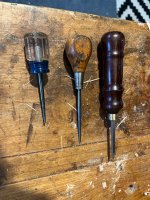
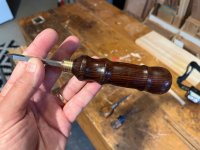
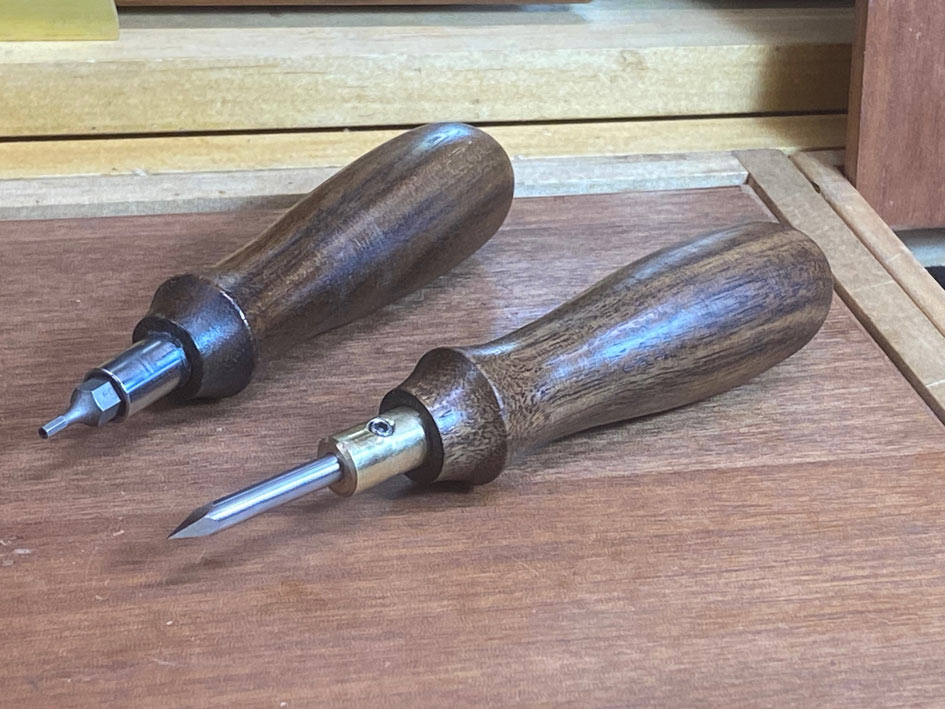
Three awls. One old Craftsman stinky handled one. One vintage Stanley that is through-tang so can hammer if needed. One birdcage one i made from a kit. I had a really nice piece of cocobolo so i turned it based on a pattern from an old style vintage birdcage awl. If you don’t have a birdcage awl, i highly recommend one. It works great for starting screws for hinges etc. this one is solid carbide and has a secondary bevel.

IMG_2072.jpeg
IMG_2073.jpegIMG_2074.jpegIMG_2075.jpeg
 
Oh I agree, everyone needs a selection of humble tools like these. Woodworking is a practical pursuit but I think there's room for some sentiment too...

The picture shows, from left to right:

- A fancy American job from Horace Brittain, with a selection of little tools inside and a cunning collet. It's showing a very useful four sided blade that will scrape a hole for a screw. A useful tool.

- A cheaper 19th century English offering with a simpler 2-jaw collet and a captive nut on a left-handed thread. Also useful.

- A fancy boxwood handled awl with a long slender spike. I bought it because I thought it looked pretty!

- A simple no name beech handled awl with a screwdriver type blade, great for making slightly larger holes in wood. On eBay it would doubtless be listed as "vintage" but I remember walking to a nearby tool shop and just buying it, new, which sort of makes me feel old.

- But not so much as the last one, which started as a cheap screwdriver. I filed a point on it and painted it green with paint left over from an Airfix kit. I was probably about nine years old. It's still useful for marking hole centres through hinges etc. I have to keep this one! 🙂

IMG_20260805_193745763.jpg
 
Oh I agree, everyone needs a selection of humble tools like these. Woodworking is a practical pursuit but I think there's room for some sentiment too...

The picture shows, from left to right:

- A fancy American job from Horace Brittain, with a selection of little tools inside and a cunning collet. It's showing a very useful four sided blade that will scrape a hole for a screw. A useful tool.

- A cheaper 19th century English offering with a simpler 2-jaw collet and a captive nut on a left-handed thread. Also useful.

- A fancy boxwood handled awl with a long slender spike. I bought it because I thought it looked pretty!

- A simple no name beech handled awl with a screwdriver type blade, great for making slightly larger holes in wood. On eBay it would doubtless be listed as "vintage" but I remember walking to a nearby tool shop and just buying it, new, which sort of makes me feel old.

- But not so much as the last one, which started as a cheap screwdriver. I filed a point on it and painted it green with paint left over from an Airfix kit. I was probably about nine years old. It's still useful for marking hole centres through hinges etc. I have to keep this one! 🙂

View attachment 57245
Great looking selection there!
 
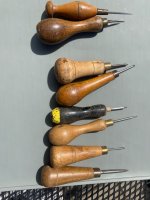
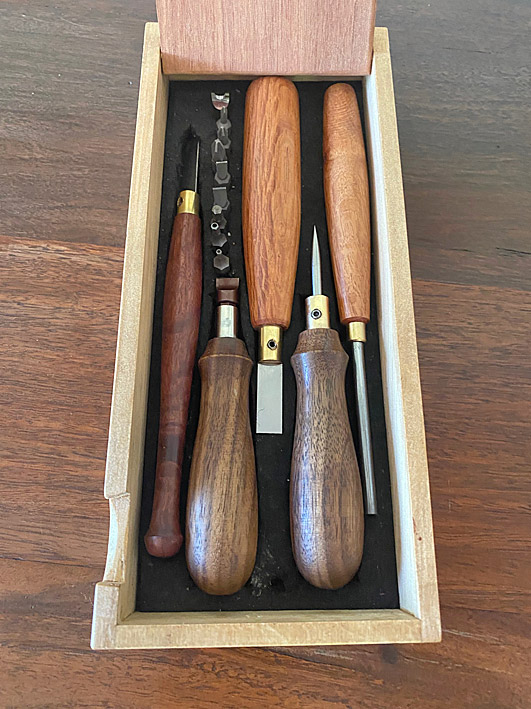
Here’s mine.
The one at the top is a fine square blade and is a favourite for tiny screw holes.
The second top, I made the blade from a small Allan key.
The one at the bottom , I remember my dad using this when hanging doors, with the hinges fitted to the door, you get the door where you want it and then temporarily fix the top hinge by driving the awl through the hinge hole and
into the frame. This holds the door well enough to get a few screws in to properly align. Works a treat and I have done it myself many times.
Is this standard practice?
 

Attachments

  • IMG_0949.jpeg
    IMG_0949.jpeg
    254.6 KB · Views: 9
Is this standard practice?
Dunno, but I'm sure I've seen references in old books about using an awl as a temporary fixing
Possibly in books written by tradesmen rather than teachers, such as the old "Doormaking" and "Window Making".

And it's nice to see confirmation that each one has its own reason to be kept and used.
 
Here’s mine.
The one at the top is a fine square blade and is a favourite for tiny screw holes.
The second top, I made the blade from a small Allan key.
The one at the bottom , I remember my dad using this when hanging doors, with the hinges fitted to the door, you get the door where you want it and then temporarily fix the top hinge by driving the awl through the hinge hole and
into the frame. This holds the door well enough to get a few screws in to properly align. Works a treat and I have done it myself many times.
Is this standard practice?
huh, never heard of that, sounds like one of those tricks of the trades. Sure beats my "shove a the front edge of my shoe under the door and try to wedge my foot under while wrestling the door with 2 hands wishing I had a 3rd hand" method
 
I always assumed that it was a common practice.
The awl (it’s nothing like an awl is it?) has a wide back for wacking it in with a mallet * and the blade is fat and round so you drive it into the hinge hole until it’s snug.
* I suspect a hammer would work, but dad certainly wouldn’t approve!
 
Last edited:
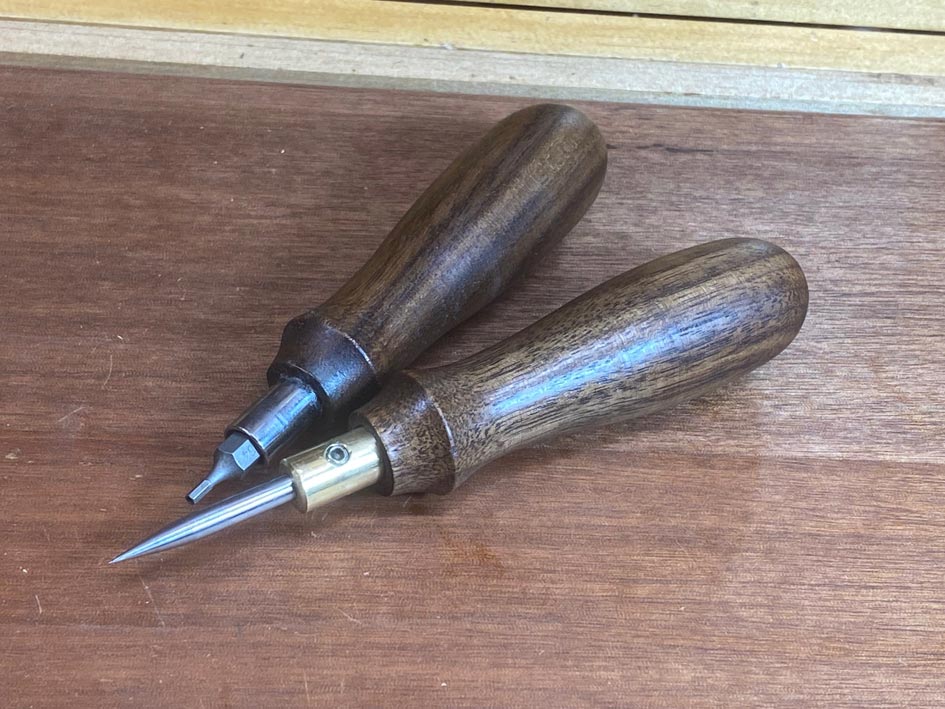
The awl in my travel tool box (currently in use at the Centre for Fine Woodworking in Nelson, New Zealand).

The shaft is held with a set screw. One end is a standard scratch awl ...


The other side is a birdcage awl. Loosen the set screw and rotate.


Travelling tools ...


Regards from Perth

Derek
 
Back
Top