• Hi all and welcome to TheWoodHaven2 brought into the 21st Century, kicking and screaming! We all have Alasdair to thank for the vast bulk of the heavy lifting to get us here, no more so than me because he's taken away a huge burden of responsibility from my shoulders and brought us to this new shiny home, with all your previous content (hopefully) still intact! Please peruse and feed back. There is still plenty to do, like changing the colour scheme, adding the banner graphic, tweaking the odd setting here and there so I have added a new thread in the 'Technical Issues, Bugs and Feature Requests' forum for you to add any issues you find, any missing settings or just anything you'd like to see added/removed from the feature set that Xenforo offers. We will get to everything over the coming weeks so please be patient, but add anything at all to the thread I mention above and we promise to get to them over the next few days/weeks/months. In the meantime, please enjoy!

3-tree table with cabriole legs

Guineafowl21

Nordic Pine
Joined
Dec 15, 2020
Messages
551
Reaction score
158
Location
Nairn
58DDE78A-CD1F-4B6A-A5BE-453F82CD2AB1.jpeg

Larch legs, beech aprons, birch top.

Legs were done on the bandsaw as per Feirer’s book ‘Cabinetmaking and Millwork’, but I didn’t like it. The finish was so rough it took a lot of hand shaping to correct.

I’d welcome opinions on making a spindle moulder template for doing them, using a ring fence and rebate block. One is under construction; pics to follow.
 
That's a nice little table!

This is a job that I'd probably prefer a bearing ring on the shaft that matches the diameter of the cutter block rather than a ring fence, but you can do it with the ring fence too.

Firstly you'll need to make a piece of ply (12mm minimum) that has the template of the outer shape of the leg cut into the edge of it, the cut needs to be very smooth as every little bump will translate to the spindle cut and it will end up a bit bumpy on the leg. I'd have the cut positioned so that the bottom of the leg is the part being cut first as it's the most fragile part plus you want to be cutting that with the grain to avoid blow-out (This is where a reversing spindle is rather nice, you could cut with the grain as far as you can in anti-clockwise rotation and flip the block upside down and run it in clockwise rotation to mould it with the grain the opposite way, remembering to feed it left to right instead of the normal way). The part would be held in place a stop each end, a fence on the operator side for the part to register against for the correct depth with toggle hold-downs on top or even a screw through into the waste to hold it during cutting.

Then you would need a secondary jig with the other internal shape cut into the plywood and the negative pattern (or just points to reference against) of the leg cut into the fence so that it is supported and easily referenced, following practically the same procedures as before although once you've done your first moulding (or third if you include the first two) you would need a supporting piece screwed to the base of the jig that is the negative pattern of the leg to support it vertically as you have just cut away the flat and square portion of the leg that it would be resting on.

In the old days they used a kind of lathe-looking jig that had a bed and two centres at each end with an indexing plate on the one centre and you would affix your pattern board to it for moulding table legs and fluting round newels and so on...

A friend of mine in Australia has one, I've never seen one in the flesh though:

GJ9phtX.png

Hopefully you can understand what I mean from my ramblings, I can draw it out if needs be.
 
I have made a shaped template, using toggle clamps. The problem with the bearing guide is that, with such a deep cut, the piece will be snatched away and damaged, as happened on a trial run. Unfortunately no reverse on my SM!

I made a wooden ring fence with quite a large difference in depth of cut between the edges and the central ‘flush point’. This way, I could offer the workpiece up to one side, at a tangent, and take a partial cut, then pivot round towards the centre and take further cuts.

There was still some snatching, which might have been my trying to work too quickly, and the fact that the trial piece was a reject with lots of knotty bits. Even the decent Goodhand toggle clamps let the piece slip, as well.

I’ve bought some foam anti-slip mesh to stick into the template to improve grip. Pics to follow and thanks for the advice.
 
Guineafowl21":27wlmgp3 said:
I have made a shaped template, using toggle clamps. The problem with the bearing guide is that, with such a deep cut, the piece will be snatched away and damaged, as happened on a trial run. Unfortunately no reverse on my SM!

I made a wooden ring fence with quite a large difference in depth of cut between the edges and the central ‘flush point’. This way, I could offer the workpiece up to one side, at a tangent, and take a partial cut, then pivot round towards the centre and take further cuts.

There was still some snatching, which might have been my trying to work too quickly, and the fact that the trial piece was a reject with lots of knotty bits. Even the decent Goodhand toggle clamps let the piece slip, as well.

I’ve bought some foam anti-slip mesh to stick into the template to improve grip. Pics to follow and thanks for the advice.

Are you trying to hog it all off in one go or have you cut most of the waste off with the bandsaw prior to moulding it?
 
That might be a better option, and still is an option, but for now I decided to go all-spindle-moulder.

Bandsawing would mean extra time to draw the template on each leg, then further time having to tack the waste pieces back on. The aim is to be able to sit a dimensioned piece in to the template, and make the four cuts. As far as I can see, only the fourth cut will require a shaped support piece.

I’ll try to do a WIP with pics for you, but not just yet - another Wadkin RB planer has appeared in my shop, in bits, and I don’t want to be firing wood shavings all over it :eusa-dance:
 
You’d only bandsaw the one face before you mould it, do all of one face on each leg, and then cut the next one out and mould it, and so on in sequence. A bit more time consuming but will result in a better cut and will be easier on the machine.
 
Trevanion":1i45b4qu said:
You’d only bandsaw the one face before you mould it, do all of one face on each leg, and then cut the next one out and mould it, and so on in sequence. A bit more time consuming but will result in a better cut and will be easier on the machine.
Good point. One problem is, I don’t really have a bandsaw - the one I used isn’t mine. I’m just holding on to it while a mate moves house. It’s a pro power or some such. Cutting anything beyond 1” thick results in comical wandering of the blade in all directions

I’ve no plans to get a bandsaw at the moment, but if I do, it’ll be a Startrite or similar heavy machine. These light bandsaws are only good for cutting shaped templates in plywood, as far as I can see, and generally I’ve got away with a coping saw for that.
 
Guineafowl21":31vvoy1m said:
.... These light bandsaws are only good for cutting shaped templates in plywood, as far as I can see, and generally I’ve got away with a coping saw for that.

Not necessarily. It depends a lot on the manufacturer, how it's been set up and most importantly the blade. I still use my small Axminster bandsaw that I've had for over ten years. It cuts well.
 
RogerS":3feffmy4 said:
Guineafowl21":3feffmy4 said:
.... These light bandsaws are only good for cutting shaped templates in plywood, as far as I can see, and generally I’ve got away with a coping saw for that.

Not necessarily. It depends a lot on the manufacturer, how it's been set up and most importantly the blade. I still use my small Axminster bandsaw that I've had for over ten years. It cuts well.
Out of interest, how would yours do with 60mm thick larch, like these legs were made from? The bandsaw I used screeched and wibbled all over the place.

I also tried ripping some 4” thick beech, but it was hopeless.
 
Guineafowl21":1hannpbi said:
Out of interest, how would yours do with 60mm thick larch, like these legs were made from? The bandsaw I used screeched and wibbled all over the place.

I also tried ripping some 4” thick beech, but it was hopeless.

A new, decent quality, and most importantly sharp blade makes a world of difference with a bandsaw, even with the little dinky units.
 
Trevanion":2ve72lkk said:
Guineafowl21":2ve72lkk said:
Out of interest, how would yours do with 60mm thick larch, like these legs were made from? The bandsaw I used screeched and wibbled all over the place.

I also tried ripping some 4” thick beech, but it was hopeless.

A new, decent quality, and most importantly sharp blade makes a world of difference with a bandsaw, even with the little dinky units.

:text-+1:
 
Trevanion":46y2942j said:
Guineafowl21":46y2942j said:
Out of interest, how would yours do with 60mm thick larch, like these legs were made from? The bandsaw I used screeched and wibbled all over the place.

I also tried ripping some 4” thick beech, but it was hopeless.

A new, decent quality, and most importantly sharp blade makes a world of difference with a bandsaw, even with the little dinky units.
This was a new-ish blade, but certainly cheap.

I take both of your points, and will give bandsaws a second chance. The few times I’ve used one had completely put me off them. In the end, almost all the shaping of those table legs was done with spokeshaves. The bandsaw left such an awful job that I reckon an adze would have done better.
 
Guineafowl21":1bhtin5d said:
Trevanion":1bhtin5d said:
Guineafowl21":1bhtin5d said:
Out of interest, how would yours do with 60mm thick larch, like these legs were made from? The bandsaw I used screeched and wibbled all over the place.

I also tried ripping some 4” thick beech, but it was hopeless.

A new, decent quality, and most importantly sharp blade makes a world of difference with a bandsaw, even with the little dinky units.
This was a new-ish blade, but certainly cheap.

I take both of your points, and will give bandsaws a second chance. The few times I’ve used one had completely put me off them. In the end, almost all the shaping of those table legs was done with spokeshaves. The bandsaw left such an awful job that I reckon an adze would have done better.

Tuffsaws make good blades.
 
Guineafowl21":2dvlrszt said:
I’ve no plans to get a bandsaw at the moment, but if I do, it’ll be a Startrite or similar heavy machine. These light bandsaws are only good for cutting shaped templates in plywood, as far as I can see, and generally I’ve got away with a coping saw for that.

Nope, you're wrong. A small bandsaw that's been correctly set up and with a good quality, sharp blade will cut to it's recommended spec, so even a tiddler ought to have a doc of 75 or even 100mm.

Have a look at the Axminster 'Diamond Ground' blades. I've used them for years and they're easily comparible with any others - Rob
 
Trevanion":2zduadc9 said:
You’d only bandsaw the one face before you mould it, do all of one face on each leg, and then cut the next one out and mould it, and so on in sequence. A bit more time consuming but will result in a better cut and will be easier on the machine.

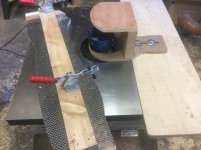
Here’s the general idea - I could easily precut with a bandsaw as you suggest. More toggle clamps needed.

B53355B4-9109-46DA-B4D3-3E5C6E1E94AA.jpeg

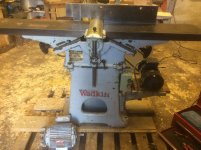
On an unrelated note, I thought you might like this Wadkin RB I’ve nearly finished commissioning for a mate. Old 1ph motor was burnt out so I’ve repowered with a new 3ph one. Switch box is a bit clunky but this could be hidden behind in the switchgear compartment, if needed:

54347CDD-8A16-4184-8466-460D384FDC65.jpeg
 
Back
Top