• Hi all and welcome to TheWoodHaven2 brought into the 21st Century, kicking and screaming! We all have Alasdair to thank for the vast bulk of the heavy lifting to get us here, no more so than me because he's taken away a huge burden of responsibility from my shoulders and brought us to this new shiny home, with all your previous content (hopefully) still intact! Please peruse and feed back. There is still plenty to do, like changing the colour scheme, adding the banner graphic, tweaking the odd setting here and there so I have added a new thread in the 'Technical Issues, Bugs and Feature Requests' forum for you to add any issues you find, any missing settings or just anything you'd like to see added/removed from the feature set that Xenforo offers. We will get to everything over the coming weeks so please be patient, but add anything at all to the thread I mention above and we promise to get to them over the next few days/weeks/months. In the meantime, please enjoy!

Back bent gouge - definition

RogerS

Moderator
Staff member
Joined
Jul 21, 2014
Messages
15,609
Reaction score
1,320
Location
Somerset
In the image below, do the numbers 6,10,13 etc refer to the radius or the length of the chord between the two outer points, please ?

pfeil back bent gouge.png

If the latter, does anyone know who might provide curved gouges defined by radius ?

I was hoping to get some carving gouges that would match the radii here. Especially on that convex part-round on the vertical.


What sort of gouge would I need? Back bent? Spoon ?

TIA

And how do you pronounce Pfeil Puh-feel? Puh-file? File ?
 
I don't know the answer to either of your questions, Roger, but the first one, if the image is in any way representative of the shape of the gouge, must refer to length/ distance rather than radius. They all appear to be of similar radius, but differing lengths.
 
On the face of it, I'd agree. But then when you look at this one...


it looks to be radius related ! Why can't they be consistent ?
 
The mm numbers are the width of the gouge. The shape is defined by the sweep or series number, and (as you can see from the chart shown on each page) that goes more by the proportion of a circle that it covers than the radius of the curvature.

Unless someone's published a conversion chart, which I'm not aware of, you'll have to choose by measuring the side-to-side (or top-to-bottom) width of the section you want, and eyeballing the right shape.
 
It's a complicated situation. I think the short answer is that, for carving tools, there isn't a simple relationship between the sweep number and the radius of the circle of which it is an arc.

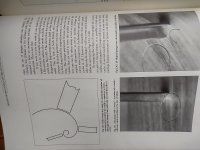
For a longer answer, I can do no better than to offer a 'fair use' extract of Chris Pye's excellent book on carving tools.

The detail of the answer comes at the end of the second page.

IMG_20210227_140423089_HDR.jpg

IMG_20210227_140441410_HDR.jpg

IMG_20210227_140504460_HDR.jpg

For a general intro to types and sizing, this summary looks ok. It also gives the pronunciation of Pfeil.

https://woodandshop.com/woodworking-han ... and-tools/

Historically, gouges for patternmakers were made to specific radii, but that's another can of worms!
 
Many thanks to you both. It might be possible to work out from geometry the radius. We know the chord, one might be able to measure the arc length (assuming they are all to the same scale). There's at least one online calculator where you put in radius and chord and it gives you the arc length. So one could then work backwards.

I had planned yesterday to trundle down to G&S Timber as their website said they were open until 5pm. Thought I'd check though. Only open for telephone calls ! Tool shops are essential suppliers ! :evil: My plan was to take my wood template down and offer up the gouges to get the best fit.
 
And after a bit of Googling, I found these

Seth- I arrived at the following by very unscientific methods (sorry jm), but the EXACT curve or sweep is not critical anyway. You can calculate the diameter of a pipe (form) for a particular gouge as follows: Multiply the desired gouge width by: For 6 sweep by 1.857; For 7 sweep by 1.667; For 8 sweep by 1.143; For 9 sweep by 1.048; For 11 sweep by 1.000 Example: For a 12mm gouge with a 7 sweep, 12 x 1.667= 20.004mm diameter pipe form. Hope this helps. Ron.

The problem here is we want to know how the sweep numbers are defined. I suggest (or guess) an arbitrary formula: sweep number n=(d + 10h)/d, where d is the half cord length and h, the sagita. For a chisel, h=0 and n=1. For a half circle, d=h=r, n=11. For 8mm number 8 sweep, the above formula gives h=2.8mm. Then the radius r=(h^2+d^2)/2h=4.2mm. Similarly, 10mm #7, r=5.7mm.
 
Roger, if you don't have a printable chart of sweeps, do say and I'll find one. There are plenty of examples of the Sheffield scheme online and there must be a comprehensive Pfeil chart somewhere.

Or if you can post some tracings of the curves you are trying to match, i can try how closely any of my mixed assortment will match.
 
AndyT":2mvzdqyn said:
there must be a comprehensive Pfeil chart somewhere.
I have the Pfeil catalogue in front of me right now and there's no definitive info within on how the sweeps are defined; it's exactly the same as those on the CHT site - Rob
 
AndyT":1e7xkxz1 said:
Roger, if you don't have a printable chart of sweeps, do say and I'll find one. There are plenty of examples of the Sheffield scheme online and there must be a comprehensive Pfeil chart somewhere.

Or if you can post some tracings of the curves you are trying to match, i can try how closely any of my mixed assortment will match.

Thanks Andy. There are quite a few charts out there on suppliers websites, thanks.

That's very kind of you to offer re matching up. I don't know if this will help ?

 
I think we're onto a winner with those formulae.

If I take a 30mm Pfeil long bent gouge to be used for the larger vertical 'round', the value sweep I need is:

((30 (the gouge width) x S)) divided by 2 = 18 (desired radius)

which comes out at around a sweep value of 1.2 which is pretty much bang on a number 8.
 
Yes, getting there I think!

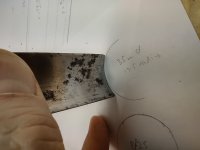
Here's the nearest I have for that big, 17.5mm radius. I couldn't get the drawing to print out exactly matching the dimensions but I have drawn a 17.5mm radius circle. The 8/25 Pfeil gouge is a fit, but a tight fit, so an 8/30 would be more practical I think. It would need to be bent, to be able to make the cut, as you already know.

IMG_20210227_175557920_HDR.jpg
 
It's a subtle thing, this sizing, and I think you need to phone CHT and get several to try for real, and return the others. I'm sure they will understand.

Here's a 7/25 on the same curve. Just a millimetre or so at each end.

IMG_20210227_180321643_HDR.jpg
 
Thanks Andy. You've confirmed my maths ! In the post above yours, I'd got to an 8/30 :eusa-dance: as well.
 
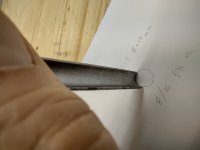
This is an 8/10 on a 5mm radius circle - looks a good fit to me.

IMG_20210227_180730069_HDR.jpg
 
And this is the best I can do for the big 60mm curve on the top. 5/25 is a bit tight. 3/20 looks better. In practice I suspect a flat chisel or narrow shoulder plane or even a file would do it. Or sandpaper!

IMG_20210227_181422729_HDR.jpg
 
AndyT":39e3ka7k said:
Yes, getting there I think!

Here's the nearest I have for that big, 17.5mm radius. I couldn't get the drawing to print out exactly matching the dimensions but I have drawn a 17.5mm radius circle. The 8/25 Pfeil gouge is a fit, but a tight fit, so an 8/30 would be more practical I think. It would need to be bent, to be able to make the cut, as you already know.


Cough splutter...

Andy a NEW tool! WTF, give me some warning before you do that again...

;) :D

Pete
 
Pete Maddex":2dw8ayq1 said:
AndyT":2dw8ayq1 said:
Yes, getting there I think!

Here's the nearest I have for that big, 17.5mm radius. I couldn't get the drawing to print out exactly matching the dimensions but I have drawn a 17.5mm radius circle. The 8/25 Pfeil gouge is a fit, but a tight fit, so an 8/30 would be more practical I think. It would need to be bent, to be able to make the cut, as you already know.


Cough splutter...

Andy a NEW tool! WTF, give me some warning before you do that again...

;) :D

Pete

Don't worry Pete. These Pfeil gouges were bought new, in the 20th century, but not by me. I really ought to get into carving, to justify owning them and to remember their first owner.
 
One of the first things that I concluded when coming into carving and expecting some form of consistency between the measurement of sweeps was that there was no consistency.

The original Sheffield List was an attempt to classify the range of sweeps produced by gouge and chisel makers, large and small, who forged their tools very skillfully by hand. There was, inevitably, a large degree of variation both within a manufacturer over time and between firms.

When I put some of my gouges, ranging in age from pre-Boer-War, even pre-Crimea-War up to newer makers in the present time to a Sheffield List chart, there still is a degree of variation. Some of the numbered marked sweeps may, or may not, match numbered sweeps on the List. A half-inch No: 5 by one manufacturer may be a No: 6 by another, for example.

As they are all parts of a circle (well, many of them - I do have a couple of old gouges that are a little elliptical in shape), we'd expect them to have a radius and that's where the predictability falls down.
Then we get to the 'Continental' system that is different again - not so much in the range of radaii on offer, but in the numbering progression.

Add that to the fact that we are mostly using the gouge in a cutting or slicing motion and it's true to say that we are only using a portion of the radius most of the time..... the full radius, tip-to-tip, becomes irrelevant. Unless we are using a gouge in a vertical stamping action, coping a curve for example, the full radius is not used.

Anyway, what I was building up to was that I was boiling up too many brain-cells to enjoy the craft and got around the occasional radius-selection dilemma with a combination of a Sheffield List, and a set of larger radius gauges that I got second-hand in a junk-shop. The actual radius was less important than matching the correct sweep to the job by comparison. When we introduce Continental sweeps, again ignoring the actual Number, we can often match the radius to British-made tools, but not always the exact width.....and vice-versa.

Given all that at the rare times that the radius was important, I reached for the radius gauge......

For those who may not have it, here is is a link to a printable-to-scale PDF by Chris Pye's website of the Sheffield list.

d3h1zj156zzd4j.cloudfront.net/pdf/sheffieldlist.pdf

Good luck with the Golden Quest to make sense out of gauge sweeps!
 
Back
Top