• Hi all and welcome to TheWoodHaven2 brought into the 21st Century, kicking and screaming! We all have Alasdair to thank for the vast bulk of the heavy lifting to get us here, no more so than me because he's taken away a huge burden of responsibility from my shoulders and brought us to this new shiny home, with all your previous content (hopefully) still intact! Please peruse and feed back. There is still plenty to do, like changing the colour scheme, adding the banner graphic, tweaking the odd setting here and there so I have added a new thread in the 'Technical Issues, Bugs and Feature Requests' forum for you to add any issues you find, any missing settings or just anything you'd like to see added/removed from the feature set that Xenforo offers. We will get to everything over the coming weeks so please be patient, but add anything at all to the thread I mention above and we promise to get to them over the next few days/weeks/months. In the meantime, please enjoy!

Devil tail dangers

Bearwoodcraft

New Shoots
Joined
Jan 5, 2022
Messages
62
Reaction score
0
Location
Rugby Warwickshire
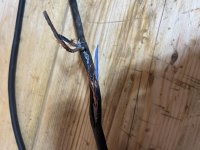
Well it happened excessive sweat in the eyes and on glasses and didn’t catch the cord but o my the belt sander sure did lol question could
It be re wired or should I replace it with a new one?
Done basic wire work but far from an expert
 

Attachments

  • EF4BB8EF-D07F-45B7-BC30-80636A9061DA.jpeg
    EF4BB8EF-D07F-45B7-BC30-80636A9061DA.jpeg
    266.2 KB · Views: 1,582
A very common accident to occur with a belt sander. Whether you can reuse the existing cable depends on where you caught it and how short the cable will be once you reuse it, once you begin getting less than 2m or so of cable length it becomes a real pain to use the machine. If the cable is too short take a piece to your local electrical factor and they should be able to sell you an identical 3m length of cable for not a hell of a lot.

Rewiring is quite simple, just take note of how the live and neutral are connected in the machine by writing it down or taking a photo before disconnecting them, as it's easy to get distracted and forget which way the wires went.
 
Just my opinion…
If you need to take it to an electrical factor to identify the correct cable, it’s beyond your ability to rewire.
 
Replace the cable. It's not worth having a lump in the middle!

If it isn't rubber cable now, you won't regret trading up if you can (and for a longer piece, too), provided the new cable can be made to fit the sander's strain relief.

Rubber cable tends to be a bit thicker for a given current rating, so it might need a new strain relief bushing - adapting the sander's casing to fit the bushing is probably the easiest route. You can get bushings and cable from RS, Farnell/CPC, and even Amazon these days, and eBay, of course. You can also still get rubber mains plugs, or at least flexible ones, and they are not expensive, although the cable might be.

If fitting a thicker cable, don't be tempted to cut off the outer sheath outside the sander - it really must be clamped inside securely (at least with one or two small cable ties). So the closer the match, the better.

If the above seems daunting, you can probably get a made-to-measure cable set, complete with tails for inside the tool, strain relief and probably a moulded 13A plug, from someone like Miles Tools (MTMC) in Yeovil. I doubt it will be inexpensive, but it will be an easy replacement.

Note that some power tool trigger swiches have a gripping blade arrangement inside - the wires of the power cord are pushed in and gripped. To release the old cord you need a small (Jeweller's sized) screwdriver - there are usually little holes on the switch adjacent to the wires going in, and carefully poking into these releases each wire. It varies though - if in doubt ask MTMC's technical department (or your spares supplier of choice), or post a photo here.

Final thought: Power tools nowadays tend to be "double insulated," i.e. with no earth in the cable at all. Your cable looks like it's that type (I can't see an earth wire in your picture).

If all you can find is three-core rubber cable to repair with, it's not a disaster: Wire the earth to the big pin of the 13A plug as normal, but cut it off with the outer sheath at the cable clamp in the tool (so only live and neutral continue to the switch). Don't leave an earth "tail" loose inside the tool!

In my view having an earthed cable is slightly safer than just two cores, since if the accident ever repeats, you probably will trip the RCD fast and not blow the fuse (slower). It's an extra protection, even though it changes nothing inside the tool itself.

E.
 
As said if you aren't sure then take it to an electrician or a mate who's able to do it Tom.

While it's far better to replace the cable it can be fixed. I've been there several times though most often with tools like electric hedge cutters and it's a simple job if you can handle a soldering iron. Looks as if you'll only lose maybe 100mm of cable to get back to clean ends and all I do is stagger the joins, solder neatly and securely and insulate each joint with heat shrink tube and then larger heat shrink over the lot to seal the joint, I often use 2 layers of tube for that though self amalgamating tape can be used instead.
Whatever you do don't be tempted to join it with terminal strip connectors which aren't secure enough, can be pulled out and therefore dangerous.
 
Lurker":1ovc1h78 said:
Just my opinion…
If you need to take it to an electrical factor to identify the correct cable, it’s beyond your ability to rewire.

I want too short as it was close to the machine so just re wired it but had to get some of the metal clips for it
 
Lurker":qfb1ni38 said:
Just my opinion…
If you need to take it to an electrical factor to identify the correct cable, it’s beyond your ability to rewire.

Also what’s an electoral factor is that an old word for a repair centre
 
Lons":1uayk2ly said:
As said if you aren't sure then take it to an electrician or a mate who's able to do it Tom.

While it's far better to replace the cable it can be fixed. I've been there several times though most often with tools like electric hedge cutters and it's a simple job if you can handle a soldering iron. Looks as if you'll only lose maybe 100mm of cable to get back to clean ends and all I do is stagger the joins, solder neatly and securely and insulate each joint with heat shrink tube and then larger heat shrink over the lot to seal the joint, I often use 2 layers of tube for that though self amalgamating tape can be used instead.
Whatever you do don't be tempted to join it with terminal strip connectors which aren't secure enough, can be pulled out and therefore dangerous.

Did end dip getting a soildering iron had some
Cheap junk thing but bought a far better one of Amazon. Not really into just having people fix things I’d rather try myself and learn from my mistakes I take a good pinch of caution and ask people I think have more knowledge than me probs everyone lol but I guess I do doubt my own abilities at times such as rebuilding a two stroke engine having changed the piston I mean what’s the worse that could happen it blows up lol well it’s still going strong
 
Bearwoodcraft":2rz6zvjm said:
Lons":2rz6zvjm said:
As said if you aren't sure then take it to an electrician or a mate who's able to do it Tom.

While it's far better to replace the cable it can be fixed. I've been there several times though most often with tools like electric hedge cutters and it's a simple job if you can handle a soldering iron. Looks as if you'll only lose maybe 100mm of cable to get back to clean ends and all I do is stagger the joins, solder neatly and securely and insulate each joint with heat shrink tube and then larger heat shrink over the lot to seal the joint, I often use 2 layers of tube for that though self amalgamating tape can be used instead.
Whatever you do don't be tempted to join it with terminal strip connectors which aren't secure enough, can be pulled out and therefore dangerous.

Did end dip getting a soildering iron had some
Cheap junk thing but bought a far better one of Amazon. Not really into just having people fix things I’d rather try myself and learn from my mistakes I take a good pinch of caution and ask people I think have more knowledge than me probs everyone lol but I guess I do doubt my own abilities at times such as rebuilding a two stroke engine having changed the piston I mean what’s the worse that could happen it blows up lol well it’s still going strong

Just be careful Tom, a 2 stoke engine blowing up is very different from a poor mains electrical join as the latter can kill you. Just saying
 
Lons":17fsyuo4 said:
Bearwoodcraft":17fsyuo4 said:
Lons":17fsyuo4 said:
As said if you aren't sure then take it to an electrician or a mate who's able to do it Tom.

While it's far better to replace the cable it can be fixed. I've been there several times though most often with tools like electric hedge cutters and it's a simple job if you can handle a soldering iron. Looks as if you'll only lose maybe 100mm of cable to get back to clean ends and all I do is stagger the joins, solder neatly and securely and insulate each joint with heat shrink tube and then larger heat shrink over the lot to seal the joint, I often use 2 layers of tube for that though self amalgamating tape can be used instead.
Whatever you do don't be tempted to join it with terminal strip connectors which aren't secure enough, can be pulled out and therefore dangerous.

Did end dip getting a soildering iron had some
Cheap junk thing but bought a far better one of Amazon. Not really into just having people fix things I’d rather try myself and learn from my mistakes I take a good pinch of caution and ask people I think have more knowledge than me probs everyone lol but I guess I do doubt my own abilities at times such as rebuilding a two stroke engine having changed the piston I mean what’s the worse that could happen it blows up lol well it’s still going strong

Just be careful Tom, a 2 stoke engine blowing up is very different from a poor mains electrical join as the latter can kill you. Just saying
Well it would just not work it’s all enclosed so doubt highly it’ll kill you and works fine now. Are you an electrician?
 
Unfortunately, a dodgy joint just not working is the best possible case scenario, and not the most likely.

What you need to be worried about is a joint that's just good enough to let the tool power on, so that you don't immediately notice anything wrong, but which has a high enough resistance that it starts to heat up and burn the insulation, or which breaks as the cable flexes and causes arcing. The vast majority of electrical fires are caused by poor cable joints or loose terminations.
 
spb":2zo7960s said:
Unfortunately, a dodgy joint just not working is the best possible case scenario, and not the most likely.

What you need to be worried about is a joint that's just good enough to let the tool power on, so that you don't immediately notice anything wrong, but which has a high enough resistance that it starts to heat up and burn the insulation, or which breaks as the cable flexes and causes arcing. The vast majority of electrical fires are caused by poor cable joints or loose terminations.

There’s no joints I cut the damaged section out and re wired it into the handle again. Splicing a damaged wire is t worth it
 
Back
Top