Malc2098
Sequoia
Having almost decided to maybe do a couple of craft fairs around Christmas, I'd need something vertical to display my wares, rather than just have them flat across the table. So I found a CNC design for tables top display shelves. I take the basic design and with the software adjust it for my particular needs.
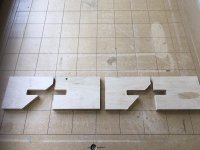
The shelving unit would be made from 12m birch ply and would be kept together, it's flat packed for knock down, with crossed halving joints. I bought birch ply as a pre-loved 8x4 sheet from a timber yard in Dorset where it had been the front cover of their counter, so it had a few screw holes in it around the edge and had a coat of varnish on one side, but it was less that half the price of a new BB sheet.
The thing with ply is that while it is sold notionally in this case as 12mm, it is rarely that size all the way round it's edges and even across its middle. So to design the halving joints on the CNC it would not be wise to create their dimensions based on its notional size. So, I measure it all the way round and the smallest I get is 12.1mm. So I design the joints in the CAD/CAM software to a size I know is bigger, 12.7mm, and then machine a couple of test pieces.

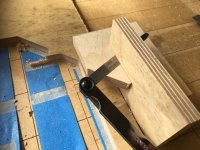
Expectantly, it turned out a little sloppy. So, to measure the slop, feeler gauges tell me what the gap is; 0.2mm. Back to the CAD/CAM software and reduce the width of the gap. The sneaky way to do it is to offset the whole design, outwards by half the feeler result. But because I had enough spare ply to do tabout 5 tries out of a 4x2 cut from my original sheet, I went up a bit and offset the whole design by 0.15mm, which increases all outside dimensions, but cut-in parts like these joints, because they face each other, it reduces their gap, in my case to 12.4mm.
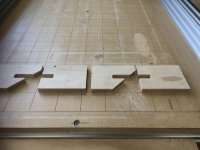

I'll accept a 0.008mm as a cosy fit without forcing.
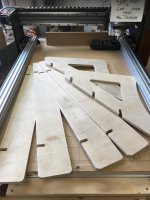
So, I redrew the whole design to achieving the 2.4mm gap in all parts of the halving joints. First I milled the sides.

Then I milled the shelves.

Then I tidied them all with with the sander.
Finally, I erected the unit.

I can't lie, I had to do a bit of fettling to get some of the joints to fit smoothly rather than to force them together, and that I think is the nature of plywood, but I am pleased with the result.
I'll probably round over all the edges with a cutter in my palm router which will be so much quicker than using the CNC machine.
The shelving unit would be made from 12m birch ply and would be kept together, it's flat packed for knock down, with crossed halving joints. I bought birch ply as a pre-loved 8x4 sheet from a timber yard in Dorset where it had been the front cover of their counter, so it had a few screw holes in it around the edge and had a coat of varnish on one side, but it was less that half the price of a new BB sheet.
The thing with ply is that while it is sold notionally in this case as 12mm, it is rarely that size all the way round it's edges and even across its middle. So to design the halving joints on the CNC it would not be wise to create their dimensions based on its notional size. So, I measure it all the way round and the smallest I get is 12.1mm. So I design the joints in the CAD/CAM software to a size I know is bigger, 12.7mm, and then machine a couple of test pieces.
Expectantly, it turned out a little sloppy. So, to measure the slop, feeler gauges tell me what the gap is; 0.2mm. Back to the CAD/CAM software and reduce the width of the gap. The sneaky way to do it is to offset the whole design, outwards by half the feeler result. But because I had enough spare ply to do tabout 5 tries out of a 4x2 cut from my original sheet, I went up a bit and offset the whole design by 0.15mm, which increases all outside dimensions, but cut-in parts like these joints, because they face each other, it reduces their gap, in my case to 12.4mm.
I'll accept a 0.008mm as a cosy fit without forcing.
So, I redrew the whole design to achieving the 2.4mm gap in all parts of the halving joints. First I milled the sides.
Then I milled the shelves.
Then I tidied them all with with the sander.
Finally, I erected the unit.
I can't lie, I had to do a bit of fettling to get some of the joints to fit smoothly rather than to force them together, and that I think is the nature of plywood, but I am pleased with the result.
I'll probably round over all the edges with a cutter in my palm router which will be so much quicker than using the CNC machine.