• Hi all and welcome to TheWoodHaven2 brought into the 21st Century, kicking and screaming! We all have Alasdair to thank for the vast bulk of the heavy lifting to get us here, no more so than me because he's taken away a huge burden of responsibility from my shoulders and brought us to this new shiny home, with all your previous content (hopefully) still intact! Please peruse and feed back. There is still plenty to do, like changing the colour scheme, adding the banner graphic, tweaking the odd setting here and there so I have added a new thread in the 'Technical Issues, Bugs and Feature Requests' forum for you to add any issues you find, any missing settings or just anything you'd like to see added/removed from the feature set that Xenforo offers. We will get to everything over the coming weeks so please be patient, but add anything at all to the thread I mention above and we promise to get to them over the next few days/weeks/months. In the meantime, please enjoy!

Green Oak questions - in prep for a log store.

sidtsloth

New Shoots
Joined
Jan 24, 2015
Messages
50
Reaction score
0
Location
Totton
Hey all.

I am trying not to just say "does anyone know of a supplier of green oak boards as well as beams?" because that makes it look like I havent searched, or looked at the Timber suppliers map.

I am just outside southampton, and having had a look around at the webpages of several suppliers who specify green oak they all seem to supply what I would describe as beams. Ok, some of them are as small as 100x100 which is in reality the largest I want to make use of for a more fancy than it needs to be log store that I plan to build.
However, I also would need some boards, potentially 20mm thick to use as side slats etc.

So my actual question is do people working with green oak
a) buy beams and resaw to their desired sizes
b) know of a supplier of boards
c) avoid working with thinner boards due to the movement of green oak as it dries
d) something I havent come up with.

I should say this will be my first forray into green oak, but I really like the idea of making mortice and tennons and pegging the joints.. I have some cast off slate roof tiles for a pitched roof, and I am thinking some lead flashing for the roof ridge (since I dont think I will be able to get hold of matching slate ridge tiles to fit).

I also dont have a bandsaw or table saw (but do have a tracksaw), so resawing might be out of my capabilities at the moment. My next purchase I think is likely to be a planar thicknesser so that I can work down to final size.

Any suggestions gratefully received.

Richard.
 
Green oak boards will move all over the place, Richard. They'll curl and twist and split. However, for a log store, that hardly matters....just so long as you are aware.

Much more important is the structure. If you've got a drawing, or even a sketch, then we can suss out the joints before you get going. There is a trap which too many fall in to of over-sizing the structural members, so it would be nice to see what you have in mind.
 
I appreciate that the idea of working green oak is appealing, but is oak necessary for your log store?

For my roof framing deck and balustrade, I could have used oak, but the largest section was 4"x4". In the end, I used larch, green-ish, I let it sit a few months, from a local sawmills. the larch coming from their own woodland. I used pegged mortice and tenons. I quite enjoyed it.
 
Hi,

Hopefully this will work.. It seems that since my last forray into uploading photos to here photobucket have changed their terms!

logstore.JPG

As for wether it "needs" to be green oak, nope, I just really like the idea of watching it weather and hopefully last...

Approx 1.4m wide, and 1.1m ish deep, standing about 1.5m high

Im thinking 100x100 legs and cross pieces.
I was thinking 20x80 for the angled slats on the back and sides (not shown).
Slate tiles roof, possibly lead roll over flashing on the apex
Thicker slats across the base, no need to be oak as they will rot whatever they are.
a shelf under the pitch for kindling to sit on, possibly one side with a lockable door for tools (little axe etc).


R.

(numerous edits - but finally got the inline pic)
 
OK, thanks for that. That's pretty small, so 4x4 is plenty big enough, and you could go to 3x3 if you wanted.

There is a fundamental design thing to deal with, though, and that is the junction at the top of the posts with the plates. You won't get a strong joint if you try to make 3 bits of wood join in a corner. Ideally, you have the two plates which run front-to-back at a lower level than the pieces that run side-to-side. The plates over-hang the posts, too. I'll see if I can find a photo to illustrate the point.
 
Here you go. This is my porch under construction:

6dxJNdI.png

This way, all the loads are taken on shoulders, rather than on tenons, and there is lots of material left in each piece even after the joints have been made. With 3 pieces meeting at the corner more material is removed from at least one of the plates, leaving the structure weaker.

Back to your design.......I would build in some bracing in 2 different directions, and obviously the roof will need some structure. It's nice to show a pair of oak rafters at the front, but behind that the others can be softwood if you want.
 
Hi Mike, thanks for the thoughts.

Im not against putting the top (or for that matter bottom) rails at different heights, but I sort of figured that I would probably be able to make them "strong enough"

I was thinking that I should be able to offset the tennons from the center line and not make them run all the way through, so that I could pin them sort of like this..

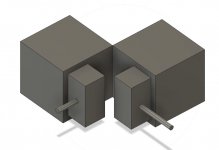
CornerJoint.JPG
 
The tenons aren't big enough. You need roughly an 18mm diameter peg roughly 25mm from the edge to hold them together, and you need at least 30mm outboard of the peg in the tenon. If you make them the right size, look at how little timber is left in the post. The sliver of timber outside the mortice has to resist all the forces of the peg. If you draw-bore this (it's the only way), that sliver will split. Also, your gable rafters wouldn't be sitting on the plate, but on the top of the posts. Thus the entire weight of the roof spreading force is being taken on the pegs holding those joints together. Our ancestors went through all this stuff on our behalf, for seven or eight hundred years, so we can thank them for learning all the lessons and leaving us with the best way of doing things.
 
Hmmm. Thanks for the comments and the picture. I was already thinking about corner bracings (wind brace) in the front, didn't know if it would be over kill. Seems like I will need to rethink the shoulders a little. Back to fusion360 for a bit :)

R.

Sent from my HRY-LX1T using Tapatalk
 
I would make sure you are happy with your dimensions. For a typical log burner, logs are 30cm or so long, especially if you buy them in. In a fairly small space like that, reaching in to the back will be a pain, especially with no side access.

I would tend to make it two logs deep, with some weather overhang, and rather wider. This is based on my own experience of tagging two cat slide log stores onto oak timber framed buildings I made. Mine are larger but I still find getting to the back a tad inconvenient.

Next winter I am also going to hang a weather shield across the front of mine (which face south and also have guttering). I would probably make the base slats more heavy duty on yours as well. Logs are heavy. Fresh cut are a good bit heavier.

In my case we also have a largish outdoor log pile with a sheet cover just on the top. They stay there for the first year and the other log stores then just get the dry seasoned stuff, which is what gets used. Depending on how you buy or harvest your logs, you may need a rotation system.
 
A tip from a chap I know who does firewood as a side business. When stacking the fresh cut and split logs he covers them with clear corrugated roofing sheets. His reasoning, it helps with the drying by acting as a ventilated greenhouse.
 
Exactly that Andy.

The trouble with a log store closed at both sides, is you are always taking logs to use from the bit that is most exposed to the weather. When we get these named severe storms, rain gets blown everywhere, and even though my log stores are sheltered, they were not sheltered enough.
 
My current store is more than twice the size of this one and fully open at the front as well as being far away from the house. Hence the building a more suitable size for what I use in a more sensible place.

As for the weather front, I was considering an extra pannel that I can hang in place on the front for inclement weather - I did briefly consider making it a swinging door, and might still go that way.

This thread has given me some more things to think through in terms of design.

It hasnt really touched on the question of what people do in order to get boards. If there is a worry of boards moving and warping by large amounts, is there a case where people use green oak posts, and dried boards for braces etc?

R
 
Well, I do use oak boards. But I am in the unusual position of having access to a lot of oak and I have never had issues with warping and splitting, largely because I can select from seasoned oak.

I have bought oak as well, including oak feather edge from Mike at Wealdon Oak who I have been dealing with for years. That has always been reliably straight and split free and I clad two buildings with it without any problems at all. He does not really sell totally green feather edge (or not to me anyway).

You only want short lengths. From a reputable supplier I would not anticipate a problem but others may have different experience to mine.
 
Anything that is jointed can be green, so your braces are fine in green oak. They will either be M&Td into the posts (which wastes a little space), or half-lap dovetailed to finish flush with the outer face. I'd do them at the back corners and not at the front, so as not to restrict access.

If you do the louvres as you have drawn them, then they can be let into housings. That will hold them from the worst of their movement issues, and so you could use green oak again for that. Slicing them out of, say, 3x3s, would be practical, as you can get most of the way through in a single pass with a circular saw. However, you would have less of a battle if you just bought some 1" boards of seasoned oak for the purpose. If you have somewhere local that supplies chestnut, you might consider doing it in riven chestnut for a nice rustic look. Chestnut and oak are virtually indistinguishable.
 
AJB Temple":25xynsau said:
Exactly that Andy.

The trouble with a log store closed at both sides, is you are always taking logs to use from the bit that is most exposed to the weather. When we get these named severe storms, rain gets blown everywhere, and even though my log stores are sheltered, they were not sheltered enough.
Hi Adrian, I was told that a little bit of rain landing on the outside of the logs doesn’t do much harm as it soon evaporates, and when you think about the amount of time when there isn’t rain landing on it compared to when it does I suppose they have a point, and the rain that does land on them is it going to get very far into the wood?
Walls and front (doors) of the wood store, my thought is that wide louvres that slope just a little from being horizontal are best just to deflect the worst of the rain and let us much wind through as possible. Ian
Ps, how about having doors on the back as well then you can take the dry stuff from there?
 
I can see us needing a log store thread soon. I’ll start one at the weekend unless someone beats me to it.
 
Hi Ian. It's true - wood is not a sponge. But you mainly want logs in winter. You really want it properly dry for the log burner (not wet on the outside) to avoid smoke and if the front is exposed, the logs will often be wet. That is our experience.
 
Andyp":3frk7ge4 said:
I can see us needing a log store thread soon. I’ll start one at the weekend unless someone beats me to it.
Andy - if it happens to start with a design for a novice builder wanting to try some thing with real joinery about 1.4wide, 1.1 deep and 1.5high then I fully support a new thread!


Sent from my HRY-LX1T using Tapatalk
 
I was thinking along the lines of a “Show Us Log Store” thread in order to share design and construction ideas.
 
AJB Temple":in44yrl2 said:
Hi Ian. It's true - wood is not a sponge. But you mainly want logs in winter. You really want it properly dry for the log burner (not wet on the outside) to avoid smoke and if the front is exposed, the logs will often be wet. That is our experience.
So true, it sounds like you need a revision Adrian, somewhere to store the logs for the month before you want them. I personally go to the other extreme and dry them down to 10 to 12% in my home-made kiln/log dryer. The government says maximum 20% , that’s like pouring water on a fire, 1/5th of the weight of wood people put in their log burners = pure water, crazy to my eyes.
When I was researching prior to installing my fire there was a shop I visited that had a section of 6” twinwall flue pipe on display that was so full of gunk that there was only a 2 inch hole through the centre. Ian
 
I'll share mine for a laugh, free pallets, paint left over from a shed, did buy a piece of OSB for the roof and then offcut of EPDM :lol:

It works but pretty it ain't.
 
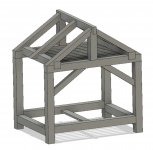
So, some more time in fusion, and some moving around of the beams to try to increase the size of the tenons has resulted in this... The bottom beams are only overlapping by 30mm so there should be room for 70mm tenons in both.

Logstore2.JPG

Still have to work out what looks best for the slats, I like the idea of them on the angle, but vertical ones would I think be easier (and require less of them).
 
Yep. Agreed - certainly in that picture - I thougth I had adjusted them in a little already, but it seems that change got removed in an undo frenzy at some point.

I need to finalise the length of the roof line (which will dictate the pitch) based on the left over tiles that I have. I was trying to avoid moving the shoulder beams inboard too far, but they will have to be adjusted to fit the roof.
 
Back
Top