• Hi all and welcome to TheWoodHaven2 brought into the 21st Century, kicking and screaming! We all have Alasdair to thank for the vast bulk of the heavy lifting to get us here, no more so than me because he's taken away a huge burden of responsibility from my shoulders and brought us to this new shiny home, with all your previous content (hopefully) still intact! Please peruse and feed back. There is still plenty to do, like changing the colour scheme, adding the banner graphic, tweaking the odd setting here and there so I have added a new thread in the 'Technical Issues, Bugs and Feature Requests' forum for you to add any issues you find, any missing settings or just anything you'd like to see added/removed from the feature set that Xenforo offers. We will get to everything over the coming weeks so please be patient, but add anything at all to the thread I mention above and we promise to get to them over the next few days/weeks/months. In the meantime, please enjoy!

Hollowing tools

GarF

New Shoots
Joined
Nov 18, 2014
Messages
66
Reaction score
12
Location
Durham
I've scored some part dry oak of suitable dimensions to have a go at some hollow forms for a change this year. Never given much thought to this before so I have a few tooling options to consider as well as thinking about work holding. I would welcome the thoughts of experienced form hollowers.

For removal of bulk I prefer the idea of cutting rather than scraping where it seems the prime options are the Hamlet brother tools, or Woodcut pro form which look a similar concept but have the advantage that I can deal in person at my local Axminster. Both look like a ring tool with a guard to reduce the likelihood of spectacular catches.

Then there are carbide scrapers for refining in every conceivable size and shape.

I'm leaning towards a straight guarded cutter and a curved (necked) scraping tool as a starter for ten. I would glad of any recommendations, particularly one make vs another. I imagine folk who fully commit to this particular rabbit hole finish up with many tools of all shapes and sizes.

More importantly I'm wondering what sort of size blank I could safely hold in my existing Axminster 'H' jaws ie serrated with capacity for a spigot 15mm long and up to 67mm dia (true circle@57mm). There's several larger options in the Axminster range but I haven't managed to turn up a reference table with guidance on jaw size selection, if such a thing exists.

Much obliged
G
 
The shielded cutter type tool are great if your timber isn’t dry, you can get great long ribbons flying off the tool with semi seasoned timber but on dry timber I found they clogged up that often I stopped using it.

The carbide tools work well but I’d definitely think about making your own as I personally think they are terribly expensive for what you get.
 
I would echo Doug's comments and would add that Oak would not be my recommendation for first attempt at hollow forms unless it's very young and green .
 
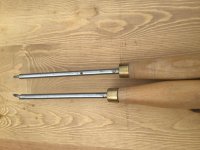
Here’s a pair that I made ages ago.
I superglued the tips in thinking that it would be easier to replace them, but in the event, I have never needed to.
Note the long handle for extra control.
 

Attachments

  • IMG_0942.jpeg
    IMG_0942.jpeg
    271 KB · Views: 591
  • IMG_0941.jpeg
    IMG_0941.jpeg
    339.2 KB · Views: 591
Doug" The carbide tools work well but I’d definitely think about making your own as I personally think they are terribly expensive for what you get.[/quote said:
Mine cost about £6 inc. the cutter. I've given up trying to post pictures.
 
Adding to what has already been posted.

For a first attempt, keep it shallow to get the feel of hollowing with a widish neck so you can see what is going on. Stop at regular intervals to clear chips from the inside, it is surprising how quick it can build up and cause a catch.

You can progress from there.

As stated, very dry wood is not the best to start on the hollowing journey.
 
I’ve been messing around recently on some texturing on oak after seeing some pieces at the Yorkshire sculpture park a few months back, so this evening with the op mentioning the Hamlet brother tools I took this photo of my first hollowing tool.

C474391A-EB4D-41DA-B181-9196C888C8E1.jpeg

The handle, ferrel, bar & cutter holder are all home made I just bought the shield & cutter.I was told the tip of the cutting edge should be inline with the centre of the bar

4F144968-AD2B-4CA4-9062-D1F5516E4092.jpeg

This made sense to me as the first skewchiegouge I made wasn’t & it was a devil for digging in.

As I said previously the little brother doesn’t work well on dry timber but is great on semi seasoned timber & if you make your own doesn’t need to cost a fortune.

On the other hand I hollowed this little box with the carbide tools

84C0E14F-E0B2-438A-89AB-DEFF3D7E8872.jpeg

It’s waiting to have the outside textured but I show it because it shows how good a finish you can get on a very dry piece of American white oak with the carbide tools & minimal shear scrapping
 
CHJ":2fihzl5c said:
I would echo Doug's comments and would add that Oak would not be my recommendation for first attempt at hollow forms unless it's very young and green .

Makes sense. The tree came down at the end of November. The stem I've dismantled must be about 20 inches diameter but I think dead in the centre- it smells rather horsey. Assuming it's been standing like that for a while, waiting for the wind to blow the right way, I suspect it's about half dry. For interest I'll dig out the moisture meter, and for safety I'll test out one of the small bowl blanks I've prepared before I decide if it'll suit hollowing.

As it happens, someone at work discarded my pen pot and replaced it with a plastic cup (!)last week. I know who the culprit is, but rather than having a hissy fit I plan to take a more passive aggressive approach and make myself a new one, and then spread copies throughout the building.
Cheers
G
 
Back
Top