• Hi all and welcome to TheWoodHaven2 brought into the 21st Century, kicking and screaming! We all have Alasdair to thank for the vast bulk of the heavy lifting to get us here, no more so than me because he's taken away a huge burden of responsibility from my shoulders and brought us to this new shiny home, with all your previous content (hopefully) still intact! Please peruse and feed back. There is still plenty to do, like changing the colour scheme, adding the banner graphic, tweaking the odd setting here and there so I have added a new thread in the 'Technical Issues, Bugs and Feature Requests' forum for you to add any issues you find, any missing settings or just anything you'd like to see added/removed from the feature set that Xenforo offers. We will get to everything over the coming weeks so please be patient, but add anything at all to the thread I mention above and we promise to get to them over the next few days/weeks/months. In the meantime, please enjoy!

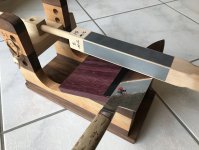
Honing guide

It looks pretty indistinguishable from this and many others like it available for half the price. Maybe the paint build up wouldn't be quite so gunky. This is the one I have.
 
I know, but none of them look decent value for money in comparison to the one I have, in my view.
 
They are not all created equal, even those which are basically the same design.
I've had two in the past. On the face of it they were identical except for the colour, but the reality was that one worked noticeably better than the other, the grip of the blade was better and the ride was better, too.
I don't have either of them (I wish I still had the Eclipse one), but I do have the Veritas one, bought when I had plenty of disposable income.

It is a nice piece of engineering, but I rarely use it. I do use it for spokeshaves (I've been using it today, as it happens) but that is only because it holds small blades better than I can.

I learned how to hold a chisel or plane iron for freehand honing when I was a lad. I guess it's like riding a bike, once you learn you never actually forget. So apart from spokeshave blades, all mine* get done freehand and the Guide gathers dust in the drawer.

*There is one other exception. I use it for my Bevel Up planes, because on them thehoning angle determines the cutting angle, whereas on a traditional Bailey plane, the cutting angle is set by the bed and I'm only honing for clearance, which is much less critical. But they are not my go-to planes anyway.
 
I've got three honing guides; one inherited and two bought. The inherited one is a genuine Eclipse and seems good. One of the bought ones is a cheap one like the Axminster one and, like Steve said, the grip and the ride are much poorer than the Eclipse one.

I've got a Veritas one though and I use that pretty much exclusively (I bought it before inheriting the Eclipse). It's fantastic (I've never really mastered doing it freehand and consistently getting the blade square to the sides after a reasonably number of sharpens, although I do have another try every now and again). To be honest, the Veritas one is so quick to set-up and use that (especially if you include the fumbling I do when freehand sharpening) I find I can sharpen quicker with the jig than I can without it.

I've bought quite a few second-hand planes and several have had blades that have been freehand sharpened so far off square that the lateral adjustment has been at its limit to get an even cut. The disadvantage of the Veritas jig (or I guess any honing jig) is that if you've just got a wonky second-hand plane blade, you have to get it square again on first sharpen. At least you only have to do it once, but it is a chore.
 
Steve Maskery":33zy4k7k said:
They are not all created equal, even those which are basically the same design.
I've had two in the past. On the face of it they were identical except for the colour, but the reality was that one worked noticeably better than the other, the grip of the blade was better and the ride was better, too.
I don't have either of them (I wish I still had the Eclipse one), but I do have the Veritas one, bought when I had plenty of disposable income.

It is a nice piece of engineering, but I rarely use it. I do use it for spokeshaves (I've been using it today, as it happens) but that is only because it holds small blades better than I can.

I learned how to hold a chisel or plane iron for freehand honing when I was a lad. I guess it's like riding a bike, once you learn you never actually forget. So apart from spokeshave blades, all mine* get done freehand and the Guide gathers dust in the drawer.

*There is one other exception. I use it for my Bevel Up planes, because on them thehoning angle determines the cutting angle, whereas on a traditional Bailey plane, the cutting angle is set by the bed and I'm only honing for clearance, which is much less critical. But they are not my go-to planes anyway.
Agreed Steve, they’re all clones to a lesser or greater extent of the original Eclipse (which I still have in my drawer) but my ‘go to’ honing guide is the Veritas, which is very difficult IMO to fault. As all my planes are bevel up, it’s as you say, almost essential to use a honing guide, particularly when trying to get an edge at 47deg for a ‘super high angle effective pitch’

I gave the very first LN guide that Ax imported a review (it’s on The Knowledge page somewhere) and it’s really a beautifully made bit of kit and superb for LN chisels and similar with a very fine, zero grind on the sides....but it’s completely and utterly useless for Japanese chisels with their short, thick, tapered blades, whereas the Veritas will accommodate them - Rob
 
I have a grand total of 1 honing guide. it's a dirt cheap stanley one that's basically a folded bit of steel a chunk tin pot metal and a pair of screws.
it works just fine. it gets used when freehand doesn't work, so about every 20 sharpens or so when my brain and arm don't communicate.

It has it's use and I don't see why anybody wouldn't have one for the price, even if you are the god of freehand sharpening. But as sharpening is a not to be trusted discussion on woodworking forums, and honing guides are all but the work of the devil when discussions get heated I'll say for the sake of it, you should all learn my way of sharpening, it takes minutes to learn, blar blar blar, you are all wrong and non of you a true woodworkers because you don't do it my way and you have a guide and you use modern sharpening techniques and blar blar blar and microbevel and included angle, yack yack yack, electron microscope analysis of edge, type of steel.......


:D
 
Some very interesting information. Thanks to all that commented. I’d actually forgotten about the Eclipse ones.
 
Mine is Eclipse. Bought it myself when I first started. Mostly I sharpen freehand or use the angle guides on the Sorby.
 
Woodster":1icr92hw said:
Some very interesting information. Thanks to all that commented. I’d actually forgotten about the Eclipse ones.
The original Eclipse is a great little guide and I recollect that some years go a certain Mr Charlseworth ‘somewhere else’ did a series of rather good modifications to it to make it ever more accurate. I can’t remember what they were, but I know I did them on the E guide I was using at the time. All I’ve done on my current E guide is to use a fine file to true up the sides of the jaws where they grip a plane blade - Rob
 
Proops was near the office when I worked.
I used to pop in maybe once a month.
In his shop he had stuff that he knew would be a problem if he mail ordered it.

These were sold as see and v cheap .... Maybe a quid each.

the casting is aluminium , once the heavy paint layer was filed off they work a treat.
I bought quite a few over the years and gifted them to various folks.
I bought good quality files there I remember he bought 2 tons (by weight) from a place in Sheffield , I still have some in their oil paper.
 
Woodbloke":9zw9xrek said:
The original Eclipse is a great little guide and I recollect that some years go a certain Mr Charlseworth ‘somewhere else’ did a series of rather good modifications to it to make it ever more accurate. I can’t remember what they were, but I know I did them on the E guide I was using at the time. All I’ve done on my current E guide is to use a fine file to true up the sides of the jaws where they grip a plane blade - Rob

IIRC he glued a couple of pieces of brass to the faces to make them better at gripping Japanese chisels. He submitted it to Nick at GW (or possibly, later, BW) and I did the Sketchup work for him. I'll see if I still have it.
 
Woodbloke":25gtzgs6 said:
.......All I’ve done on my current E guide is to use a fine file to true up the sides of the jaws where they grip a plane blade - Rob

Yep, I did too on my cheapie, to clear off a gob of paint. It's no use with square edge chisels (they don't fit in the cut outs), but then I don't use it for chisels anyway, just planes. Unless I need to return a chisel to square after months of hand sharpening when it might have drifted out a bit.
 
Mike G":fu1adtv2 said:
Woodbloke":fu1adtv2 said:
.......All I’ve done on my current E guide is to use a fine file to true up the sides of the jaws where they grip a plane blade - Rob

Yep, I did too on my cheapie, to clear off a gob of paint. It's no use with square edge chisels (they don't fit in the cut outs), but then I don't use it for chisels anyway, just planes. Unless I need to return a chisel to square after months of hand sharpening when it might have drifted out a bit.

Can’t remember when was the last time I used my Eclipse, but the Veritas gets used all the time, simply (as was said earlier by Steve) you need one for BU plane blades, which are now and have been for years, my ‘go to’ planes. ‘Cos they’re BU blades to go into a 12deg bed I don’t even need to bother with the faff of doing a cambered edge; I just knock off the corners. Easy peasy :D

Edit - I used the Richard Kell No.3 for years; the Veritas is light years ahead. The Kell is for sale if anybody wants it- Rob
 
I have the Veritas, bought when I was young and inexperienced. It works great, although it is the only one I’ve used :lol: downside to a guide is I’ve never learned how to sharpen freehand whereas if I hadn’t had one I’d probably have got the hang of it by now!
 
If you are happy with the guide Matt, don't change. I mainly freehand because I have a lot of Japanese kitchen knives, so I get lots of practice on water stones. However, freehand sharpening can introduce a lot of error, and in particular rocking the blade. It's quite difficult to teach people to freehand sharpen, especially long knives. Nothing at all wrong with using a guide - it's just a method, like any other.
 
One of the great things about using a guide is that it shows you what you are trying achieve when you sharpen freehand. That's actually really important for beginners, who can otherwise rub the blade on a stone for a while without much idea of what they are aiming to do. I do think it advantageous to move beginners on to freehand sharpening as soon as possible, but if they want to stick with a guide, that's perfectly all right too.

I use a guide every time for sharpening my plane blades because I don't do a secondary bevel, and this means that I never have to grind them. What time I lose in setting up a guide and a few extra strokes honing the whole primary (only) bevel I gain by never having to re-grind. My way.....one amongst many. They're all correct if they result in a sharp blade.

I take a different approach with chisels, where a freehand-sharpened secondary happens in the normal way, and maybe once or twice a year a bit of a correction using a honing guide. I find narrower bevel edge chisels the hardest to keep square......and having a square end is quite important for chopping out vertical mortices.
 
Interesting you mention knives Adrian, I have sloyd knives for green wood which I sharpen freehand and can get them razor sharp. When it comes to traditional knives with a small bevel I’m stumped! Have very good kifxhen knives as well as a lovely sheep’s foot folding knife which I cannot get sharp at all don’t know what I’m doing wrong.
 
Me too. I can get the kitchen knives sharp about one time in 3, I reckon. And what on earth is the steel for?
 
Steel is only for honing, not sharpening. Realigns the edge. I hardly ever use a steel.

Most issue with sharpening kitchen knives is that people don't have the angle right and are in fact thinning behind the edge, not sharpening. So they see lots of metal coming off but edge is untouched. Rocking the blade is the other big problem I see people do.
 
Matt - some knives are just very difficult. I have an expensive folding pocket knife that is like that: I'm very experienced at knife sharpening, but can't get a good edge on this one. It's supposedly Rockwell tested at around 62.

On the other hand I have a French mushrooming / truffle pocket knife bought with my paper round money in France when I was 15. You only need to show it a stone and it is scalpel sharp.
 
The problem i see a lot is pulling a slicing motion to quickly so the burr never quite forms. Along with not hitting the bevel angle and forming a pear shaped bevel as mentioned. Because the isnt much bevel, its hard to work out what angle to go at. I was shiwn to atart high an work back but this isnt really correct.

As to steels,i have a ceramic steel that sharpens as well as dresses, not impressed with it. I also have a 14" steel given to me by a chef friend. Its awesome for dressing a blade but it scares the crap out of my wife and MIL when i use it. :lol:

Buy an opinol, carbon steel varity. Ome of my favourite knifes made and always takes a keen edge as well as keeping it.
 
Yes, ceramic "steels" come in lots of grades. For high quality knives even fine grit ones are much too aggressive for my liking, but fine for workaday catering knives. I don't like them at all for single bevel knives. :shock:
 
All my knives are western or western imitations off eastern knives (mainly kamagata or santuko with a curved cutting edge). I have one true kamagata ( still a double bevel) but I need to rehandle it. whilst I believe knives are the most important tool in a kitchen I don't see the point in stuff that I have to baby, I sold a few very nice knifes that had to treated with kit gloves and bought 3 stellar santuko style knifes (paid a fiver each for a normally 30 quid knife) and my wife got me a Robert Welch. Other than the occasional clever I don't use anything else now. They are all razor sharp.
 
I can’t get along with water stones for any sharpening, but for my Japanese kitchen knives I use the Spyderco ceramic rods. Not foolproof by any means, but better than waterstones for me - Rob
 
A lot of people on knife forums start off with Spyderco or similar systems. Never tried them personally but they seem to work really well for some blade geometries, and I image they are very consistent.

My experience was originally steels (ignorance) then two faced water stones (400/2000 or something). Was OK but not brilliant. Did a couple of knife making courses in Japan and there the makers all sharpen freehand on water stones with zero fuss. I spent hours and hours there grinding, sharpening and honing knife after knife and since then I've always done it on stones freehand. I find stainless steel (Misono in my case, which uses Swedish steel) far harder to sharpen than the Hitachi blue or white that most of my knives are made of. I prefer single bevel as users and none of them are Damascus. I have some German steel knives (Gustav Emil Ern) that sharpen very well, and some others of various brands such as Henkels that don't. The ones out in blocks my wife is allowed to ruin, I mean use, whereas the Japanese ones are kept in sayas.

Knife forums, like tool forums, are alive with sharpening threads. Everyone has their method, nearly everything works, and it's just preference or what you were taught. There is a lot of myth and cobblers about razor sharp this that and the other, but most of it is tosh. A knife is a tool and it needs to cut a tomato cleanly with no effort! If it does that, it's good enough in my book.
 
Do kitchen knives really need to be that sharp? I sharpen chisels and plane blades to something like 6000 or 8000 grit (I can't remember which), but for kitchen knives I just rub each side of the bevel a few times on the fine grit side (1000 or 1200 I think) of an Axminster double-sided diamond stone. It only takes a few seconds and is enough for the knives to go through the skin of a tomato with zero effort, so I've never seen the point of doing more. That's with a couple of "Sabatier Professional" knives (I know that isn't very specific, but I can't remember more than that), a Global one and a Wüsthof.
 
Dr.Al":1iby95co said:
Do kitchen knives really need to be that sharp?
Well, the biggest tests used to demonstrate sharpness by the sort of people that like to sharpen kitchen knives are to slice through a tomato sideways without holding it, and to drop a tomato onto the blade and have it cut cleanly in two. Those are apparently quite doable with a 140 grit stone, which suggests that for all practical purposes, no they don't.
 
Agree. There is no need. It's all personal preference. 99% of the time I touch up edges frequently on a 2000 grit splash and go water stone that I keep out for that purpose. An old belt serves as a strop, with a bit of autosol on it. Occasionally I repolish and sharpen fully, sometimes re-etch, but I enjoy that now and again.
 
For cutting just about everything except raw meat I use Kitchen Devil serrated knives. Have lasted at least 20 years and never need sharpening. Copes with slicing tomatoes and cucumber as fine as you like.
I also use kirtchen scissors to cut smaller pieces of meat and fish.
The cooks knife just comes out for larger joints of steak and carving cooked joints.
 
Andyp":3s8rnilh said:
For cutting just about everything except raw meat I use Kitchen Devil serrated knives. Have lasted at least 20 years and never need sharpening. Copes with slicing tomatoes and cucumber as fine as you like.
I also use kirtchen scissors to cut smaller pieces of meat and fish.
The cooks knife just comes out for larger joints of steak and carving cooked joints.

Her majesty will use the serrated bread knife for everything. She says that the other kitchen knives that I have sharpened using a steel are too sharp. :(
Although it might be just a ploy to get me to do the chopping,cutting and carving.
I am otherwise pretty useless in the kitchen.
 
I am slowly working the wife away from using the bread knife for everything, but its taking a while.
Suprisingly I have to cut the bread.

Pete
 
Back
Top