• Hi all and welcome to TheWoodHaven2 brought into the 21st Century, kicking and screaming! We all have Alasdair to thank for the vast bulk of the heavy lifting to get us here, no more so than me because he's taken away a huge burden of responsibility from my shoulders and brought us to this new shiny home, with all your previous content (hopefully) still intact! Please peruse and feed back. There is still plenty to do, like changing the colour scheme, adding the banner graphic, tweaking the odd setting here and there so I have added a new thread in the 'Technical Issues, Bugs and Feature Requests' forum for you to add any issues you find, any missing settings or just anything you'd like to see added/removed from the feature set that Xenforo offers. We will get to everything over the coming weeks so please be patient, but add anything at all to the thread I mention above and we promise to get to them over the next few days/weeks/months. In the meantime, please enjoy!

Japanese Tea Cabinet

Woodbloke

Sequoia
Joined
Jul 22, 2014
Messages
7,531
Reaction score
1,653
Location
Salisbury, UK
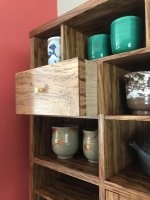
Finished today, a Japanese Tea Cabinet; constructed from Brown Oak veneers over a lipped, laminated pine core. All the construction is with long ply splines aka Alan Peters; no dominos, no biscuits, no trad joinery. Even the 8mm thick shelves and partitions are joined with 3mm thick ply splines.
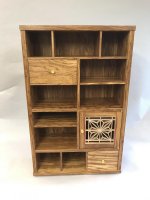
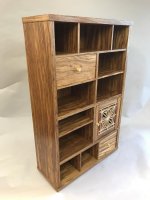
IMG_4711.jpg

IMG_4713.jpg

Shelves and partitions aren't flush either; most are set 2mm lower than others which made for an 'interesting' build :D The back is veneered Brown Oak with a....
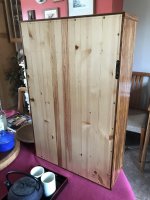
IMG_4717.jpg

...thick pine backing veneer and is glued, screwed and nailed to the carcase. The cabinet is hung using some Haflé cabinet hangers which I've had for the last twenty years and never used :lol: There are two drawers which appear :eusa-whistle: to be 'standard' but each has...

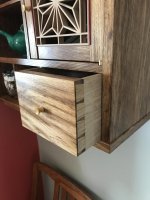
IMG_4715.jpg

IMG_4720.jpg

IMG_4721.jpg

...separate secret compartment :D

The door contains a 'kumiko' panel made in Yakusugi Cedar from Yakushima, Japan.
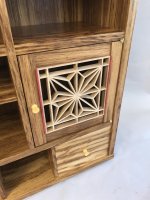
IMG_4716.jpg

It's essential that the door is made absolutely, dead 100% square and true. Mine wasn't :eusa-violin: so I enlarged the gap (or error) with a small router bit and fitted a strip of Pink Ivory each side....very Alan Peters :eusa-whistle: The door rails sit 2mm below the 'kumiko' panel and the Pink Ivory inserts are 2mm higher. The door catch in African Blackwood is an improved version of the one Krenov used as it's both spring loaded and incorporates and upstand to limit the door travel. The door's hung using offset Brusso knife hinges.

All pulls are identical (hopefully) and turned from English Boxwood acquired from WH a couple of weeks ago.

The cabinet went up onto the wall this morning with no issues...

IMG_4730.jpg

...and was promptly filled with stuff collected from our travels - Rob
 
Indeed.

What are “long ply splines”. Loose tongues perhaps? How were they made and the joints put together?
 
Love that door! Don’t like tea unless it’s herbal and doesn’t have any tea in it :lol:

I also would like to know what the long splines are.
 
MattS":ohs937tw said:
I also would like to know what the long splines are.

Thanks chaps. Japanese green tea is obligatory almost anywhere you go in Japan and as well as green tea ice cream (which is to die for btw :D) is wonderful...go into the tiniest noodle restaurant and your cup will be constantly refilled, free of charge.

Long ply splines were a favourite of the late and very great, Alan Peters. Simply machine a matching groove in each piece of timber and find a piece of birch ply for a snug fit; sort of a long elongated wafer. Thus if my groove(s) are 150mm long with a combined depth of say 12mm, I'd be looking for a piece of ply around 140mm long and around 11mm wide and fitting snuggly enough to allow for an easy sliding fit. I also made my own ply splines from oddments of aeroply squished together under cauls, then passed through the Jet drum sander for thicknessing to fit the grooves. I think many folk think of doms or biscuits these days, but the ply spline is an easy method of construction which IMO shouldn't be overlooked - Rob
 
Thought so. So tongue and groove with loose (glued) tongues.

Are you happy with those door hinges Rob?
 
Andyp":2kvin8x9 said:
Are you happy with those door hinges Rob?
The offset knife hinges from Brusso are very good Andy. I've used them before on other projects and apart from the price (which will deprive you of an arm and both legs) there's nowt not to like.

On this cabinet, I had to set in the upper hinge after the shelf was glued in place (I forgot...brain in neutral, thumb in etc etc :lol: ) which was a bit awkward and not the brightest thing I've ever done, but with a bit of bodging around I managed to set in the leaf to the correct depth - Rob
 
Very impressive. makes me feel like an amateur seeing the quality you produce :)

As to tea - I hate any perfumed teas so earl grey and many others are not for me. Doubt I'd like Japanese tea but never tried it. Builders tea or Assam if being a bit posher for me.

Did you make the door panel too? I saw panels like that being made in Japan on youtube. Lots of careful work.
 
Robert":2l119n14 said:
Did you make the door panel too? I saw panels like that being made in Japan on youtube. Lots of careful work.
Thanks Robert. I like proper builder's tea in a pint mug for breakfast, but Japanese green tea has a much more delicate flavour and is certainly not 'perfumed' as is the current trend with many teas. If you try it, use 'hot' water but never boiling as it kills the taste.

I made the 'kumiko' panel from Yakusugi Cedar from the island of Yakushima, just off the coast of Japan so it is the 'real deal'. A pal of mine from Devizes (Andy Pickard) recommended Michael Pekovich's book 'The Why & How of Woodworking' in which there's an excellent chapter on how to build a 'kumiko' panel. It's very fiddly but quite enjoyable; the main thing is that you need to make super accurate jigs for the small pieces which is relatively easy if you get hold of a digital bevel gauge from 'the old firm'.
That said, I would thoroughly recommend that book in any case as it's a really excellent tome, notwithstanding some of the dire machining habits of our colonial cousins :lol: - Rob
Edit - rather than use a tablesaw as illustrated in the book, I used a 3mm router cutter to make the initial grid pattern.
 
That looks extremely good!
:D :D
:text-goodpost:


Drinking green tea takes some getting used to. "An aquired taste!"

I buy the green + mint which is good.
Also buy the ginger tea (in bags).
Get 4 mugs of tea from one bag.

Both are very healthy and good for my kidneys.
 
Back
Top