• Hi all and welcome to TheWoodHaven2 brought into the 21st Century, kicking and screaming! We all have Alasdair to thank for the vast bulk of the heavy lifting to get us here, no more so than me because he's taken away a huge burden of responsibility from my shoulders and brought us to this new shiny home, with all your previous content (hopefully) still intact! Please peruse and feed back. There is still plenty to do, like changing the colour scheme, adding the banner graphic, tweaking the odd setting here and there so I have added a new thread in the 'Technical Issues, Bugs and Feature Requests' forum for you to add any issues you find, any missing settings or just anything you'd like to see added/removed from the feature set that Xenforo offers. We will get to everything over the coming weeks so please be patient, but add anything at all to the thread I mention above and we promise to get to them over the next few days/weeks/months. In the meantime, please enjoy!

Knives

Windows

Old Oak
Joined
Jan 25, 2022
Messages
1,439
Reaction score
443
Location
Cumbria & West Kent
What knives do you all use and when do you use them? For example, when creating a groove, do you knife the edges or rely on nickers on the plane or…? Do you use a knife to reinforce marks made with a marking gauge or use a knife instead of a gauge? Do you use knife marks in preference to pencil? What’s up with knives?
 
That's a lot of questions!

I have a few marking knifes but I mostly use a Stanley Folding Pocket Knife (as championed by Paul Sellers).

I struggle to sharpen nickers, so I like to try to make their life easy by knifing the edges (although I still leave the nicker in place).

Reinforcing marks from marking gauges: it depends. Mostly I'll just leave the marking gauge line, but if it looks a bit faint to me then I'll reinforce it. Occasionally I'll use my edge gauge thing (shown in the second photo in this post) with a knife as an alternative to a marking gauge.
 
Whatever I find first amongst the clutter on my bench :lol:
 
A traditional rosewood handled marking knife. As I am right handed the bevel is on the right and that is always used on the waste side of any cut :eusa-dance: Obviously :D
I also make them from old hacksaw blades with tape wound round for a handle. These are good for marking the pins from tails.
Oh and old jigsaw blades can be ground into neat little mini knives or even mini chisels.
Ive got a few old style table knives as well ground into all shapes. Ground off square they make good filling knives.
There's also an old kitchen Devil veg knife kicking around somewhere too.
 
It is exceptionally rare that I mark out to cut in my wood or metal activities. When I do I use a 0.7mm HB pencil and make a mental note according to fit required to cut one or other side or to split the line.
Normally work is either jigged off another component or a rod.
For general purposes, there is usually a retractable Stanley knife lurking under the bench clutter.

Bob
 
I use a gauge when the mark is parallel to a reference edge, and a knife when it isn't. If a gauge line needs reinforcing, I'll run the gauge over it again, and maybe add pencil to it if needed.

As for knife versus pencil, a pencil is for approximate markings; a knife is for exact ones. Pencils for breaking down rough stock and identifying pieces, knives for laying out joinery.
 
Japanese 'Kiridashi' knives for general marking out and a homemade 'V' pointed knife with a very slim blade for dovetailing. I also a Pfeil carving knife with a very narrow blade for cleaning out the corners of dovetail sockets; much better than a chisel - Rob

Edit - very fine line black gel pen now used instead of a pencil which shows up much better on most woods.
 
Grooves are with the grain, so need no knife or nicker cuts, unless there's an area of particularly awkward grain. Housings, (US: dadoes) which go across the grain, need something. What they get depends on how I'm cutting them. If the sides are sawn, I might cut a channel to guide the saw. That would be marked out with a try square and marking knife. Shallow ones would just be chiselled. Through housings might be cut with a dedicated plane but that doesn't happen often.

As for the knives, well, I have several, but not a huge number, including home made ones like Ray's.
 
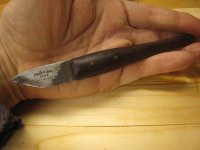
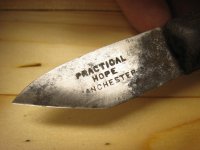
Huge numbers are all relative, Rob. I'll just offer pics of one for now:

hope_knife1.jpg

hope_knife2.jpg

hope_knife3.jpg

hope_knife4.jpg

I've no idea of the original meaning of the markings, but as we all know from the song, Manchester has so much to answer for ;)
 
Really like the shape of that knife Andy, reminds me of and makes me wonder if it is a cut down pallet Knife?
We all work differently, I hold my try square with the stock on the far side of the piece to be marked, perhaps it’s due to my arthritic thumb lol.
 
Ian, I've no idea if it was made like it is or was cut down. Either way, I do just like the way it fits in my hand, especially when held like a pen. I can't even remember where I got it!

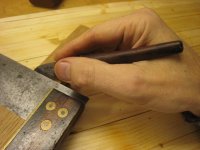
As for which way round the stock is, I do tend to do all my marking very right-handed, with my hand and the knife to the right of the square. So on one end, the face edge will be away from me, and the stock will be away from me too; when I turn the work end for end, I'll position the square as shown in the third photo, still against the face edge, which is now the one nearest me.

That's probably not efficient but it's my habit, and I find it makes sense to stick to habits so that I can work systematically, with less risk of taking a line from the wrong edge.
 
Thanks everyone. Very informative.

I’m a big fan of the referencing rather than measuring approach. Would love to hear more examples of ways to avoid measuring things.

I did not realise that with-grain grooving would be unlikely to benefit from scoring. Was hoping that my less than perfect results would see a boost with a little knife work. Have been free-handing grooves with a chisel so far. I’m probably 10x faster than the first one I did, but still v slow, so switching to the plane for some rabbets today. I won’t bother sharpening the 405’s nicker then. It has obviously never been used and I was not looking forward to sharpening the little blighter.
 
I have a cut down "Kitchen Devil". The steel isn't as wonderful as most workshop tools, so it needs a touch on the diamond plates and strop rather more often than a purpose made marking knife would.......but it works perfectly, and the pointy shape gets into small dovetails rather easily. Best of all, it was somewhere between dirt cheap and free, depending on which accountant you use.
 
The best knife in the kitchen here is a Kitchen Devil. Think my wife’ll be disappointed if I steal it for woodworking though.
 
Back
Top