• Hi all and welcome to TheWoodHaven2 brought into the 21st Century, kicking and screaming! We all have Alasdair to thank for the vast bulk of the heavy lifting to get us here, no more so than me because he's taken away a huge burden of responsibility from my shoulders and brought us to this new shiny home, with all your previous content (hopefully) still intact! Please peruse and feed back. There is still plenty to do, like changing the colour scheme, adding the banner graphic, tweaking the odd setting here and there so I have added a new thread in the 'Technical Issues, Bugs and Feature Requests' forum for you to add any issues you find, any missing settings or just anything you'd like to see added/removed from the feature set that Xenforo offers. We will get to everything over the coming weeks so please be patient, but add anything at all to the thread I mention above and we promise to get to them over the next few days/weeks/months. In the meantime, please enjoy!

Mike builds a teardrop (cedar roof)

That looks like a home-made one to me, and it doesn't have a kitchen.
 
It looks very unbalanced - front heavy. But admirable for people to make their own.
 
Whislt awaiting the arrival of the chassis, I took the opportunity to do stock preparation. Preparing long bits of wood in my workshop isn't completely straightforward. I decided to start with the framing material, which is Douglas fir (6x2). I opened my hatch:

IMG_8120.jpg

IMG_8121.jpg

.....and put a face and edge on all of the boards using my planer:

IMG_8122.jpg

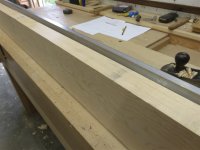
Unfortunately, with a short infeed table, this does nothing to straighten or flatten, so I set about doing that by hand. I use a long straight edge of aluminium, which I rub backwards and forward on the wood. This leaves a grey smudge from the oxidation on the high spots:

IMG_8123.jpg

IMG_8124.jpg

....which are then easy to plane off by hand:

IMG_8125.jpg

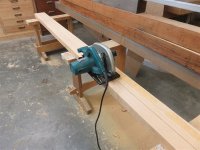
However, the boards are way longer than my bench, and this was just going to be so slow and cumbersome. I came up with a new plan to get a reference edge. I would rip a straight edge through the middle of the boards with a circular saw:IMG_8126.jpg

After passing this over the planer I had a decent edge from which to rip strips on the bandsaw:

IMG_8127.jpg

It took careful positioning of the bandsaw (my only moveable pice of machinery), to be able to fit the wood through the machine. I ripped it all into strips, and then carefully set up the thicknesser to produce the exact same thickness as the insulation bords I'll be using. Remember, this is all for the walls (and roof):

IMG_8128.jpg

The roof members will be used on edge, rather than flat, and the couple of pieces which came up a bit thinner than I'd hoped were marked up for use in the roof:

IMG_8129.jpg

I need a few 4x1s, as well as all those 2x1s, so I edge-joined some 2x1s:

IMG_8130.jpg

With the thicknesser set I then brought everything to its final thickness:

IMG_8131.jpg

That's the framikng stock prepared. Now for the Cedar strips for the outer skin. I had selected some wonderful straight quarter-sawn stock at the woodyard:

IMG_8132.jpg

This is all going to be ripped down into strips finishing about 22mm x 6mm. To get theose to end up quarter sawn, I needed to first cut into 23/ 24mm strip parallel with the end grain, but before doing that I needed reference face and edges. Quickly through the planer on adjoining faces:

IMG_8133.jpg

Then, because there is no chance of squaring this up through my small machine, I brought everything square with a hand-plane:

IMG_8134.jpg

IMG_8135.jpg

Finally, I could start bandsawing. Saw-plane-saw-plane-saw-plane.........

...............would be the story of the next 2 or 3 days. I don't use my hatch often, but when I need it it's invaluable:

IMG_8136.jpg

IMG_8137.jpg

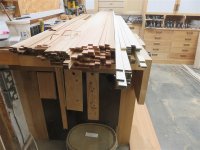
Eventually, I had a pile of 24-ishmm wide planks, planed all round (bar one edge):

IMG_8138.jpg

IMG_8139.jpg

More in a second..........
 
In addition to having western red cedar in the outer skin, I want to have some contrasting strips. Up in my wood-store (loft) I knew I had some ash:

IMG_8140.jpg

IMG_8141.jpg

I cleaned it up and ripped and planed it to the same thickness as the cedar:

IMG_8142.jpg

Saw-plane-saw-plane-saw..........ad nauseum. It was really nice to see the contrasting colours emerge. Cedar is soft and light, but can be beautiful.

IMG_8143.jpg

In the middle of all that work, my plywood arrived. I was surprised by how pale it was, and by how light it was, and my first impression is that it looks decent qualtiy (flat, true, and lacking in visible voids):

IMG_8144.jpg

Eventually, days later, I had a pile of strips, and lots of bags of shavings:

IMG_8145.jpg

IMG_8146.jpg

Just as an experiment, and to show you the wall build-up, I prepared some ply, some Celotex, and some cedar:

IMG_8147.jpg

I glued one of the bundles together using PU:

IMG_8148.jpg

.......and when it had dried overnight, hung weights on the glued and the un-glued wall sections:

IMG_8149.jpg

IMG_8150.jpg

IMG_8152.jpg

That's the reason I will be using PU glue on this build, and why the insulation will be glued in place both sides. I've never seen anyone do that, in the hundreds of videos on the subject on Youtube.
 
Last edited:
Did you plane that lot by hand?
Did you consider an alternative insulation, a wood fibre such as pavatex isolair?
 
Did you plane that lot by hand?

No, no. I pushed it over the planer, and fed it through the thicknesser. The only hand planing was getting the initial lumps of cedar square.

Did you consider an alternative insulation, a wood fibre such as pavatex isolair?

No. Celotex is the right material in this circumstance. There is no breathability required (it's fibreglassed on the outside), and I have a board and some off-cuts left after doing my house.
 
No, no. I pushed it over the planer, and fed it through the thicknesser. The only hand planing was getting the initial lumps of cedar square.


No. Celotex is the right material in this circumstance. There is no breathability required (it's fibreglassed on the outside), and I have a board and some off-cuts left after doing my house.
Are you bonding the outer inner and insulatiin? Would make it much stronger. End grain balsa would work too.
 
Are you bonding the outer inner and insulatiin? Would make it much stronger. ....

Yes, that's what the experiment showed. Both skins are glued to the insulation, and it is very much stiffer than without glue.
 
It does seem strange that nobody glues it up like you are intending Mike, makes a lot of sense and obviously much stronger. But why not? I hope the answer doesn’t manifest itself further down the line.
Just a thought, questioning the reliability of glueing to the foil layer, I’ve never tried it, does it give as good a grip compared to Polyiso without a surface covering?
 
Just a thought, questioning the reliability of glueing to the foil layer, I’ve never tried it, does it give as good a grip compared to Polyiso without a surface covering?

I've no idea, Ian, I'm afraid.
 
View attachment 35007

That's the reason I will be using PU glue on this build, and why the insulation will be glued in place both sides. I've never seen anyone do that, in the hundreds of videos on the subject on Youtube.
Looks like you are creating a structuall insulated panel which I find fascinating. I have visited a factory that produced these panels by basically filling the void between two OSB panels with a close cell insulation. Incredible strong!
If the foil paper doesn't break this should work very well.
Interesting write up as always Mike.
Edit, just wondering if the odd deep score to the foil paper might help the pu adhere to the foam core
 
Looks like you are creating a structuall insulated panel

Well yes, I guess that's a good analogy. Foan-cored boards have been around for a while, and I was more thinking of those. The walls of refrigerated lorries, for instance, are very strong and light as a result of being plastic-foam-plastic sandwiches.

Edit, just wondering if the odd deep score to the foil paper might help the pu adhere to the foam core

We'll find out because that's exactly what will be happening in the roof. Because of the curves, I'll be scoring and breaking the insulation boards and filling the gaps with foam.
 
I have taken a scan through this thread Mike and it looks like a very unusual woodworking project.

We have a caravan and boat too, I recently changed the trailer on my speedboat and found I needed to move the axel about 600mm to the rear of the trailer to obtain the right balance. The axel on boat trailers are normally a separate unit to the main framework and fixed to the the trailer main frame with U bolts. This type of setup allows easy adjustment of the axel if needed so all I had to do was undo the U bolts and slide the axel to the rear of the trailer to obtain the right balance. My speedboat has a large 75Hp four stroke outboard engine which uses the same block as the 90 and 115Hp ouboards so it is a big heavy unit hence the need to re-position the axel 600mm further to the rear of the trailer. I used a car engine hoist to lift and hold the rear end of the trailer in the air while I played around with the position of the axel for balance and position, the engine hoist made life easy. Good luck with the project Mike.
 
Looks like you are creating a structuall insulated panel which I find fascinating. I have visited a factory that produced these panels by basically filling the void between two OSB panels with a close cell insulation. Incredible strong!
If the foil paper doesn't break this should work very well.
Interesting write up as always Mike.
Edit, just wondering if the odd deep score to the foil paper might help the pu adhere to the foam core
Yes it is a sip.....

Old fashioned caravans were alu, wood frame / insulation , plywood inner.
Then Bailey came along and bonded the inner and outer skin to the insulation (alutech) demonstrated it's strength by putting a car on top of one of theirs. So yours will be just as strong if not stronger if you use curved surfaces.

Others followed too swift solid etc.
 
Well if you haven’t already bought the boards it might be as well to find out, be a real shame if the foil/wood joint failed, or even if the foil/polyiso joint failed.
I think you want the boards without foil...
Foil like polythene won't be a good surface to stick imho..
 
The reasons I suggested wood fibre insulation was that it would be stiffer than celotex and bond to the cladding far better. The downside is it is probably much heavier.
 
Oooooh, I can feel another experiment coming on! I'll set something up this afternoon.
Experiment done. Make your predictions now, and I'll post photos this evening. Where did it fail under load?
 
Here's the experiment. I cut back the ply and foam to allow the cedar to stick out enough to take the load:

IMG_8160.jpg

IMG_8161.jpg

That hung there for half an hour, so I gave it a little prod to see if I could break it:

IMG_8162.jpg

Pete was absolutely spot on:

IMG_8163.jpg

But the thing I was testing was the bond between the wood and the foil, and between the foil and the foam. Which would fail first?


IMG_8164.jpg


Perfectly intact from the break and fall.


So, to test the connections between the layers I just pulled at the ply and the cedar to prise them apart, and this is where it failed:

IMG_8165.jpg

IMG_8166.jpg

So, there's our answer, folks. The glue bonds are the strongest point of the sandwich. The failure was through the Celotex foam. Not the foil/ foam junction, and not the foil/ cedar (or ply) junction.

That's a relief, and the plan remains unchanged.
 
Mike
I'm sure you've factored it into your plans but when the panels are made up for modern caravans and motorhomes there are timber frames and sections incorporated in the sandwich around door openings and where you need fixing points for bed frames, kitchen units etc.

As an aside, James awoke a long forgotten memory when he mentions Alutech. whilst not the same company we used to sell Alucobond in thin sheets I think mainly 6mm from memory to the construction industry so you probably came across it. We spent a fair amount of effort persuading architects to specify it for commercial projects. That was back in the eighties so long long ago.
 
Time to do some proper woodwork.

The commercially-made teardrop I repaired a few weeks ago had butt-and-staple joints. That's not my way. I am going to make this as though it were a boat, or a piece of furniture. I started by cutting up all the Douglas fir stock and laying it against the pattern:

IMG_8153.jpg

I do stuff by hand where I can, of course:

IMG_8154.jpg

I've a frame drawing I won't bore you with showing the location of all the timber in the walls. Much of the location boils down to where I'll need to fix into the walls, so it's been carefully thought through. The most solid point of the frame is the door surround. With all those loose pieces following the curve of the roof, I thought I would start construction with something solid and fixed, to which I could then attach other components. So I began with the door frames. Marking out and joints are as per usual: knife, square, chisel, saw.......but then I used a router (screaming monster) rather than a router (plane) to get the depth of the half-laps right:

IMG_8155.jpg

IMG_8156.jpg

Shoulders:

IMG_8157.jpg

I quickly hacked off the bulk of the waste without much marking:

IMG_8158.jpg

Screaming monster (with a bearing guided trim cutter):

IMG_8159.jpg

The housings were again marked with a knife, then sawn, chiseled and routed. I'll see if I can remember why I chose to do blind joints...........

IMG_8167.jpg

IMG_8168.jpgIMG_8169.jpg

After a quick clean up in the corners of the housings it was time to glue. I have bought myself a new toy for this job, because of the cedar strips on the outside. I thought that rather than clamp I would try the air pinner out:

IMG_8170.jpg

IMG_8171.jpg

I made two of those, as I did of everything else. There are a lot of lap joints in my immediate future.
 
Last edited:
Mike
I'm sure you've factored it into your plans but when the panels are made up for modern caravans and motorhomes there are timber frames and sections incorporated in the sandwich around door openings and where you need fixing points for bed frames, kitchen units etc.

As an aside, James awoke a long forgotten memory when he mentions Alutech. whilst not the same company we used to sell Alucobond in thin sheets I think mainly 6mm from memory to the construction industry so you probably came across it. We spent a fair amount of effort persuading architects to specify it for commercial projects. That was back in the eighties so long long ago.

Our posts crossed. Yes, the frame members are located very much where fixings are required into the walls. The biggest loading on the walls is going to be from a bracket at each end of the awning on the roof, so making the fixing points for that as robust as possible is a priority. Obviously there's the door (all round), and the various cupboards and shelves.

As for Alutech.......I did some commercial buildings 20 odd years ago where we used their rainscreen panels on the outside. I still have some of the samples in my store shed, and they get cut up now and then when I need aluminium.
 
I knew of course that you would have already planned it.

I might have a few samples left as well among the various other plastics I have in my hoard which my wife calls junk. :oops:
 
I know it took precious time but I’m glad you’ve proved the glue bond works, and better than I had feared!
Which make of glue are you using Mike, and does it come in a tube you fit to a gun?
 
.....Which make of glue are you using Mike, and does it come in a tube you fit to a gun?

Soudal 30 minute "Lumberjack" PU, and no, it's in a normal plastic bottle. I bought a box of disposable gloves at the same time as I bought the glue, as I can see things getting messy. I hate PU, but it's the glue recommended for sticking Celotex, and it's waterproof.

IMG_8147.jpg
 
Soudal 30 minute "Lumberjack" PU, and no, it's in a normal plastic bottle. I bought a box of disposable gloves at the same time as I bought the glue, as I can see things getting messy. I hate PU, but it's the glue recommended for sticking Celotex, and it's waterproof.

View attachment 35045
Good stuff and it's waterproof!
 
It's horrible stuff.
Messy, smelly, limited shelf life, I detest the stuff however it works and very well indeed, especially in damp conditions or where you need some minor gap filling. so I use it as well but there are usually a lot of swear words floating around.
 
Just wondered how you are going to join the roof panels to the side panels Mike?

My cravan has Alutech panels which are joined using aluminium extrusions these overlap the outter aluminium panels and are sealed using a flexible sealant. There can be a lot of flexing when on the road so I guess a hard non flexible joint would end up cracking and letting in water.

I had to re-seal one joint on my caravan a couple of years ago and the supplier of the sealant suggested Sikafex 522 which is a One component sealant. The joint is holding out very well but I expect the joints should be looked at every 8 to 10 years depending upon exposure to flex and the elements.
 
Don't forget how small this thing is, Mark.

In principle, the whole thing is a torsion box/ monocoque. I'm going to be fibreglassing the joint, with lapped sheets of glass fibre, and an additional strip, then the entire joint is going to be covered by a cover moulding (made of laminated bog oak), which again will be glassed over. It's going to be enormously strong. I'm very much aware that this wouldn't work on a caravan-sized project, but this thing is tiny in comparison. Also, the chassis is very stiff .
 
Don't forget how small this thing is, Mark.

In principle, the whole thing is a torsion box/ monocoque. I'm going to be fibreglassing the joint, with lapped sheets of glass fibre, and an additional strip, then the entire joint is going to be covered by a cover moulding (made of laminated bog oak), which again will be glassed over. It's going to be enormously strong. I'm very much aware that this wouldn't work on a caravan-sized project, but this thing is tiny in comparison. Also, the chassis is very stiff .
Why the capping? Just several layers of fibreglass?

Either it's a monocoque or it's not. Mixing building styles is a recipe for failing (in a boat building world anyway!)
 
Don't forget how small this thing is, Mark.

In principle, the whole thing is a torsion box/ monocoque. I'm going to be fibreglassing the joint, with lapped sheets of glass fibre, and an additional strip, then the entire joint is going to be covered by a cover moulding (made of laminated bog oak), which again will be glassed over. It's going to be enormously strong. I'm very much aware that this wouldn't work on a caravan-sized project, but this thing is tiny in comparison. Also, the chassis is very stiff .
I guess you have given enough pre-design thought into it before setting out on the construction Mike, it was just a thought that sprang to mind regarding my own experience. It's an amazing project to add to the woohaven2 site which is interesting to follow, good thread!
 
Why the capping? Just several layers of fibreglass?

Aesthetics, mainly, (I'm not confident of getting a neat-looking fibreglass joint), but a secondary waterproofing for the joint.

Either it's a monocoque or it's not. Mixing building styles is a recipe for failing (in a boat building world anyway!)

I'm not sure what the correct description is, but "strong" or "rigid" are the starting points. Bear in mind the size. This is smaller than almost any wooden dinghy or tender you can think of, and has got a strong structural bulk-head only 1.8m from the front.
 
Back
Top