• Hi all and welcome to TheWoodHaven2 brought into the 21st Century, kicking and screaming! We all have Alasdair to thank for the vast bulk of the heavy lifting to get us here, no more so than me because he's taken away a huge burden of responsibility from my shoulders and brought us to this new shiny home, with all your previous content (hopefully) still intact! Please peruse and feed back. There is still plenty to do, like changing the colour scheme, adding the banner graphic, tweaking the odd setting here and there so I have added a new thread in the 'Technical Issues, Bugs and Feature Requests' forum for you to add any issues you find, any missing settings or just anything you'd like to see added/removed from the feature set that Xenforo offers. We will get to everything over the coming weeks so please be patient, but add anything at all to the thread I mention above and we promise to get to them over the next few days/weeks/months. In the meantime, please enjoy!

Mystery Plane

Joined
Apr 3, 2021
Messages
301
Reaction score
65
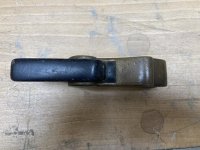
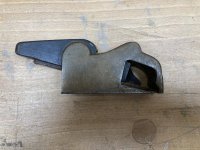
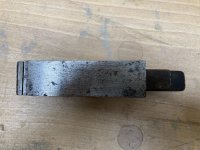
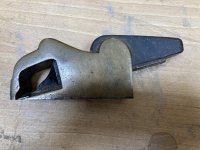
I have been asked to sharpen this plane by my FIL who inherited it. I assume that it is a brass shoulder plane with a wooden wedge, possibly ebony. It also looks like the sole and nose are steel. I was wondering if more knowledgeable members of the forum might be able to tell me a bit about the plane. To remove the blade to sharpen it that I just need to tap the wedge out. How delicate do I need to be in doing this?

Many thanks,

Mark
 

Attachments

  • 165A7702-6DBB-4134-A636-1C1415A6DFAC.jpeg
    165A7702-6DBB-4134-A636-1C1415A6DFAC.jpeg
    189.1 KB · Views: 3,430
  • 551C7328-61A8-4EEB-AE4D-F1D6EAF84008.jpeg
    551C7328-61A8-4EEB-AE4D-F1D6EAF84008.jpeg
    322.7 KB · Views: 3,430
  • 1E469D15-A544-4358-AA0B-049F92F6C06B.jpeg
    1E469D15-A544-4358-AA0B-049F92F6C06B.jpeg
    451.9 KB · Views: 3,430
  • 4A2E4C6D-8EB8-4FDD-AC21-706706BDB2DF.jpeg
    4A2E4C6D-8EB8-4FDD-AC21-706706BDB2DF.jpeg
    328.7 KB · Views: 3,430
  • DC1E98C5-EA22-4E92-BF1A-9E9E20918288.jpeg
    DC1E98C5-EA22-4E92-BF1A-9E9E20918288.jpeg
    422.2 KB · Views: 3,430
I'd call it a bullnose plane - a shoulder plane has a greater length of sole in front of the mouth. The bullnose plane can feel awkward at first, because of that very short toe, but it does enable it to do some particular jobs well.
The obvious one is cleaning up a stopped rebate. You still need to do a little bit of chiselling to make room for the plane to work, but not much.
They are also good for chamfering, especially when the ends have been cut down first with a chisel (maybe into the decorative lamb's tongue shape) leaving a long flat to be planed down between them.
Also, if you start the plane at 45 degrees in plan and in section, you can chamfer all round the inside rim of a frame using a bullnose plane. (Sorry if that's not clear - it's tilting and skewing the tool at the same time. )

It's also handy for easing an arris, as you might do with a block plane.

As for getting the iron out, you need to tap carefully either on the heel or on the top of the bulge. I'd use a little beech mallet or the white side of a Thor hammer, so as to avoid marking the brass.

I think little cast planes like yours must have been reasonably popular into the 20th century, judging by the number still around. But because so few have any branding, they are not as sought after by collectors, who often specialise in one or two named makers.
 
As Andy, said.........

You may find a maker's name on the blade. Owner's stamps?

Whether, with all that venerable wear it is a good user or just another old plane to retire gracefully is up to you and the plane.

The wedge, obviously, comes out by being driven backwards......

There's a possibility that it may be well-lodged with age and muck, and it won't shift.

If so, don't flog it to death, try plan B. Apply some heat to the metal body slowly. Not enough to get it untouchably hot, but with the intention to expand the metal around the wedge. Allow it to cool. The first time it may not oblige. If so, do it again, but this time, after allowing it to stay warm enough to expand, cool it rapidly...... repeat.

There may be a temptation to add some sort of 'easing fluid', if so please bear in mind the compatibility with the wood.

Good luck,
 
Argus":22qby4tb said:
The wedge, obviously, comes out by being driven backwards......

Doh! Of course. :oops: Serves me right for giving generalised advice rather than looking closely at the pictures in front of me.
 
don't tap the wedge, tap the body and hold the wedge. it's hard to explain how but normally you'd flip the thing over and hold it in the palm of you hand with the wedge between finger and thumb. Then tap the back of the body towards yourself.

it looks like it maybe a kit rather than a made plane. there were a few brass castings available at one point that you added a blade and a wooden wedge too. the sole being steel may suggest someone has modified it, and given that a bullnose is a bugger to use, this might be someone trying to resolve an issue but not quite going about it the right way.

a bullnose has it's uses but as said, they can be a bit of a pita to use. I've found they need to have a very tight mouth (I've got a record one with an adjustable nose) and you need to apply a bit more pressure to the back of the plane so it doesn't dive in.
 
I'll just add that the steel sole was an extra feature, well worth having on a bronze plane which can wear quickly and leave dark marks on pale woods. Looking in the Melhuish catalogue from 1905, a gunmetal bullnose plane with an ebony wedge cost 8 shillings for an inch wide, 8 and six for 1 1/8" or 9 bob for the 1 1/4" width.
But adding on a steel sole cost an extra two shillings!

(In comparison, the Preston equivalent cast plane, with a screw adjustable iron, which would now be much more valuable, was only 6 shillings and a new-fangled Stanley No 4 smoother was only 7 shillings.)
 
Andy, does it have a price for the very rare and highly desirable model with the ring through the nose...? :eusa-whistle:

I'll get me coat.

Oh, but afore I go, if the plane's been sitting in an unheated shed or garage, it might be worth just keeping it somewhere warm and dry for a bit, as that may be sufficient to get the wedge more amenable to movement if it's currently not. Also novocaine's advice to drive the plane off the wedge rather than vice versa is wise. A wedge, once dinged, can never be undinged, and you feel a damn fool after you've done it. Don't ask me how etc...
 
My experience of both bullnose and chisel planes is that they are almost useless in real life. :x

There are very few occasions when a sharp chisel won't do the job quicker and better, and if you have to pick up a chisel to deal with the bit a plane won't reach, then best bet is leave the plane in the drawer. For chamfers a block plane does the job fine and dandy.

I actually hunted down a good quality chisel plane because I thought it would be useful for getting into awkward spots in some joints. And I was wrong.

Of course, I am a hand tool heathen really.
 
Thanks for all the information and advice. I turned it upside down and gave the body a little tap with a mallet and it came nicely apart. The blade does have some marking on the word at the top is Ward, but I can’t quite make out what is beneath it.
 

Attachments

  • 03B32E3E-17C1-48B4-AF28-5C753F1199D7.jpeg
    03B32E3E-17C1-48B4-AF28-5C753F1199D7.jpeg
    1.3 MB · Views: 3,297
And to the right is their trade mark, two crossed hammers above an anvil, with the initials W and P, for Ward and Payne.
 
Back
Top