Quite some time ago, I bought this nice old thread box and tap.
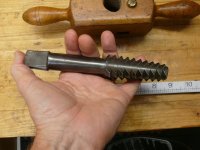
It's bigger than my others - 1¼" diameter - and if I am ever going to use it, I need something to hold the tap with. The top of the tap is tapered one way and slightly rounded so my metalwork tap wrenches won't do. I don't think I'll get far with a couple of spanners or Mole grips either. So I decided to make something suitable from wood.
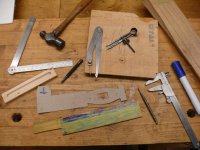
I didn't have anything drawn out in advance but I found a bit of left-over hardwood (sweet chestnut actually) that I thought was about the right size and sketched out a shape on it, with the help of a cardboard template.

I bored out a hole in the middle

and chiselled away the surrounding wood until the hole was nearly big enough to let the tang of the tap in, but not all the way.
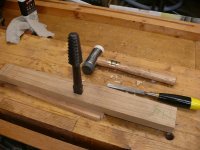
I thought that the edges of the hole would need some reinforcement. Steel would be good, but I decided that two bits of ⅛" thick brass would be ok and much easier to work. I'd already decided that in this project I was definitely aiming at 'functional' not 'accurately measured and consistent everywhere' so I cut another just-good-enough template and drew round it, then cut out the shapes. I do really need to buy a new marker pen that hasn't dried up.
I cut the shapes out with a hacksaw I actually bought new

and a somewhat older jeweller's piercing saw, probably made by an anonymous outworker somewhere in Lancashire in the 19th century:

I realised that I couldn't just use screws to hold these plates in place, as they would have to be rather short so as not to hit the screws from the other side. So I decided to rivet instead.
I marked around each plate and chiselled and routed away to depth.

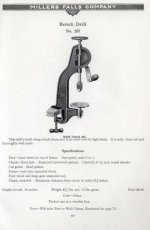
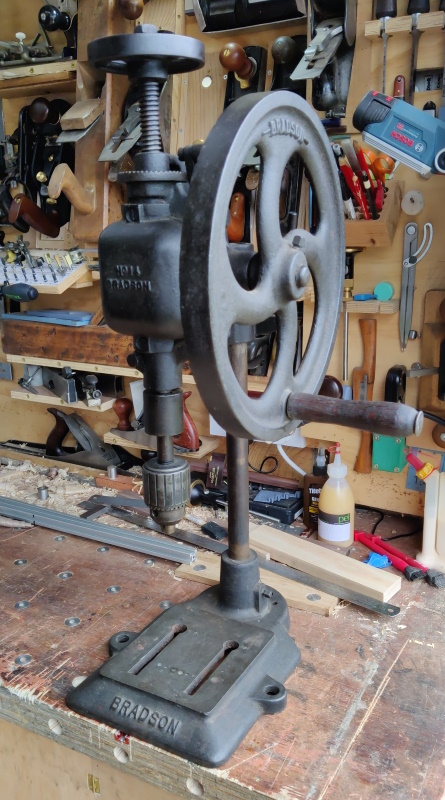
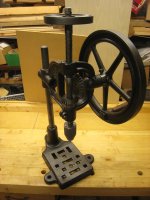
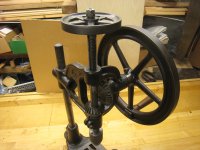
Then I put the plates in and drilled right through both of them on my smaller bench drill, which likes to sit beside its bigger cousin .
.
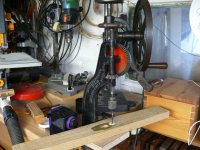
I opened out the holes with a tapered reamer. (The green ink on it was to make sure I went to the same depth on all the holes.)
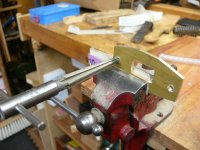
Before fitting the brass plates I finished off the shaping of the wooden body. First I cut out the shape on the bandsaw:
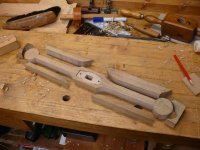
Then it was a simple job of marking pencil lines for chamfers and shaping with one of my favourite spoke shaves.


I cut some bits of brass rod to what I hoped was the right length and hammered them down to form the rivets
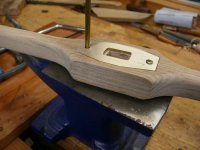
and enjoyed that stage when filing and sanding makes them pretty nearly disappear:

To make the hole in the handle fit the tapered tang of the tap, I pushed the tap in, then filed away the marks on the sides of the hole, a little bit at a time.

As made, it's just about tight enough to be able to hold the tap so it doesn't fall out. If it loosens too much, I could always add a clamping screw from one side or line the hole with something grippy.
Having got this far, I couldn't resist trying it out. I bored a hole in a bit of scrap ash

and worked through with the tap

This worked quite nicely - I think the holder is about the right length to give plenty of torque but not too clumsy to use.
However, the tap didn't feel very sharp at all, certainly not as sharp as other, smaller taps for wood that I have. I carefully refreshed the edges with a saw file and some 400 grit paper round a tube.
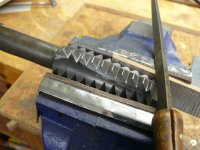

That felt sharper on my fingers and I think it helped.
But I've hit the 20 photo limit, so I'll continue in a few minutes...
It's bigger than my others - 1¼" diameter - and if I am ever going to use it, I need something to hold the tap with. The top of the tap is tapered one way and slightly rounded so my metalwork tap wrenches won't do. I don't think I'll get far with a couple of spanners or Mole grips either. So I decided to make something suitable from wood.
I didn't have anything drawn out in advance but I found a bit of left-over hardwood (sweet chestnut actually) that I thought was about the right size and sketched out a shape on it, with the help of a cardboard template.
I bored out a hole in the middle
and chiselled away the surrounding wood until the hole was nearly big enough to let the tang of the tap in, but not all the way.
I thought that the edges of the hole would need some reinforcement. Steel would be good, but I decided that two bits of ⅛" thick brass would be ok and much easier to work. I'd already decided that in this project I was definitely aiming at 'functional' not 'accurately measured and consistent everywhere' so I cut another just-good-enough template and drew round it, then cut out the shapes. I do really need to buy a new marker pen that hasn't dried up.
I cut the shapes out with a hacksaw I actually bought new
and a somewhat older jeweller's piercing saw, probably made by an anonymous outworker somewhere in Lancashire in the 19th century:
I realised that I couldn't just use screws to hold these plates in place, as they would have to be rather short so as not to hit the screws from the other side. So I decided to rivet instead.
I marked around each plate and chiselled and routed away to depth.
Then I put the plates in and drilled right through both of them on my smaller bench drill, which likes to sit beside its bigger cousin
.I opened out the holes with a tapered reamer. (The green ink on it was to make sure I went to the same depth on all the holes.)
Before fitting the brass plates I finished off the shaping of the wooden body. First I cut out the shape on the bandsaw:
Then it was a simple job of marking pencil lines for chamfers and shaping with one of my favourite spoke shaves.
I cut some bits of brass rod to what I hoped was the right length and hammered them down to form the rivets
and enjoyed that stage when filing and sanding makes them pretty nearly disappear:
To make the hole in the handle fit the tapered tang of the tap, I pushed the tap in, then filed away the marks on the sides of the hole, a little bit at a time.
As made, it's just about tight enough to be able to hold the tap so it doesn't fall out. If it loosens too much, I could always add a clamping screw from one side or line the hole with something grippy.
Having got this far, I couldn't resist trying it out. I bored a hole in a bit of scrap ash
and worked through with the tap
This worked quite nicely - I think the holder is about the right length to give plenty of torque but not too clumsy to use.
However, the tap didn't feel very sharp at all, certainly not as sharp as other, smaller taps for wood that I have. I carefully refreshed the edges with a saw file and some 400 grit paper round a tube.
That felt sharper on my fingers and I think it helped.
But I've hit the 20 photo limit, so I'll continue in a few minutes...
Last edited: