• Hi all and welcome to TheWoodHaven2 brought into the 21st Century, kicking and screaming! We all have Alasdair to thank for the vast bulk of the heavy lifting to get us here, no more so than me because he's taken away a huge burden of responsibility from my shoulders and brought us to this new shiny home, with all your previous content (hopefully) still intact! Please peruse and feed back. There is still plenty to do, like changing the colour scheme, adding the banner graphic, tweaking the odd setting here and there so I have added a new thread in the 'Technical Issues, Bugs and Feature Requests' forum for you to add any issues you find, any missing settings or just anything you'd like to see added/removed from the feature set that Xenforo offers. We will get to everything over the coming weeks so please be patient, but add anything at all to the thread I mention above and we promise to get to them over the next few days/weeks/months. In the meantime, please enjoy!

Playing about with a big tap holder part 2

AndyT

Old Oak
Joined
Nov 23, 2020
Messages
3,342
Reaction score
1,008
Location
Bristol
Name
Andy
For the screw to go into the hole I needed something round and the right diameter. I already had this bit of old, very dry birch that I had turned for some reason, long forgotten.

P1100021.JPG

It was almost the right size. Rather than tidy up enough to use the lathe, I reduced it in size with this adjustable witchet, an impulse buy that has proved surprisingly useful on several occasions.
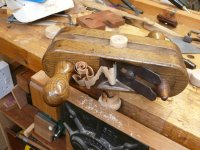
P1100023.JPG

It's like a giant pencil sharpener, but will produce a straight cylinder. You can adjust the final size by turning the adjusting screws.

The end needs a chamfer to help it line up with the screw box. I have the right tool for that, which does the job in a few seconds and is even more like a giant pencil sharpener.

P1100026.JPG

P1100027.JPG

I've not yet dismantled the thread box to sharpen it, but it worked sweetly anyway, cutting a nice continuous shaving

P1100028.JPG

I seem not to have taken a photo of the male thread - sorry. Maybe I was distracted into finding out if there was any consistency of sizing on the thread cut by this tool and some cramps I already have.

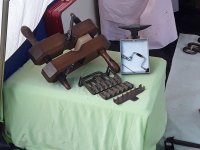
I was pleased to find that there was, on this nice old nineteenth century one from Newcastle. You can see my new sample nuts assembled on one of its old rods and my new rod inserted into the threaded hole in one of the jaws

P1100029.JPG

They are all 1¼" diameter and almost (but not exactly) four threads to the inch.

I reckon I can call that a success and I certainly enjoyed several hours playing with tools and making this.

I'll give it a coat of something - linseed oil or shellac - and try and find a place to keep it. If I want another distraction, I could always make a replacement rod for the one on the bench in that last picture, which has lost the thread for a couple of inches.

I need to find some suitable wood too, as I know it makes a big difference. I have some walnut which I believe would be ideal, but very old beech can be pretty good too, judging by the quality of the old work on here:
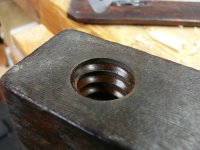
P1100035.JPG

That shine doesn't come from soaking the wood with CA glue - it's the burnishing of age and use. :)
 
Fascinating read, thanks for sharing Andy. That adjustable cylinder making plane looks interesting; I've never seen one like that before.
 
Fascinating, Andy. I've seen those adjustable pencil-sharpener thingamejigs before, being used by a wheelwright to put a taper on the end of spokes in a wooden wheel.
 
Last edited:
You seem to have some tools I haven’t got!

Nice job and a good write up.

I bought 4 small clamps the same your one only 3 had the screws so I need to make some but haven’t got the right sized thread box I need a half inch 6 top.

Pete
 
Brilliant Andy. 👍

I've never seen an adjustable wichet. It doesn't look too difficult to make one....but then you'd need a tap and die. :rolleyes:

Old wooden jack planes would be a good source of old beech if you could bear to scrifice them. I've seen them for next to nothing on Facebook and antique shops, think of saving them from people turning them into table lamps. Boxwood and lig Vi if you can get it should be ideal.
 
For the screw to go into the hole I needed something round and the right diameter. I already had this bit of old, very dry birch that I had turned for some reason, long forgotten.

View attachment 34867

It was almost the right size. Rather than tidy up enough to use the lathe, I reduced it in size with this adjustable witchet, an impulse buy that has proved surprisingly useful on several occasions.

View attachment 34868

It's like a giant pencil sharpener, but will produce a straight cylinder. You can adjust the final size by turning the adjusting screws.

The end needs a chamfer to help it line up with the screw box. I have the right tool for that, which does the job in a few seconds and is even more like a giant pencil sharpener.

View attachment 34869

View attachment 34870

I've not yet dismantled the thread box to sharpen it, but it worked sweetly anyway, cutting a nice continuous shaving

View attachment 34871

I seem not to have taken a photo of the male thread - sorry. Maybe I was distracted into finding out if there was any consistency of sizing on the thread cut by this tool and some cramps I already have.

I was pleased to find that there was, on this nice old nineteenth century one from Newcastle. You can see my new sample nuts assembled on one of its old rods and my new rod inserted into the threaded hole in one of the jaws

View attachment 34872

They are all 1¼" diameter and almost (but not exactly) four threads to the inch.

I reckon I can call that a success and I certainly enjoyed several hours playing with tools and making this.

I'll give it a coat of something - linseed oil or shellac - and try and find a place to keep it. If I want another distraction, I could always make a replacement rod for the one on the bench in that last picture, which has lost the thread for a couple of inches.

I need to find some suitable wood too, as I know it makes a big difference. I have some walnut which I believe would be ideal, but very old beech can be pretty good too, judging by the quality of the old work on here:

View attachment 34873

That shine doesn't come from soaking the wood with CA glue - it's the burnishing of age and use. :)
Brill thanks, no I didn’t know they were called Wichets, and in fact the last time I used one was at School and they weren’t adjustable. I used one to make the spindles for a Windsor rocking chair, using square stock I quickly learned that it had to be the same across the flats as the diameter of the rod to be produced, if it was larger the tool produced slight spirals.
Love that bell shaped chamfer cutter. I suppose one could be made in wood on the lathe utilising a spoke shave cutter. Any chance you could do a pic straight on showing the angle the cutter is mounted at please Andy?
Ian
 
Thanks all for the positive comments and shared appreciation of old tools.

Portable tools to make things round go under lots of different shapes and names, sometimes hinting at the craft they were used in, such as "stail-engine". There were even cast aluminium versions with standard spokeshave irons until quite recently, from Ashem, which might be what you used at school, Ian.

I certainly can't remember them all without a handy reference book or two, so I checked in Salaman's Dictionary of Woodworking Tools (highly recommended!) and he says that "witchet" is an American term for a rounding plane. Here's what he says about the tool in question, more clearly and concisely than I can:


rounder.jpg

My late friend Ted had a magnificent one, bigger than mine, with brass lining pieces inside the conical bore. It's now in the collection that AndyB @toolsntat exhibits from time to time, but as Bob says, it shouldn't be impossible to make your own. He's right too about old jack planes as a source of good dry beech. I have one, which was an utter basket case (worn down, no handle, no iron, abused as a cutting block all over) which I have actually managed to bring myself to cut a bit off to make a smaller plane out of; it could still be a donor for a tool like this.

And as requested, here are some more photos of the spoke trimmer. One feature I didn't mention is that there is a little rod inside which you can set as a depth stop, to prevent yourself whirling away until your spokes are all just shavings on the floor.

P1100039.JPG

P1100040.JPG

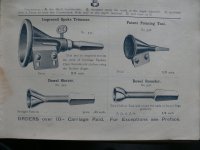
Here it is in the 1905 Melhuish catalogue, alongside its smaller and simpler relatives:

P1100048.JPG

If you don't want to make your own (which again, does sound practicable) there are some options from Veritas. (You can see them here, alongside the more trad beech version from Ray Iles. https://www.oldtoolstore.co.uk/rounders-and-tenon-cutters-16-c.asp

For little dowels, I think a two-hole pencil sharpener and some self control would do.
 
Thanks all for the positive comments and shared appreciation of old tools.

Portable tools to make things round go under lots of different shapes and names, sometimes hinting at the craft they were used in, such as "stail-engine". There were even cast aluminium versions with standard spokeshave irons until quite recently, from Ashem, which might be what you used at school, Ian.

I certainly can't remember them all without a handy reference book or two, so I checked in Salaman's Dictionary of Woodworking Tools (highly recommended!) and he says that "witchet" is an American term for a rounding plane. Here's what he says about the tool in question, more clearly and concisely than I can:


View attachment 34884

My late friend Ted had a magnificent one, bigger than mine, with brass lining pieces inside the conical bore. It's now in the collection that AndyB @toolsntat exhibits from time to time, but as Bob says, it shouldn't be impossible to make your own. He's right too about old jack planes as a source of good dry beech. I have one, which was an utter basket case (worn down, no handle, no iron, abused as a cutting block all over) which I have actually managed to bring myself to cut a bit off to make a smaller plane out of; it could still be a donor for a tool like this.

And as requested, here are some more photos of the spoke trimmer. One feature I didn't mention is that there is a little rod inside which you can set as a depth stop, to prevent yourself whirling away until your spokes are all just shavings on the floor.

View attachment 34885

View attachment 34886

Here it is in the 1905 Melhuish catalogue, alongside its smaller and simpler relatives:

View attachment 34887

If you don't want to make your own (which again, does sound practicable) there are some options from Veritas. (You can see them here, alongside the more trad beech version from Ray Iles. https://www.oldtoolstore.co.uk/rounders-and-tenon-cutters-16-c.asp

For little dowels, I think a two-hole pencil sharpener and some self control would do.
Thanks Andy, it’ll be a while before I have everything sorted to be able to attempt one, but I’ve made copies of your posts, again thanks.
Ian
Here is the beast for your perusal Ian....

View attachment 34911
That’s a beautiful tool, but it’s a little difficult to work out the size from that photo, what size rods/dowels can it produce?
 
Ah, Ian I have just boxed in that stack of boxes with others after doing the show today...
I'll let you know later.
Cheers, Andy
 
Back
Top