Malc2098
Sequoia
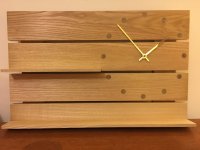
I've just finished a commission to construct a clock with shelves.
It is a copy of one made from pallet wood. This one is made from white oak shelves liberated from a County Council's Central Library refurbishment. The hour markers are from leftover oak jointing pegs of my recent roof framing construction. It is finished with bees wax to maintain the lightness of the oak.
I was trying to be efficient and double up on the milled lengths in order to make a second clock.
In trying to make the faces of the rails look interesting together, and to ensure all the hour markers were contained away from the rail edges, I ended up with the narrow rail having the clock mechanism fitted which is now visible. I will try and arrange the second clock's rails in order for the mechanism to be fully hidden behind a wide rail.
The shelves are glued into rebates routed in to the rails.
The vertical posts fit in slim housings at the back of the rails allowing just sufficient room for the mechanism to fit when the clock is hung on a wall. They are screwed to the rails.
The posts use flush mounted brass slotted mirror plates that fit over screws just protruding from the wall.
Laying out the loose rails with the clock face size dependent of the 100mm minute hand.

Making sure the rail is the correct size for the clock spindle.

Out comes the blue tape again to mark out the positions of the hour markers and to protect the clock face.

Finished article.

It is a copy of one made from pallet wood. This one is made from white oak shelves liberated from a County Council's Central Library refurbishment. The hour markers are from leftover oak jointing pegs of my recent roof framing construction. It is finished with bees wax to maintain the lightness of the oak.
I was trying to be efficient and double up on the milled lengths in order to make a second clock.
In trying to make the faces of the rails look interesting together, and to ensure all the hour markers were contained away from the rail edges, I ended up with the narrow rail having the clock mechanism fitted which is now visible. I will try and arrange the second clock's rails in order for the mechanism to be fully hidden behind a wide rail.
The shelves are glued into rebates routed in to the rails.
The vertical posts fit in slim housings at the back of the rails allowing just sufficient room for the mechanism to fit when the clock is hung on a wall. They are screwed to the rails.
The posts use flush mounted brass slotted mirror plates that fit over screws just protruding from the wall.
Laying out the loose rails with the clock face size dependent of the 100mm minute hand.
Making sure the rail is the correct size for the clock spindle.
Out comes the blue tape again to mark out the positions of the hour markers and to protect the clock face.
Finished article.