• Hi all and welcome to TheWoodHaven2 brought into the 21st Century, kicking and screaming! We all have Alasdair to thank for the vast bulk of the heavy lifting to get us here, no more so than me because he's taken away a huge burden of responsibility from my shoulders and brought us to this new shiny home, with all your previous content (hopefully) still intact! Please peruse and feed back. There is still plenty to do, like changing the colour scheme, adding the banner graphic, tweaking the odd setting here and there so I have added a new thread in the 'Technical Issues, Bugs and Feature Requests' forum for you to add any issues you find, any missing settings or just anything you'd like to see added/removed from the feature set that Xenforo offers. We will get to everything over the coming weeks so please be patient, but add anything at all to the thread I mention above and we promise to get to them over the next few days/weeks/months. In the meantime, please enjoy!

Scratch stocks

Mike G

Petrified Pine
Joined
Jul 30, 2014
Messages
12,657
Reaction score
3,397
Location
Suffolk
Name
Mike
Does anyone here have an old scratch stock or two, with the original handle (stock)? And does anyone have any old texts on the subject?

I have been doing quite a bt of scratching lately, with my own homemade scratch stocks, and there are a couple of issues which I would be interested in seeing the original solutions to. ( <A preposition is something you should never end a sentence with. Sorry.) Firstly, waste. The stuff you remove jams itself against the blade (is it a blade?), and packs really really solid. This soon interferes with your work, and needs removing. It's a bit compressed for a brush, so I use a brad awl to pick it away.

td7W6ca.png

That's one of the reasons why the thing works best if you stick the blade further out (down) than you think you need. The top of your cove, for instance, doesn't align with the underside of the scratch stock, otherwise you will never get a complete profile (you leave a flat bit on top). Here's mine:

venqw1F.png

I have also created a little hollow in the corner where waste can gather.

So, is there a better way, or is this just the way things are done? Did guys doing this for hours every day really stop every 30 seconds to clear the debris?

The other issue is blade creep. I've ended up with a screw and washer on the top of my stock holding the top of the blade down, otherwise it doesn't take long for it to ease gently out of position. Was this what the old guys did, or did they have a neater solution?
 
I can answer the blade creap question, hardwood and lots of screws, mine is beach and I never have problems with the blade moving.

I don't remember having clogging problems, do you go backwards and forwards? that should help to clear the shavings.

Pete
 
Yes, I do go backwards and forwards, once the track has been established. All that does is compress the waste against both side.

Good suggestion. I'll make my next one in beech. You know how when you chuck something together quickly as an experiment you're still using it 30 years later........that explains my softwood scratch stocks.
 
If I remember right, my experience of scratching a similar small bead on oak sheves included plenty of pauses to pick out compacted shavings. It might help to knock the arrises off first, so there's not so much work for the scratch.

I can't help with pictures at the moment but my best scratch stock is made of beech. The body is split in two, held by screws and nuts. The fence screws up onto the body, held by long screws and nuts going vertically. The bottom of the body is bevelled along both edges so they meet in a V. This is the bit that bottoms out as a depth stop, so the bevels allow some of the waste to escape.
An old friend made it for me. I think the design was from a Robert Wearing article in the Woodworker, as reprinted in one of his books.

Also, have a look for Garrett Hack's design, with a long fence, used single handed.
 
I haven’t tried it but I wonder if a bit of a rub with a candle on the stock might help prevent bits sticking to it. Now I think about it the first thing I made when I got to Teacher training college was a scratch stock and the body was made from Iroko which is a Teak alternative so naturally oily, perhaps that was on purpose?
It may be that the heat generated melts the lignin in the Wood causing it to act like glue - think of the reconstituted shaving briquettes for woodburners they are held together with the lignin melted by heat and pressure.
When I’m in the workshop next I’ll have a look in my 1950’s woodworker books for designs.
Ian
 
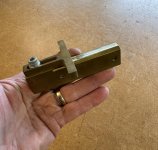
I don't use mine very much but I do have a rather nice one:

IMG_0926.jpeg

Some years a ago Pete Newton (Newt, now sadly deceased although Bob9f will remember him) was making a project and needed to insert a boxwood line some distance from the edge. Normal, 'shop made wooden ones weren't suitable as they wobbled so he machined a number (six I think) of these superb tools, made from 8mm thick, solid brass with a fully adjustable fence - Rob
 
That looks rather posh, Rob.

Are you guys implying that you have one scratch-stock, and change the blades for differing profiles? Because I just whip up a new stock each time, meaning there is no fiddling with the tool before it's ready to use.
 
Mike G":eqnf3etf said:
That looks rather posh, Rob.

Are you guys implying that you have one scratch-stock, and change the blades for differing profiles? Because I just whip up a new stock each time, meaning there is no fiddling with the tool before it's ready to use.

Yes. It's a trade off, but with a more carefully or durably made tool swapping a cutter is about as easy as swapping a drill bit.
 
sunnybob":24r0yco4 said:
I've just had to look up scratch stock as I havent heard of it before :eusa-doh:
Maybe this video will help?
https://www.finewoodworking.com/project ... atch-stock

I have a couple that look just like that one. Which is probably no coincidence as I subscribed to FW for a few years. Does bung up a bit, but scraping it clear isn't too tedious.
 
Mike G":3tr1fiq1 said:
Are you guys implying that you have one scratch-stock, and change the blades for differing profiles?
That's what I do. I made a batch of crude marking gauge type tools: a pin gauge, fixed double-pin gauge, cutting gauge, pencil gauge, and scratch stock. None of them very smart but they work. If I need a scratch stock I have to create a new "cutter" anyway. My projects are all different enough that I don't think I have ever re-used a cutter on a later project, so the time taken to change cutters is a minor part of the job.
 
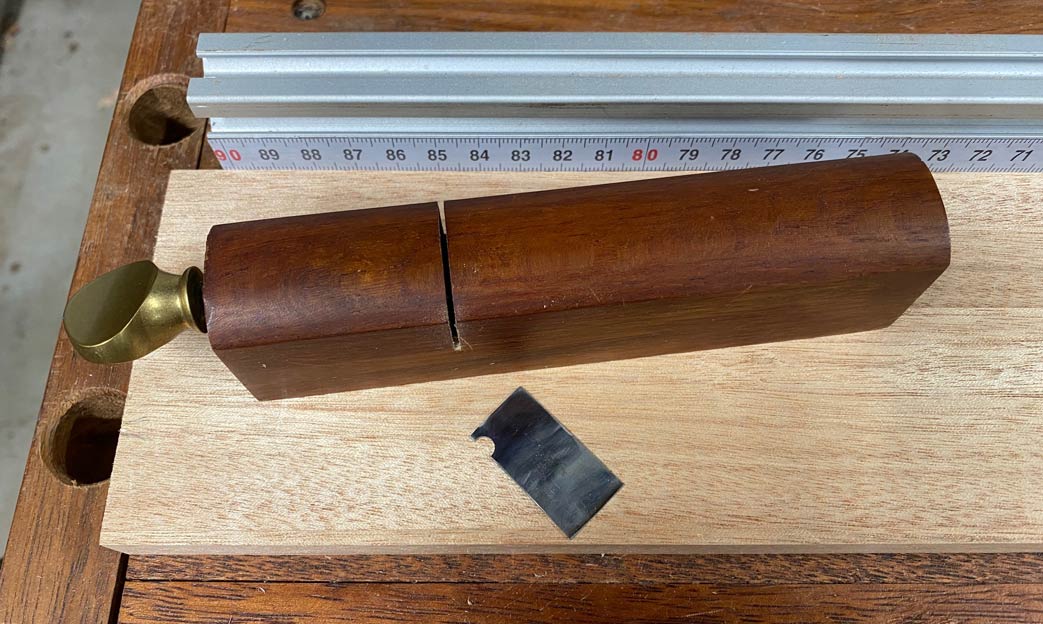
It's a week late, so Mike's probably already made all the scratch stocks he needs, but I have found a picture of the tool I was trying to describe.

IMG_8000.JPG

In the photo I had set it up for chamfering, which is why the bit of special, expensive, high-grade steel I used for a cutter was at that odd angle.

You'll probably spot that it's made of ash :oops: . Not beech, but just as suitable.
 
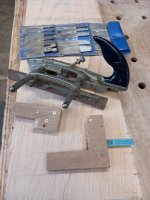
Late again, my offerings, I do occasionally need to "scratch" a profile, one option I have is my Record 50 with some useful cutters and the last resort is as rough and ready as it can get:

scratch.jpg
 
This is my one, made of a scrap of oak about 35 years ago. Most of the cutters are made of hacksaw blade. I have sometimes thought of making a fancier one but have never got round to it.
 

Attachments

  • IMG_1098A.JPG
    IMG_1098A.JPG
    358.1 KB · Views: 1,704
Hacksaw blades seem a popular source for cutters. I use old hard-point saw plates. I have way more of them than I have broken or worn out hacksaw blades. I tend to keep old bandsaw blades, so that's another potion.
 
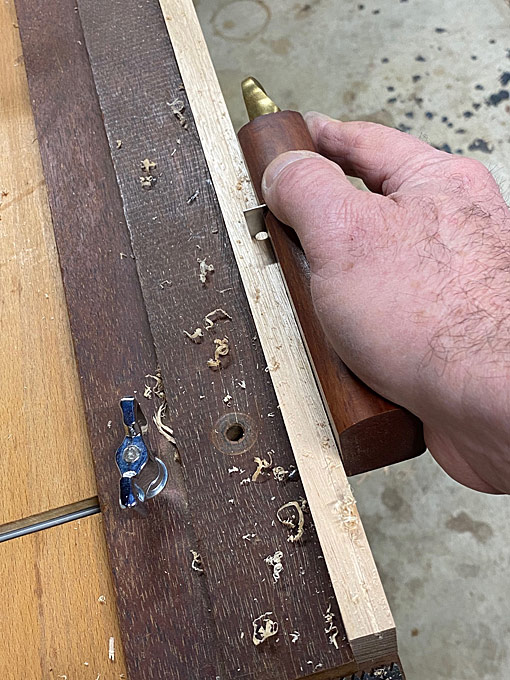
Scraping a bead for drawer slips ...

E1.jpg


The scraper is made from hardwood and uses a shaped section of bandsaw blade to create the shape. This design comes from Garrett Hack ...

E2.jpg


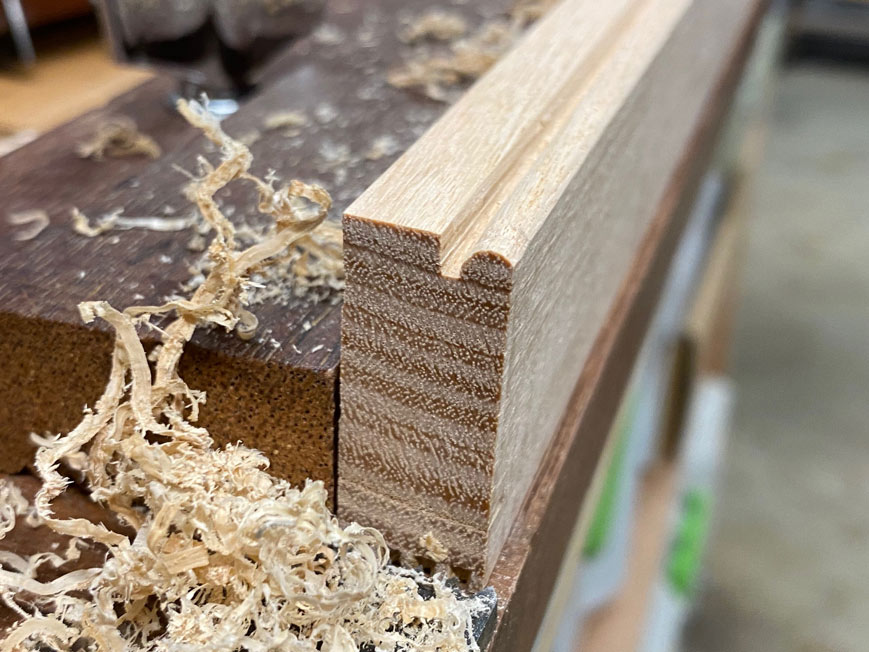
This is final shape created ...

E3.jpg


When using a scratch stock like this, run a pencil over the top of the emerging bead. This will aid in gauging when the bead is complete … otherwise you run the risk of lowering it below the height intended.

Regards from Perth

Derek
 
Back
Top