

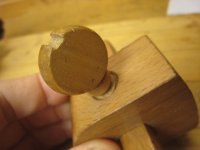
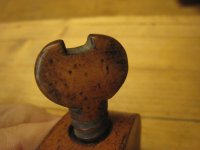
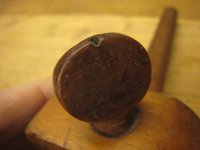
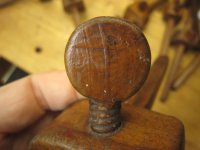
In Sam's thread about making a marking gauge, I mentioned that there is generally a little notch at the top of the thumbscrew. I've learned somewhere - but I can't remember where - that it's one of those little oddities, like the nib on a handsaw, where nobody is really sure why.
Rather than clutter up that thread with a long digression, I thought I'd start a fresh one and see if anyone can come up with an explanation that we all like.
Let's start with some history and some pictures.
I think the most comprehensive history of woodworking tools is still Bill Goodman's , from 60 years ago. He refers to this 1607 Dutch engraving by Hieronymus Wierix (used on the cover of his book) as including the earliest known illustration of a marking gauge, .

(Engel met een doek vol gereedschap - 1617 - Rijksmuseum, Netherlands - Public Domain.
If you zoom in on the full image, you can see the tool in question, ready for use:

but there's no visible means of fixing the setting.
In his Mechanic Exercises, first published in London in 1680, Joseph Moxon wrote about how to use a "gage" in which the oval stock was "fitted stiff upon the Staff" and adjusted by knocking it on the bench. So it seems that some early gauges did lack any sort of locking mechanism and perhaps the Dutch used that sort in Wierix's time.
The illustrations of tools in Moxon are not always a good match for the text - as he lifted some of them from a 1670 French work by Andre Felibien. His picture of the gauge shows a tool with a thin square stock, not an oval one:
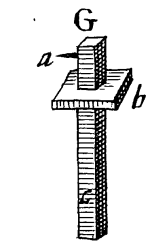
This is a French style tool. The thin stock and square shaft also appear in this illustration from André-Jacob Roubo's l'Art du Menuisier of 1761:
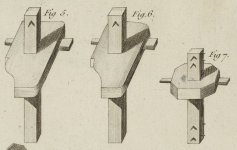
(L'art du menuisier... par M. Roubo le fils,.... Partie 1 by Roubo, André Jacob (1739-1791). Auteur du texte - National Library of France, France - No Copyright - Other Known Legal Restrictions.)
 www.europeana.eu
but the gauges shown there clearly have wedges, at right angles to the shafts. Interesting designs, with their wide stocks, but with no thumbscrews.
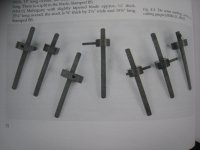
In England, the Seaton Chest of 1797 contains seven marking and cutting gauges, but they are all made to use wedges for setting the width.

My search for historic images runs a bit dry at this point.
One of the earliest - and prettiest - tool catalogues is Joseph Smith's 1816 Explanation or Key, to the various manufactories of Sheffield which was the forerunner of the Illustrated Sheffield List. This was a general catalogue used by many manufacturers. There's a really good scan here https://www.europeana.eu/en/item/9200518/ark__12148_btv1b8529037p or a straight pdf here https://archive.org/details/explanation-or-key-to-manufactories-of-sheffield.
Here's the page of gauges:

which is unfortunately not as clear as you might like. There are thumbscrews at last, but they look a bit too weedy to be made of wood. Maybe they were brass? They do look about the same size as the ones on the end-adjustable mortise gauge.
While we are on the subject of nicely illustrated early catalogues, I'll mention another, even though it's not English. It's from le Chevalier de Wertheim, an Austrian manufacturer and was published in French in 1869 as a catalogue to accompany a display of tools which was shown at various big trade exhibitions. It was also a sort of lavish reference book for students with 45 plates, 18" by 24", containing 1081 pictures and measured drawings. It's a very rare book; only a couple of copies are known. It shows tools for many woodworking trades - cabinetmaker, turner, cooper, wheelwright, carver, mechanic and covers a huge range of specialised planes, saws, chisels and so on. Volume one is the descriptive text, Volume two is the illustrations. The original is in the collection of the University of Princeton, who have digitised it and made it available, which is a good thing.
(I read about this on Joel Moskowitz's excellent blog here where I also learned that our own London Science Museum used to own the displays of tools but dismantled them and sold them off in the 20th century )
)
Here's the picture of marking gauges.

There's a mixture of continental and British styles there but the point of including it is to show that the thumbscrew on Fig 23 is definitely a brass one, not a wooden one, so my guess about the ones in Smith's Key might be ok.
I'll get onto later pictures, but the image limit is now 10, so I'll do that in a second post.
Rather than clutter up that thread with a long digression, I thought I'd start a fresh one and see if anyone can come up with an explanation that we all like.
Let's start with some history and some pictures.
I think the most comprehensive history of woodworking tools is still Bill Goodman's , from 60 years ago. He refers to this 1607 Dutch engraving by Hieronymus Wierix (used on the cover of his book) as including the earliest known illustration of a marking gauge, .
(Engel met een doek vol gereedschap - 1617 - Rijksmuseum, Netherlands - Public Domain.
If you zoom in on the full image, you can see the tool in question, ready for use:
but there's no visible means of fixing the setting.
In his Mechanic Exercises, first published in London in 1680, Joseph Moxon wrote about how to use a "gage" in which the oval stock was "fitted stiff upon the Staff" and adjusted by knocking it on the bench. So it seems that some early gauges did lack any sort of locking mechanism and perhaps the Dutch used that sort in Wierix's time.
The illustrations of tools in Moxon are not always a good match for the text - as he lifted some of them from a 1670 French work by Andre Felibien. His picture of the gauge shows a tool with a thin square stock, not an oval one:
This is a French style tool. The thin stock and square shaft also appear in this illustration from André-Jacob Roubo's l'Art du Menuisier of 1761:
(L'art du menuisier... par M. Roubo le fils,.... Partie 1 by Roubo, André Jacob (1739-1791). Auteur du texte - National Library of France, France - No Copyright - Other Known Legal Restrictions.)
L'art du menuisier... par M. Roubo le fils,.... Partie 1
Collection : Descriptions des arts et métiers, faites ou approuvées par MM. de l'Académie royale des sciences
but the gauges shown there clearly have wedges, at right angles to the shafts. Interesting designs, with their wide stocks, but with no thumbscrews.
In England, the Seaton Chest of 1797 contains seven marking and cutting gauges, but they are all made to use wedges for setting the width.
My search for historic images runs a bit dry at this point.
One of the earliest - and prettiest - tool catalogues is Joseph Smith's 1816 Explanation or Key, to the various manufactories of Sheffield which was the forerunner of the Illustrated Sheffield List. This was a general catalogue used by many manufacturers. There's a really good scan here https://www.europeana.eu/en/item/9200518/ark__12148_btv1b8529037p or a straight pdf here https://archive.org/details/explanation-or-key-to-manufactories-of-sheffield.
Here's the page of gauges:
which is unfortunately not as clear as you might like. There are thumbscrews at last, but they look a bit too weedy to be made of wood. Maybe they were brass? They do look about the same size as the ones on the end-adjustable mortise gauge.
While we are on the subject of nicely illustrated early catalogues, I'll mention another, even though it's not English. It's from le Chevalier de Wertheim, an Austrian manufacturer and was published in French in 1869 as a catalogue to accompany a display of tools which was shown at various big trade exhibitions. It was also a sort of lavish reference book for students with 45 plates, 18" by 24", containing 1081 pictures and measured drawings. It's a very rare book; only a couple of copies are known. It shows tools for many woodworking trades - cabinetmaker, turner, cooper, wheelwright, carver, mechanic and covers a huge range of specialised planes, saws, chisels and so on. Volume one is the descriptive text, Volume two is the illustrations. The original is in the collection of the University of Princeton, who have digitised it and made it available, which is a good thing.
(I read about this on Joel Moskowitz's excellent blog here where I also learned that our own London Science Museum used to own the displays of tools but dismantled them and sold them off in the 20th century
)Here's the picture of marking gauges.
There's a mixture of continental and British styles there but the point of including it is to show that the thumbscrew on Fig 23 is definitely a brass one, not a wooden one, so my guess about the ones in Smith's Key might be ok.
I'll get onto later pictures, but the image limit is now 10, so I'll do that in a second post.







 - Rob
- Rob

