• Hi all and welcome to TheWoodHaven2 brought into the 21st Century, kicking and screaming! We all have Alasdair to thank for the vast bulk of the heavy lifting to get us here, no more so than me because he's taken away a huge burden of responsibility from my shoulders and brought us to this new shiny home, with all your previous content (hopefully) still intact! Please peruse and feed back. There is still plenty to do, like changing the colour scheme, adding the banner graphic, tweaking the odd setting here and there so I have added a new thread in the 'Technical Issues, Bugs and Feature Requests' forum for you to add any issues you find, any missing settings or just anything you'd like to see added/removed from the feature set that Xenforo offers. We will get to everything over the coming weeks so please be patient, but add anything at all to the thread I mention above and we promise to get to them over the next few days/weeks/months. In the meantime, please enjoy!

Application of Glue

Andy Kev.

Nordic Pine
Joined
Jan 4, 2021
Messages
681
Reaction score
36
Today I had to glue up four bits of beech i.e. two glue ups each of two pieces, each freshly planed flat. I had recently taken delivery of new glue: a bottle of Titebond III and a bottle of Titebond Liquid Hide Glue. The latter is my usual glue of choice because of the longer open time. On the bottle of the III it said apply it liberally, so I did and as expected there was squeeze out every where and the two pieces slipped around a bit when clamping. Nonetheless it did the job.

With the liquid hide glue I applied it thinly but evenly. The two pieces almost sucked onto each other and I had to use light hammer taps to align them. They were stable while clamping and this job was also done. There was also virtually zero squeeze out.

Then I remembered something I was told by the teacher on the only woodwork course I've ever managed to attend. He pointed out that glue bonds at the molecular level and so theoretically for two perfectly flat surfaces, you only need a molecular thick layer of glue. Obviously some woods plane smoother than others but the thinnest coat - being inevitably many millions of molecules thick - will always be approximately the same. This thin spreading of liquid hide glue is what I've usually used in the past and it has never let me down. In the light of this comparative test, I shall be sticking to that.

Any thoughts?
 
I tend to work with what I was always taught - if you don't put enough in, you can't put it in afterwards. So what if you squeeze the excess out?

As an aside - manufactures usually specify with PVA to apply to one side only. I've never heard a valid reason for this.
 
Only tried one bottle of Titebond and thought it was horribly messy stuff, so very runny compared to Evostick, I only tried it after everyone on here using it. Happy with my thicker Evostick and never had a failure.
Must say I haven’t tried hide glue — yet! But it sounds promising.
Ian
 
I tend to work with what I was always taught - if you don't put enough in, you can't put it in afterwards. So what if you squeeze the excess out?

As an aside - manufactures usually specify with PVA to apply to one side only. I've never heard a valid reason for this.
Yes I have read that too.

I once visited Bolton and Paul (They were a huge wooden window, door and stair manufacturer) I saw them assemble window joints by dipping the joints into a tub of what looked like PVA so it seems like nobody takes any notice of... Apply the glue to one side only!
 
I hate squeeze-out, so apply the absolute bare minimum of glue (I always use a brush)..........and I don't use Titebond. It's just too thin for my taste.
 
I've been happily using the liquid hide glue for years and agree with what you wrote about the economy, grippiness and tidiness in use.

I've got some PVA in case I'm working in a hurry but don't often need it.
 
You can certainly have too much glue, because glue is a liquid and obviously incompressible if you put too much glue in a lamination for instance and you can't get enough pressure to "squeeze" the excess glue out of the joint you can end up with quite a thick glue line which can be a problem depending on the glue and the application.
 
I've not understood the fascination with Titebond when Everbuild 502 and D4 are so much cheaper.
Everbuild glues are excellent (D4 especially) but there's one huge hefalump in the room; they have a remarkably short shelf life and if not used will turn horribly lumpy in the bottle. I can't recount the number of times I've had to bin a partly used litre bottle of D4. On the other hand, if you have an application that uses a lot of the stuff relatively quickly, 'tis ideal; veneering boards for a project is a case in point. For that reason, I've given up the ghost on using Everbuild D4 and have reverted to TB3, which will last up to 10 years if stored in a cool environment - Rob

Edit - Mike G; saw one of Cosman's videos where he uses the bare minimum of glue but applies it with a small artist's paint spatula, which looked an interesting proposition as he appeared to apply the stuff more accurately than using a paintbrush.
 
Shelf life is the big thing for me too - with the very limited time I get to spend in the workshop, I'm on my second bottle of TB2 in the last five years. Even ignoring the wastage that would come with a shorter shelf-life, there's a lot of value in just knowing that I've got glue when I need it. If I had to abort a glue up because the glue's gone lumpy, it might be a week or more before I can get back to continue it, so it's worth the money for me just to avoid that happening.

As for applying thin layers, I have one of these things bought from I can't remember where, but it's convenient for being able to apply relatively liberally with the brush end and very thinly with the flat end. The dry glue just peeling off afterwards with no washing required is a bonus.
 
...

As for applying thin layers, I have one of these things bought from I can't remember where, but it's convenient for being able to apply relatively liberally with the brush end and very thinly with the flat end. The dry glue just peeling off afterwards with no washing required is a bonus.
I got a nifty red one from Axminster. Highly recommended.
 
There is 5 of us at times.:)
But then I have not included the mini magnum sticks that have rounded ends that are not well suited for glue spreading. They end up as kindling.
 
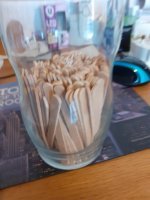
I just paid £6 or whatever it was for a thousand lolly sticks. More than enough for my lifetime. Kebab skewers, cotton buds and toothpicks are useful as well.
 
wudcare PVA is my favourite, haven't had an issue with shelf life if it's kept indoors, I don't see the point in paying more for tightbond.
 
Presumably something like Cascamite (now that it's allegedly back to the old recipe - I still haven't tried the free sample they sent me) is good for shelf life?
 
Am I the only one who doesn't care about glue? I used hide glue once, for repairing some antique chairs. Apart from that I use whatever wood glue I pick up at the local store and don't have glue problems. My theory is that these days any brand is good enough to meet my needs.
 
I have been using Gorilla Glue ex USA, about 90% waterproof, on all the beehives.

Then local shed ran out of stock and I had to use some local stuff, also ‘waterproof’.

Not been able to source hide locally.

Generally use 3mm baboo skewers, gets the glue into the dowel holes and biscuit slots. Bought a silicone brush same as SPB’s for the Ash joining. A real treat.

Tend not to keep a bottle older than 9 months, only buy the large 18oz or 500ml. Each one gets marked with date of purchase. Also check the manufacturer dates on the bottle.

Applying – do not skimp on the glue, once clamped wipe off excess with damp cloth then after 30 mins loosen clamps and clean both sides before clamping again.
 
Doesn't anyone use a roller to apply glue. If done right, you can get almost exactly the same amount evenly on both surfaces.

Learnt that from applying printers ink on to a a copper block to take fingerprints. ;)
 
Doesn't anyone use a roller to apply glue. If done right, you can get almost exactly the same amount evenly on both surfaces.

Learnt that from applying printers ink on to a a copper block to take fingerprints. ;)
I've tried in the past, but used the wrong sort of roller - it was a paint roller (all I had) and soaked up most of the glue!

I think it needs to be a less porous roller for glue but I've never got round to finding one. I think they'd be really useful for gluing big areas.
 
I think I'd quite like to have a little roller. I presume they are made of hard rubber. Do any of the online dealers stock them?

At the moment I mostly use whatever tiny offcut comes to hand e.g. a 3" x 1" x 1/4" piece of pine. It produces quite an even coating. Lolly sticks are definitely very good, though.
 
Most of my gluing work with the instruments is quite narrow, so I use a wallpaper roller, about 40mm wide.

If you just g00gle 'wallpaper roller', you'll find others of different materials or wider.

I keep mine in a cup of water so that the glue comes off i it, and just wipe the roller before gluing next.
 
I 'acquired' wooden coffee/tea stirring sticks as well which can be easily sharpened to a point with a craft knife. Magnum sticks are preferable though;) - Rob
It is only the full sized Magnum sticks that are straight and I am not allowed to eat that much ice cream in one go.:(
 
As a postscript to this, a couple of days ago I stumbled on this:


and bought the fourth item down on the list. It's a glue applying kit which will meet all my needs for ever, unless I suddenly develop the urge to glue largish pieces of sheet goods to each other. Definitely recommended. I don't know if it's available in the UK (perhaps on Amazon?).
 
As a postscript to this, a couple of days ago I stumbled on this:


and bought the fourth item down on the list. It's a glue applying kit which will meet all my needs for ever, unless I suddenly develop the urge to glue largish pieces of sheet goods to each other. Definitely recommended. I don't know if it's available in the UK (perhaps on Amazon?).
I've got the fourth item as well as the first one (available on Amazon) and they're excellent. Interestingly Rob Cosman uses a small artists palette knife to apply glue to say, dovetails rather than a paintbrush as I do. Can't see that it make a lot of difference - Rob
 
I've got the fourth item as well as the first one (available on Amazon) and they're excellent. Interestingly Rob Cosman uses a small artists palette knife to apply glue to say, dovetails rather than a paintbrush as I do. Can't see that it make a lot of difference - Rob
I've only used my new kit once but I immediately went to the palette end of the brushes as opposed to the brushes themselves. For small surfaces - in this case the walls of small mortices - they were perfect. I'll probably use the brush ends for somewhat larger surfaces.
 
P.S. We've been here before and I think it was Doug who shot down the IKEA number as not standing up to professional use, so as he earns his crust that way, I yielded. But, I am a lumbering, slow amateur and my two are now going on eight years old...and still intact.
 
Back
Top