Eric the Viking
Nordic Pine
- Joined
- Dec 10, 2020
- Messages
- 923
- Reaction score
- 372
Around 17 years ago, I scored a big assortment of hardwood offcuts, from a local furniture restorer who was retiring. I filled my long wheelbase Landrover (having removed the middle row seats!), and it was well down on the springs once I'd loaded it. He wouldn't take much money for it - strangely I was the only person who'd responded to his advert.
Roll on to now and I need to make a new threshold strip for our front door. We've redone the hall floor and the door, which is probably about 110 years old now, has acquired 1 3/4" of gap under it. Which is draughty...
So I did what I usually do: go up in the attic and find something suitable from the various piles in-stick up there.
I found what I thought was the perfect piece, of teak, I think (nothing is labelled!). It was filthy, and obviously only rough sawn (still had the mill's stencil on it, which stupidly I planed away before photos). It was the right size and shape and wonderfully straight
So I dragged the P/T out of its dark corner, and, thanks to Dr. AI of this parish, fitted a fresh set of sharp knives (not for long - it's teak after all!). And what was revealed was very pretty - if you like Teak, which I do.
It only needed about 3mm off the worst side to remove the saw marks and water stains entirely. I got a bit of tearout as there's the corner of a knot right at one end, but it's teak, after all, and that'll be hidden underneath.
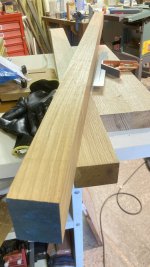
It's the piece on top in the picture, and it's much nicer still in real life. The shine is straight off the thicknesser, no sanding or finish. The other bits underneath are AWO, for another project (while I had the P/T out, etc.). Apart from posing for the camera they'll play no further part in the story.
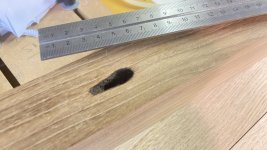
I'd noticed a hole in one side of the teak, when I found it up in the attic, but I thought it was simply where a dead knot had dropped out. It's keyhole-shaped and about 1" long by 5/8" wide at the widest part. I was intending to drill it out and plug it, after all, that'll be hidden by the doormat.
After planing, the hole was rather more obvious, and I thought I should investigate a bit further. It's rough sided, a bit like the surface of a coconut and quite a bit darker than the surrounding wood.
The odd thing about the whole piece of stock was that the knot didn't run all the way through - there ought to be some evidence on the other side, Shirley?
Up close it didn't look quite how I imagined a dead knot might look in teak...
... nah, it couldn't be very deep. I still have enough waste, if I'm careful moulding it, to make a plug from the same piece, but it'll have to be a bit bigger than I thought. Oh foolish man!
I tapped it, hole downwards on the concrete: sawdust (and probably frass) came out. Groan.
The only things usefully to hand were a couple of cable ties, but it was obvious what I really needed was a wire rope ladder and my old caving helmet. Here's the result:
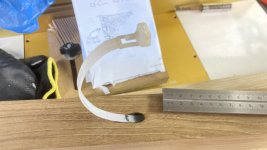
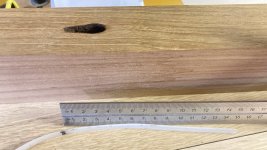
Yes, that's 150mm. And it's apparently wider at the end, and goes on a bit further too (I found some galvanised wire to experiment with after the pic.). To make matters worse, it's on an angle. I was planning to take a chunky rebate out for the door itself, but that'll be chunkier still if I'm not careful.
So what the heck was it that likes teak so much for breakfast? Thankfully it probably died in the South American saw mill - I could find no trace of eggs nor corpses inside. But the planer knives didn't stay sharp for all four sides - that's only about 17 linear feet, so how could anything actually want to eat the stuff?
Regarding the threshold, I'll probably have to hove over to Robbins and shell out for some Sapele or similar. I might try to finish machining it but, infuriatingly, the hole is almost exactly central in one of the narrower sides. I might get lucky and miss the damaged part when doing the rebate, but it's pretty unlikely.
You're a well-travelled bunch: does anyone know what the culprit might be?
And has anyone got any bright ideas as to how I might deal with the damage neatly? I'm wondering about using a 1/2" plunge bit to cut out as much as possible and let in some more teak, but as I said, I probably won't have a good match. At least it's not loadbearing or otherwise structural, and it would be a shame to waste it...
E.
Roll on to now and I need to make a new threshold strip for our front door. We've redone the hall floor and the door, which is probably about 110 years old now, has acquired 1 3/4" of gap under it. Which is draughty...
So I did what I usually do: go up in the attic and find something suitable from the various piles in-stick up there.
I found what I thought was the perfect piece, of teak, I think (nothing is labelled!). It was filthy, and obviously only rough sawn (still had the mill's stencil on it, which stupidly I planed away before photos). It was the right size and shape and wonderfully straight
So I dragged the P/T out of its dark corner, and, thanks to Dr. AI of this parish, fitted a fresh set of sharp knives (not for long - it's teak after all!). And what was revealed was very pretty - if you like Teak, which I do.
It only needed about 3mm off the worst side to remove the saw marks and water stains entirely. I got a bit of tearout as there's the corner of a knot right at one end, but it's teak, after all, and that'll be hidden underneath.
It's the piece on top in the picture, and it's much nicer still in real life. The shine is straight off the thicknesser, no sanding or finish. The other bits underneath are AWO, for another project (while I had the P/T out, etc.). Apart from posing for the camera they'll play no further part in the story.
I'd noticed a hole in one side of the teak, when I found it up in the attic, but I thought it was simply where a dead knot had dropped out. It's keyhole-shaped and about 1" long by 5/8" wide at the widest part. I was intending to drill it out and plug it, after all, that'll be hidden by the doormat.
After planing, the hole was rather more obvious, and I thought I should investigate a bit further. It's rough sided, a bit like the surface of a coconut and quite a bit darker than the surrounding wood.
The odd thing about the whole piece of stock was that the knot didn't run all the way through - there ought to be some evidence on the other side, Shirley?
Up close it didn't look quite how I imagined a dead knot might look in teak...
... nah, it couldn't be very deep. I still have enough waste, if I'm careful moulding it, to make a plug from the same piece, but it'll have to be a bit bigger than I thought. Oh foolish man!
I tapped it, hole downwards on the concrete: sawdust (and probably frass) came out. Groan.
The only things usefully to hand were a couple of cable ties, but it was obvious what I really needed was a wire rope ladder and my old caving helmet. Here's the result:
Yes, that's 150mm. And it's apparently wider at the end, and goes on a bit further too (I found some galvanised wire to experiment with after the pic.). To make matters worse, it's on an angle. I was planning to take a chunky rebate out for the door itself, but that'll be chunkier still if I'm not careful.
So what the heck was it that likes teak so much for breakfast? Thankfully it probably died in the South American saw mill - I could find no trace of eggs nor corpses inside. But the planer knives didn't stay sharp for all four sides - that's only about 17 linear feet, so how could anything actually want to eat the stuff?
Regarding the threshold, I'll probably have to hove over to Robbins and shell out for some Sapele or similar. I might try to finish machining it but, infuriatingly, the hole is almost exactly central in one of the narrower sides. I might get lucky and miss the damaged part when doing the rebate, but it's pretty unlikely.
You're a well-travelled bunch: does anyone know what the culprit might be?
And has anyone got any bright ideas as to how I might deal with the damage neatly? I'm wondering about using a 1/2" plunge bit to cut out as much as possible and let in some more teak, but as I said, I probably won't have a good match. At least it's not loadbearing or otherwise structural, and it would be a shame to waste it...
E.
Last edited: