Raymedullary
Sapling
- Joined
- Jan 20, 2020
- Messages
- 322
- Reaction score
- 86
I would do it for the offcuts.


Yes, I get that. I was talking really about garden volunteers. The National Trust for example depends on large numbers of volunteers and in many cases is exploitative.All my labour is unpaid. Always. I've no problem with that.
Ditto canal and rivers trust...Yes, I get that. I was talking really about garden volunteers. The National Trust for example depends on large numbers of volunteers and in many cases is exploitative.
Mike, I love Thames Barges. I seriously considered building one of them before I decided on a Norfolk Wherry instead.I rode down to Maldon yesterday, and there were 7 Thames Sailing Barges on the quayside. I know they're not Norfolk Wherries, but they were also tough working boats designed with simplicity and robustness in mind, and to be operated by a crew of only two. I got chatting with one of the guys who suggested I volunteer with them. They do lots of restoration work in the winters, and accomodation is provided over the weekends on one of the boats. It'd get me out of the house.....
It seems to be a controversial method for some, as it's not the traditional steam box, but I find that it works brilliantly, particularly because of the plank already being in situ. Not sure how I'm going to do it for the wherry planking though, haven't decided yet.Fascinating to see you steam bend that blank in situ.

It wastes a bit more than a bandsaw blade, but somehow I haven't met anyone with a mobile bandsaw mill, only chainsaw mills. The one in Norfolk left a rather rough finish, but Ollie's set-up was very smooth, so there wasn't too much wasted, which was nice.I’m somewhat amazed/surprised that you do so much milling with a chain saw. It obviously works for you though.

Very interesting to see the work and progress Don.In the latest episode of Building Lady Garnet, we're milling oak planks for my 48-foot trading wherry, and steaming timbers into the 9-foot dinghy.
Thanks Robert! That's a very good question, it's been a bit hit and miss at times. Maybe 17 hours a week at best? I haven't really kept track!Very interesting to see the work and progress Don.
I expect it’s easier getting on with things in the summer months. How many hours per week are you spending on it?
Cheers
Robert
I don't have one myself, but my mate Ollie has a mobile sawmill which has been very handy!Have you thought about getting a mobile sawmill to cut up your logs - would be alot more efficient use of time and materials?

Thank you! That is very encouraging to hear.This particular member of your audience doesn’t find it hard to be sustained.
Thank you, I must admit that I was surprised at how much time and effort was needed just to sort the oak for the build... and all that oak will only take me to roughly halfway through the planking! I take Sunday as my day of rest, but otherwise, I try to keep at it as much as possible. I work part time at the boatyard for my proper job, 3 to 4 days a week, but on those days, I try to do an hour or two of work on the wherry after I finish work at 4. That's probably the hardest time, if I'm honest. On the days when I can spend the whole day on the wherry, I really get into a groove and I don't want to go home at the end of the day! But I have to, because I do video editing in the evenings!I already had some idea that boat building needs tons of wood and megatons of effort. My view is being ably reinforced by the engagingly told story so far!
Don, I hope you don't have to work in the 30°+ heat and can allow yourself some time off occasionally.

I may be able to move it to a better location at some point, but right now I am very limited for space. The yard has already been very kind with how much space they've allowed me to use for timber storage, and I think on top of the containers was really the only option. It is covered on top and partially down the sides with corrugated bitumen.One observation I do have though, from your last video, is putting that Oak beam up on the container, that's a far from ideal situation, I fear that it will dry out, shake and crack, making it unusable in the long run, all my big Oak, I keep in my cart shed, out the direct sun and covered up to negate it drying too rapidly:
View attachment 34234
Very good question. My wherry will have an additional "slipping keel" which will be bolted onto the underside of the oak keel which I'm scarphing in the video. The slipping keel, as the name suggests, is easily removable if the wherry needs to go into shallower water. Traditionally it would be made of pine; however, I am considering having a metal slipping keel for extra ballast. But that is very much undecided at the moment!You probably covered this in an earlier video Don, but is there a lead ballast keel on the wherry?
I didn't know that. So the wherry would have to be grounded and tipped on it's side to get the keel off? I'm wondering what the advantage is over having removable ballast immediately above and around the keel but inside the hull? I realise that there would be a slight difference of centre of gravity, but not enough to make a difference in a broad beam boat designed to operate in shallow water?Very good question. My wherry will have an additional "slipping keel" which will be bolted onto the underside of the oak keel which I'm scarphing in the video. The slipping keel, as the name suggests, is easily removable if the wherry needs to go into shallower water. Traditionally it would be made of pine; however, I am considering having a metal slipping keel for extra ballast. But that is very much undecided at the moment!
Actually, the slipping keel is designed to be taken off (and put back on again) while the wherry is still in the water. The slipping keel is attached with three bolts, you remove those long bolts to release the keel and then quickly put in shorter bolts to replace them. Putting it back on seems like it would be more difficult! There were lines on one end and a metal keel band on the other than you lined up on the stem and stern, which should put the slipping keel in the right place to take the long bolts. According to Roy Clark, who wrote the definitive book on wherries, a good wherryman could do it without letting in more than a bucketful of water for each bolt.I didn't know that. So the wherry would have to be grounded and tipped on it's side to get the keel off? I'm wondering what the advantage is over having removable ballast immediately above and around the keel but inside the hull? I realise that there would be a slight difference of centre of gravity, but not enough to make a difference in a broad beam boat designed to operate in shallow water?
 I learn something daily.
How did they manage to sink it under the yacht and line up the bolt holes?!Actually, the slipping keel is designed to be taken off (and put back on again) while the wherry is still in the water. The slipping keel is attached with three bolts, you remove those long bolts to release the keel and then quickly put in shorter bolts to replace them. Putting it back on seems like it would be more difficult! There were lines on one end and a metal keel band on the other than you lined up on the stem and stern, which should put the slipping keel in the right place to take the long bolts. According to Roy Clark, who wrote the definitive book on wherries, a good wherryman could do it without letting in more than a bucketful of water for each bolt.
Regarding the ballast, since my ambitious plan is to use Lady Garnet to transport cargo on the Thames, I have to think about modern regulations, which will not allow a cargo vessel to heel over a certain percentage (7%, I think?). Of course, those regs are not about sailing vessels (in fact, there are currently no regulations written for UK inland waterway sailing cargo vessels) but the authorities will probably still apply them to Lady Garnet. So when they do the stability test, Lady Garnet needs to be ballasted enough to stop her heeling past that percentage. A metal slipping keel, rather than a pine one, might make that crucial difference. When is comes to removable ballast inside the boat, I don't think it achieves that same level of stability as the slipping keel, pound for pound, because in addition to the weight being lower down, the slipping keel also provides extra surface area against the water, further preventing the boat from heeling. Also, there are regulations about the height of the deck above the waterline. Putting in enough ballast to achieve the same stability as a metal keel would add a greater amount of weight, which in turn would sink her lower in the water, meaning the wherry would have to carry less cargo to obey the rules on freeboard. Unless the authorities agreed that when carrying cargo, the ballast could be removed and the weight of the ballast added to the allowed tonnage. But I'm not sure they'd agree to that.
As I said, it's all still very undecided. But the slipping keel is the last part of the boat to be made, so I have a few years to figure it out! I'd much rather make it from wood, of course.
They would push it under with a boathook. Then you lined the metal bands on the stem and sternpost in place, and at that point, the keel "should" be in the right position under the boat. Then you went into the hold, removed the first bolt, and put in the longer bolt... and hoped that it would go in! I don't intend to be taking the slipping keel on and off any more than is absolutely necessary, that's for sure!How did they manage to sink it under the yacht and line up the bolt holes?!
Where did you learn your boat building skills?I've switched over to working on the nine-foot dinghy, which will be the tender for the wherry, in this episode. The dinghy is in the way where it is in the tent, so I need to get it finished!
The International Boatbuilding Training College in Lowestoft... now sadly closed down.Where did you learn your boat building skills?

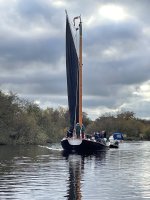

Thanks Don. If (as I'm sure you will) you can get another beautiful craft like that on the water, then you'll have done a wonderful thing!Beautiful! That's the wherry Maud, the only clinker-planked trading wherry afloat... for the moment, that is. Lady Garnet will double the number in a few years! I've never sailed on Maud, but she is a lovely-looking craft. She isn't as well known as the Albion, the carvel-planked wherry that I crew on, but Maud does tend to sail much later into the year. Albion stops sailing at the end of September, I believe.
