
-
Hi all and welcome to TheWoodHaven2 brought into the 21st Century, kicking and screaming! We all have Alasdair to thank for the vast bulk of the heavy lifting to get us here, no more so than me because he's taken away a huge burden of responsibility from my shoulders and brought us to this new shiny home, with all your previous content (hopefully) still intact! Please peruse and feed back. There is still plenty to do, like changing the colour scheme, adding the banner graphic, tweaking the odd setting here and there so I have added a new thread in the 'Technical Issues, Bugs and Feature Requests' forum for you to add any issues you find, any missing settings or just anything you'd like to see added/removed from the feature set that Xenforo offers. We will get to everything over the coming weeks so please be patient, but add anything at all to the thread I mention above and we promise to get to them over the next few days/weeks/months. In the meantime, please enjoy!
You are using an out of date browser. It may not display this or other websites correctly.
You should upgrade or use an alternative browser.
You should upgrade or use an alternative browser.
"Chewed wires caused blaze". Myth or truth
- Thread starter RogerS
- Start date


Steve Maskery
Old Oak
Not sure about that Roger.
There must be a micromoment between shorting and tripping which could be enough to spark.
Slight, I grant you.
S
There must be a micromoment between shorting and tripping which could be enough to spark.
Slight, I grant you.
S

Mike G
Petrified Pine
I still find fuses in some of the buildings I visit. I'm sure most of us have seen sockets wired off lighting circuits. I'm sure there must be thousands of buildings where the earth spike has been pulled out to clear a way for an extension, or some paving. In a newly-wired modern home you'd be pretty certain to be right, but most of our building stock is old, and much of it improperly maintained.I really don't buy this suggestion as a cause of fires. If they chew through the insulation then the wires short, the MCB blows. No fire.
Steve Maskery
Old Oak
My barns are all fuse-protected. We do have MCBs in the house itself.
S
S
Spectric
Sapling
If damaged or worn insulation can cause fires, chaffed wiring has caused fires in avionics and industry then a rodent is doing no more than causing damage to the insulation and or the conductors which could be reducing the csa of that wire. If the wiring is protected by a 20 amp type B MCB then you need at least three times that rated current to cause it to open which means a short not a partial short that is flowing just say 10 amps and this could be enough to produce sufficient heat to ignite some materials. This is why you have photoelectric smoke detectors which being optical are particularly effective at detecting slow smouldering fires often caused by overheated wiring.

Trevanion
Old Oak
On modern systems, there are failsafes. On old systems, anything could happen.
A few years ago, I was being electrocuted in the shower because the neighbours had some dodgy electrical work done outside which had gotten wet and was sending voltage down the earth line on our shared transformer, and then through our bonded pipes to the shower fittings.
A few years ago, I was being electrocuted in the shower because the neighbours had some dodgy electrical work done outside which had gotten wet and was sending voltage down the earth line on our shared transformer, and then through our bonded pipes to the shower fittings.
HappyHacker
Sapling
I did an electrical inspection on a building and failed it on a low insulation resistance on most of the circuits. Further inspection revealed squirrels has been eating the insulation where the cables ran through the void under the roof. The photo shows the state of part of the wire on just one of the circuits.
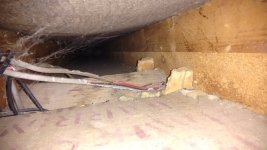 The circuits were protected by MCBs and none had tripped. In this case the conductors have maintained their separation. I can't remember what the insulation resistance was and my old computer refuses to display the original report so I can't see it but it will have been less than 1 MOhm.
The latest wiring regs would like us to install Arc Fault detectors to trip if there is any arcing on a circuit in order to stop fires so it must be a possibility. Cynicism aside I have seen overheated connections causing melted blobs of choc connectors but they have usually tripped the MCBs before the fire started so I would suspect that if the conditions were right chewing could allow sufficient current to flow to cause a fire especially if the rodent became part of the circuit.
The circuits were protected by MCBs and none had tripped. In this case the conductors have maintained their separation. I can't remember what the insulation resistance was and my old computer refuses to display the original report so I can't see it but it will have been less than 1 MOhm.The latest wiring regs would like us to install Arc Fault detectors to trip if there is any arcing on a circuit in order to stop fires so it must be a possibility. Cynicism aside I have seen overheated connections causing melted blobs of choc connectors but they have usually tripped the MCBs before the fire started so I would suspect that if the conditions were right chewing could allow sufficient current to flow to cause a fire especially if the rodent became part of the circuit.

Sheffield Tony
Nordic Pine
If your rodent creates a circuit to earth on a circuit protected by an ELCB, it should trip the ELCB fairly uneventfully. If it is on a circuit not protected by an ELCB (eg, an older lighting circuit, quite likely in a loft space), or makes a circuit from Live to Neutral without connecting to earth, even on an 8A MCB your rodent can dissipate 2KW without tripping the MCB. I would imagine it would get pretty hot.
Sheffield Tony
Nordic Pine
Oh, and for some strange reason squirrels are really fond of PVC.
SamQ aka Ah! Q!
Old Oak
Guinea pigs too....Oh, and for some strange reason squirrels are really fond of PVC.

Trevanion
Old Oak
Oh, and for some strange reason squirrels are really fond of PVC.
Squirrels, rats, and other rodents gnaw on cables mostly because they are sharpening and reducing the length of their ever growing teeth rather than "eating" the cable.
For a time they were putting pesticide in the sheathing of the cable to help prevent this, but they found rats were just spitting out the sheathing anyway and so the poison had little to no effect.