• Hi all and welcome to TheWoodHaven2 brought into the 21st Century, kicking and screaming! We all have Alasdair to thank for the vast bulk of the heavy lifting to get us here, no more so than me because he's taken away a huge burden of responsibility from my shoulders and brought us to this new shiny home, with all your previous content (hopefully) still intact! Please peruse and feed back. There is still plenty to do, like changing the colour scheme, adding the banner graphic, tweaking the odd setting here and there so I have added a new thread in the 'Technical Issues, Bugs and Feature Requests' forum for you to add any issues you find, any missing settings or just anything you'd like to see added/removed from the feature set that Xenforo offers. We will get to everything over the coming weeks so please be patient, but add anything at all to the thread I mention above and we promise to get to them over the next few days/weeks/months. In the meantime, please enjoy!

Mike builds a teardrop (cedar detail)

In a couple of ways, at least. Firstly, I'll do a split charge system from the car alternator, so that once the car battery is fully recharged it can put its output into the leisure battery whilst driving. Secondly, there'll be a shore-power connection to enable 240 volts to come in to a charger on board. This will be the 240 volt system's only role. Nothing will run on mains. Finally, I am still umming and ah-ing over solar. A fixed panel may not be well oriented, and may be an annoyance when choosing orientation when setting up camp. It won't help when parked up between trips, as the camper will be kept in a garage.


No. There'll be no need for an inverter.


Interesting. I didn't know any of that. But yes, I'd want a gauge to show me the state of the charge.
Coulomb counter from AliExpress is what I use in my solar powered shed. Less than £30 IIRC . I believe some LiFePO4 batteries have SOC indicators built-in, but I don't know if they'd be accessible/visible in your application.
I had two 120ah lead acid batteries in my shed set-up, lasted less than two years, and even when new the useable capacity was about half the rated capacity. Now have a single 24v 100ah LiFePO4 and it was the best £400 I spent that year, and will probably see me out.
Unlike your common or garden Lithium batteries, they don't catch fire either. Which is nice.
 
In a couple of ways, at least. Firstly, I'll do a split charge system from the car alternator, so that once the car battery is fully recharged it can put its output into the leisure battery whilst driving. Secondly, there'll be a shore-power connection to enable 240 volts to come in to a charger on board. This will be the 240 volt system's only role. Nothing will run on mains. Finally, I am still umming and ah-ing over solar. A fixed panel may not be well oriented, and may be an annoyance when choosing orientation when setting up camp. It won't help when parked up between trips, as the camper will be kept in a garage.


No. There'll be no need for an inverter.


Interesting. I didn't know any of that. But yes, I'd want a gauge to show me the state of the charge.
Irrc 12v is 50% of charge about the empty capacity level on an LA battery.
 
I did a bit of an electrical upgrade on the old caravan last year. It never had a split charge from the car battery or even a charge from 240V we always had to charge via a separate battery charger. Anyway when we did it we also installed a cable and plug mounted underneath and out the back ready to plug in a solar panel (funds couldn't stretch when we did the electrical). We didn't want to fix anything through the van, and a spearate panel had the advantage for us of being moveable. Only downside is it's another thing to store inside when travelling but it's thin! Might be worth considering? It was a specific plug we installed and for the life of me I can't remember what it was called.
 
I did a bit of an electrical upgrade on the old caravan last year. It never had a split charge from the car battery or even a charge from 240V we always had to charge via a separate battery charger. Anyway when we did it we also installed a cable and plug mounted underneath and out the back ready to plug in a solar panel (funds couldn't stretch when we did the electrical). We didn't want to fix anything through the van, and a spearate panel had the advantage for us of being moveable. Only downside is it's another thing to store inside when travelling but it's thin! Might be worth considering? It was a specific plug we installed and for the life of me I can't remember what it was called.
Anderson plug?
 
In the long hiatus waiting for the chassis to turn up, I fiddled about with the two sides, and did some preparatory work for the cedar strip finish on the outside. This in addition to stripping the outside of my house and priming it. Anyway, one of the little tasks was to "fair" both sides together so that they were identical in shape. I clamped them together, with the completed on at the bottom:

IMG_8275.jpg

I needed to saw some off the top one, and had to work out a way of transferring the line of that to the top of the one that needed adjusting. I came up with a gauge-thingy:

IMG_8276.jpg

IMG_8277.jpg

I could then trim to near-enough, and finish off with planes and a belt sander. I now know that both sides are the same shape. I did the insulation in the second as I had done in the first side:

IMG_8282.jpg

I also added a piece of wood to the left hand side which isn't on the right, because something important and load-bearing will be hinged off that side of the kitchen later on:

IMG_8283.jpg

The chassis really should have been here weeks ago. Whilst waiting, I made a jig for the router, wqorked out a pattern, and spent far too long removing 2mm deep sections from some of the ash strips:

IMG_8284.jpg

IMG_8286.jpg

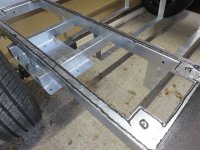
And then one day, out of the blue, the chassis arrived:

IMG_8304.jpg

IMG_8305.jpg

IMG_8306.jpg

My very first action was to check all of the dimensions, particularly the diagonals and the location of the suspension unit mounting plates. Everything was pretty much spot on, which relieved me greatly. It was to turn out that I didn't check thoroughly enough.

My first task on the chassis was to mount the independant suspension untis and the wheels. Because I don't know where they'll end up, and I want to be able to move them without too much of a hassle, I decided to sandwich some felt between the mounting plates and the units, rather than gunk them up with a compound. This will hopefully keep water out of the join:

IMG_8307.jpg

IMG_8308.jpg


IMG_8309.jpg

IMG_8310.jpg

IMG_8311.jpg

I've only used 3 of the 8 bolts to ease the work in re-locating later. It won't be driven like this!

My next job was to mount the corner "steadies".......essentially built-in jacks to level and stabilise the corners of the trailer. This should have been a quick and easy job........if I had designed the brackets properly. I didn't, and ended up, eventually, cutting off the back brackets:

IMG_8312.jpg

There is a top plate to the moving brace, which will bear on the underside of the chassis:

IMG_8313.jpg

I didn't think this was a good idea, and decided to add a nylon piece to the top to avoid the steel-on-steel wear. Before I could measure that properly, I had to remove the rear bracket. Before first, then after:

IMG_8314.jpg

IMG_8315.jpg

I deliberately cut quite a way away from the chassis to avoid any damage: and I then painted the cut steel with a zinc primer. To be continued......
 
Last edited:
IMG_8318.jpg

I could now level everything up properly, and measure for the nylon pad:

IMG_8317.jpg

IMG_8316.jpg

Phenolic ply isn't cheap, so it was with a little trepidation that I marked up the first cut for the floor, and attacked it with a circular saw:

IMG_8319.jpg

It actually cut beautifully cleanly, so I cut out all of the floor pieces. I have quite a lot of Black Jack (so called liquid DPM........essentially a thinned bitumen, turned into a waterproofing paint), so I decided to use it to seal the cut edges:

IMG_8320.jpg

IMG_8321.jpg

After drilling locating holes, I squeezed out some beads of Hippo Pro 3, which is an alternative to CT1......a low modulous waterproofing gunk which is both a glue and a sealant:

IMG_8322.jpg

IMG_8323.jpg

All of the bolts holding the floor down go through the full sandwich of ply-framing/ insulation-phenolic ply, so couldn't be used just to hold the phenolic ply down. I clamped instead:

IMG_8323.jpg

At some point I had also mounted the jockey wheel, but that didn't justify a photo. Between thunderstorms I carried the sides over to the garage:

IMG_8324.jpg

and once the Hippo 3 ws set enough I picked them into position for a dry fit, and clamped:

IMG_8327.jpg

I knew as soon as I lowered them onto the floor that we had a problem:

IMG_8325.jpg

IMG_8326.jpg

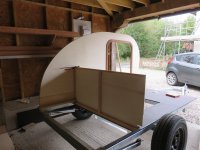
The frame isn't straight. The back end is 22mm down. I can't work with that, so the guy who made it is coming up to have a look, and will probably have to put it in a press. So, there'll be another hiatus. Still, we get a first look at the shape and size of the finished article:

IMG_8327.jpg

IMG_8328.jpg

IMG_8329.jpg

IMG_8330.jpg
 
So do you use the jockey wheel for support and levelling at the front?

Yes. Three points define a plane, and a three legged stool doesn't rock even on the most uneven floor.......so two jacks at the back and one at the front is all we need.
 
One thing I forgot to say is that the delay in the arrival of the chassis has meant I have missed my chance to get the fibreglassing done this autumn. I can carry on with building the interior, but I had really, really wanted to get the shell watertight before the weather got too bad. Those of you with experience of fibreglassing will know better than me, but doing epoxy work in November in an unheated space is just asking for trouble......and when it comes to the toss-up between finishing my house and finishing the teardrop, I'm afraid the house wins.
 
The frame not being level is a shame Mike. Will they be able to press it level evenly on both side all in one go?
I'm hoping so.......but I'm leaving it up to them. I haven't paid for it yet, and I won't pay for it until everything is as per the drawing. Even if that means they have to start from scratch with a new one.
 
What the hole in the floor for?
Would a T shaped chassis not have sufficed?
 
There is a top plate to the moving brace, which will bear on the underside of the chassis:
Yes, and the friction between same can lead to a bind-up, that then fractures the 'sliding shoe' as the jack is wound up, usually in a French camp site on Bastille Day. 😠 Great idea and execution on the nylon pad.
 
That chassis issue is a real bummer.

My plan is to start my surfboard build in the new year but the glassing would have to wait until a warm spring day.
 
Yes, and the friction between same can lead to a bind-up, that then fractures the 'sliding shoe' as the jack is wound up, usually in a French camp site on Bastille Day.
Ooooh.........that doesn't sound good.

😠 Great idea and execution on the nylon pad.

Thanks. It crossed my mind to split the nylon, with a thin strip on the underside of the chassis plus the pad on the steady. But I'm trying to avoid any drilling into the galvanising. Maybe next time.............:)
 
That chassis issue is a real bummer.

Yes, it's quite an issue. I'm sure they'll sort it out.

My plan is to start my surfboard build in the new year but the glassing would have to wait until a warm spring day.

Yes, it's a frustration, isn't it. If only epoxy wasn't so temperamental.
 
That's most unfortunate. (Chassis). I'm surprised that they didn't get a laser on it during the build. Putting it in a press sounds interesting: won't that risk fracturing the welds? Possibly in a way that is not visible. I know that car chassis can be straightened after an accident so maybe he has access to specialist gear?
 
.......Putting it in a press sounds interesting: won't that risk fracturing the welds? Possibly in a way that is not visible. I know that car chassis can be straightened after an accident so maybe he has access to specialist gear?

The bend is quite distinct, rather than being a general curve. It is behind the rear-most weld of the "normal" cross-members, so I think bending it straight will be relatively-risk-free. Put it this way: I'm more concerned about the phenolic ply in the locality than I am about the fabrication itself.
 
Mike, that is all rather frustrating. Will you continue or moth ball it until the spring?
 
No, I'll carry on. Other priorities take over, but I'll work on it here and there. Hopefully all I'll have to do in spring is the glassing etc, with everything else being complete.

-

As an aside, I've weighed it, and the rolling chassis comes in at 208 kgs, which is pretty much exactly what was predicted by Bob (Lons) a couple of months ago.
 
Whilst I was away cycling around Norfolk, the fabricator came up to my house and straightened the chassis. He did it fairly well, but not perfectly. I asked him to come back, but was wrapped up re-rendering the house and so was unable to photograph the process. It involved a big RSJ, some clamps, some spacers, and a bottle jack, and they did a decent job. When I could grab a moment, I could then start putting everything together.

One of the issues I have mulled over in the early hours when trying to sleep, is that there is no reference locating the frames on the chassis, and in relation to each other. Here's the front and back of the frame when it's roughly in the correct location, to show you what I mean. They just don't align with anything:

IMG_8339.jpg

IMG_8340.jpg


Whilst I am sure I could get over small discrepancies, obviously it would be easier if things were parallel, square, and symmetrical. I came to the decision that the bulkhead between the sleeping area and the kitchen would be the best way to control everything, because so long as it was right angles to both sides then I would know where everything was correctly in relation to everything else. So, I set about making that bulkhead. I started with 6mm ply, and noted immediately that it was out of square:

IMG_8332.jpg

I trued that up, and then used a pair of pinch sticks to get the exact distance between the walls and transfer it to the ply:

IMG_8333.jpg

When I cut the ply out, I also cut a batten to the exact same length, marked it up loudly, and will use that for reference later. The ply had to be shaped around some bits and pieces, but once dry fitted I could immediately square up the walls:

IMG_8334.jpg

IMG_8336.jpg

I spent a long time measuring and checking square, to make sure everything was absolutely spot on. I even made a 3:4:5 square especially for the purpose:

IMG_8338.jpg

I quickly realised that the ply was too bendy to be reliable for this task, so decided to add the framing to stiffen it up. If you refer back to the section drawing I posted weeks ago you'll see that the bulkhead in question is insulated, hence the framing:

IMG_8337.jpg

I'm just not doing butt joints anywhere.

At this point I realised that one of the sides of the straightened chassis wasn't straight enough. Here's the gap with a wedge in it:

IMG_8341.jpg

That's getting on for 4mm. OK, that's a damn sight better than the 22mm we started with, but too thick to deal with just with the sealant. As it was the weekend and I had no choice, I decided to have a go at it myself. I laid a big piece of green oak on some packers, and with 3 clamps I squeezed the frame up to the oak:

IMG_8342.jpg

About 25mm of bending produced a result, but an immeasurably small one:

IMG_8343.jpg

IMG_8344.jpg

I tried again, with bigger packers, and had to use a spanner on the clamps to get enough pressure on them:

IMG_8345.jpg

Eventually, I achieved a dramatic improvement:

IMG_8346.jpg

However, that created a bend elsewhere, so I spent some while chasing smaller and smaller bends along the frame using the same technique:

IMG_8348.jpg

That took a couple of hours of stuffing about, but I got everything to within coo-ee of straight. It cost me a G clamp, which failed impressively under load.

After that, I made final preparations for fixing the frames permanently. Little things like allowing for welds:

IMG_8350.jpg

........by chamfering part of the frame away:

IMG_8349.jpg

Back in a minute.......
 
Last edited:
Having stiffened up the bulkhead with the frame, I was able to do a final dry fit of the side walls to their exact locations. I clamped them in place, and set about marking for the bolt holes which would locate and secure them. I sharpened up a short piece of threaded rod, pushed it through the holes in the frame, and tapped it with a hammer to produce a centre mark:

IMG_8351.jpg

IMG_8352.jpg

I had to do that because I couldn't get a drill near a few of the holes from the underside of the trailer. There's just stuff in the way. I could then use the centre mark to drill a pilot hole, then a recess for the head of the carriage bolts, and finally the 9mm bolt holes:

IMG_8353.jpg

I gunked everything up carefully:

IMG_8354.jpg

IMG_8355.jpg

I am specifically using this adhesive because it is low modulous, (flexible), watertight, gap-filling, sticky as hell, and it lasts forever. If there is going to be any movement, it will be between the bodywork and the chassis, so a flexible adhesive seems sensible. Anyway, the first side was soon in place:

IMG_8356.jpg

Next came the bulkhead:

IMG_8357.jpg

Naturally, I forgot to take a photo of the second side in place. You'll just have to take my word for it. Everything was then secured with M8 stainless steel bolts, albeit with temporary mild steel nuts. I found the box of stainless Nyloc nuts as soon as I had finished tightening the last temporary one. Ho hum.

On to the floor. I did lots of sawing, chiselling, marking and measuring, and eventually had the floor frame ready for fitting:

IMG_8359.jpg

IMG_8360.jpg

This was a particularly awkward joint to chop out in situ:

IMG_8358.jpg

Nonetheless, it all went together OK, and was bedded down in the same black gunk as holds the frame down:

IMG_8361.jpg

All glued and pinned, and finally clamped down ( I don't want anything squeaking!!):

IMG_8363.jpg

Once the insulation and ply are in place, then coach bolts will squeeze the whole lot down to the chassis.

Here's a general view of the scene:

IMG_8362.jpg
 
Last edited:
Most impressive, I imagine that the design for this has been fairly long in the making, if you’re anything like me it’s in 3d in your imagination looking at it from every angle with lots of sketches.
Don’t want to be negative but I’m reminded of when I asked why Stainless bolts weren’t used on car chassis ( back in the 70’s) and the answer came back that they sheared and snapped as they became brittle.
 
Most impressive, I imagine that the design for this has been fairly long in the making, if you’re anything like me it’s in 3d in your imagination looking at it from every angle with lots of sketches.
Don’t want to be negative but I’m reminded of when I asked why Stainless bolts weren’t used on car chassis ( back in the 70’s) and the answer came back that they sheared and snapped as they became brittle.

They're not under much strain here, and there are dozens of them. Some teardrops have just 4 bolts holding them on to the chassis, but I think I've got 30. I guess the choice is between soft-ish stainless and rusty, locked-up fixings.

And yes, I first drew this over 2 years ago, and have re-drawn it umpteen times since. I'm now noting on my main drawing what I would do differently next time!!
 
Great reading and viewing. It occurred to me that similar to my registering different parts of the build with my instruments, you could register off a centre line, maybe even with string going from front to back. Then any hypotenuse on the port side should be equal to its opposite on the starboard. Then you know everything is square to each other.
 
Great reading and viewing. It occurred to me that similar to my registering different parts of the build with my instruments, you could register off a centre line, maybe even with string going from front to back. Then any hypotenuse on the port side should be equal to its opposite on the starboard. Then you know everything is square to each other.
I like that idea.
 
marked it up loudly
Ah yes, we've all been there with frustrating jobs, Mike.
It cost me a G clamp, which failed impressively under load.
Bloody hell. Bet that risked an immediate laundry visit!

I was intrigued to see you needed stiffening braces on the ply panels. Most of the trailers (and vans) I'm acquainted with are constructed with thin ply, much thinner than you might expect, maybe 5 mm, and every bit of it has been so braced. The struts too are of "light" section, pr'aps 12mm square - and butt joined/stapled! You would think that was flimsy, but it's halfway to a torsion box, and is usually reinforced by attachment to a floor or vertical, stronger, panel. It's also very light, which is what one is aspiring to.

Great job, Mike. I was especially impressed by your chassis straightening. I repaired a trailer 40.years ago, that lived on for 25 more years, but I used a torch on the bend to soften it, then a meaty Birmingham Screwdriver to persuade it straight. Your method is much more controlled and precise, duff G clamps not withstanding.
 
I'm wondering if it would be possible to erect a tent like affair inside the garage, maybe out of insulation board and bubble wrap, and heat it enough for a couple of days to do the fibre glassing?
 
I'm wondering if it would be possible to erect a tent like affair inside the garage, maybe out of insulation board and bubble wrap, and heat it enough for a couple of days to do the fibre glassing?
Probably, but the way things are working out I'll save that job until the spring, and it could be just about the last job of the build. We wouldn't be using it before spring anyway, so nothing to lose by doing it in that order.
 
I wonder if "next time" means that all Mike's useful experience of lightweight construction is going to be used on a glider, or better, a pedal powered aeroplane of his own cunning design... ;)
 
I was dismayed when the boat build was (temporarily :cool:) deferred. I was looking forward to helping.
 
Part 14......

The floor is insulated as per all the other outside surfaces. Here is the 25mm Celotex held down well against the expansion of the PU glue holding it in place:

IMG_8364.jpg

After de-clamping, and filling the gaps with foam:

IMG_8368.jpg

I have something of a confession to make. I waste an inordinate amount of time in every single project I do trying to work out which piece of stock to use for which particular part. The first bit of floor here was easy:

IMG_8369.jpg

..........but the two silly little bits either side of the well held me up for hours. I ended up drawing all of the remaining bits I needed and all of the remaining stock of 1/2" ply I had, and after printing it, cut everything out so that there could be no more (internal) conversation on the matter. I drive myself absolutely nuts with this behaviour. Nonetheless, this time there was a way I could have cut things out which would have meant running out of ply, so I guess it was somewhat justified. In the meantime, whilst distracted, I took delivery of a pair of brackets which will support the forward end of the corner steadies (jacks):

IMG_8366.jpg

Drilling the appropriate holes for riveting them in place cost me two 3.5mm drill bits. After a deal of frustration trying to drill the holes with the brackets loose, I eventually decided to adhere the brackets in place, and then drill the holes once everything had gone off. The approach worked, but it was a tedious and frustrating job:

IMG_8367.jpg

The above photo shows the brackets propped in place whilst the Hippo 3 set overnight. At the same time, I glued the Celotex into the bulkhead that separtes the sleeping area from the kitchen. This is a change from the normal practice with teardrops, but I want to entirely isolate the sleeping area:

IMG_8365.jpg

Eventually, I was confident enough with my cutting decisions that I was able to complete the fixed part of the floor. You can actually see one of my drawings for what-is-cut-from-where in the following photo:

IMG_8370.jpg

The next major task was the well. This hangs below the floor of the trailer, and so is designed to be made of phenolic ply. It's going to get wet and muddy, no doubt. The thing is, I was determined to make all the joins of the box with dovetails. I wonder whether the material has ever been dovetailed before!!

It was a bit of a pig. Obviously, it's impossible to use a chisel. That didn't leave me much choice but to use a rasp. It's many a long year since I made dovetails with a rasp. I didn't mind sawing the stuff, because obviously a saw can be re-sharpened:

IMG_8371.jpg

IMG_8372.jpg

Rasping without breaking out the far edge is a bit of a discipline. I rasped down to the line on both slides.........but on a slope:

IMG_8373.jpg

IMG_8374.jpg

This left a mound in the middle, which then got filed flat:

IMG_8375.jpg

IMG_8376.jpg

You also couldn't do trial fits, for fear of breaking off layers when dismantling if any part was a little too tight. To be fair, this is my approach in proper wood too. I'd barely offer the parts together just to check I hadn't made a major cock-up:

IMG_8377.jpg

Instead of gluing with PU, I had long decided to use Hippo 3, as I imagined this box might be subject to some flexing. PU is a bit brittle, but Hippo 3 is flexible:

IMG_8378.jpg

It took literally days to make a single box. Don't rush to dovetail phenolic ply, and don't rush to use a rasp instead of a chisel for ordinary dovetails! Eventually, though, it was finished:

IMG_8379.jpg

IMG_8380.jpg

Whilst that was curing I made the frame for the removable hatch over the well. This has to be pretty strong as it is under our hips as we sleep. This p[robably doesn't need explanation:

IMG_8381.jpg

IMG_8382.jpg

IMG_8383.jpg

That's my photo limit. Back in a sec......
 
Back
Top