• Hi all and welcome to TheWoodHaven2 brought into the 21st Century, kicking and screaming! We all have Alasdair to thank for the vast bulk of the heavy lifting to get us here, no more so than me because he's taken away a huge burden of responsibility from my shoulders and brought us to this new shiny home, with all your previous content (hopefully) still intact! Please peruse and feed back. There is still plenty to do, like changing the colour scheme, adding the banner graphic, tweaking the odd setting here and there so I have added a new thread in the 'Technical Issues, Bugs and Feature Requests' forum for you to add any issues you find, any missing settings or just anything you'd like to see added/removed from the feature set that Xenforo offers. We will get to everything over the coming weeks so please be patient, but add anything at all to the thread I mention above and we promise to get to them over the next few days/weeks/months. In the meantime, please enjoy!

Un Rabot de Menuisier

Dr.Al

Old Oak
Joined
Dec 31, 2020
Messages
3,969
Reaction score
2,895
Location
Dursley, Gloucestershire
Name
Al
Today we popped into a Brocante (antiques shop) in Brittany & I got tempted to part with €15 for a souvenir.
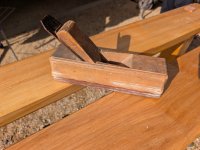
11811.jpg

I don't think it's anything particularly special & I doubt I'll end up using it that much, but sometimes we must allow temptation to get the better of us!

It needs a bit of TLC that'll have to wait until I get home.

The sole attachment shows some curvy ripples (I imagine these were cut by machine):

11812.jpg

The mouth opening is relatively small:
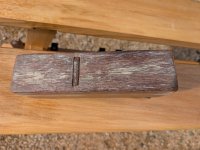
11813.jpg

Most planes I've seen in French junk shops (usually jointer plane length) have mouth openings you could shove a baguette through so it was nice to see something a bit tighter. As you might be able to see in that picture, the blade will need a lot of work.

All the bits:

11814.jpg

I find the blade set-up quite interesting. If you look at the blade & cap iron you'll notice there's no way to join them together (this seems quite common on the planes I've seen in French junk shops), which feels like it could be a bit awkward when setting the plane up. However, the plane body has a slot that seems intended to allow clearance for the cap iron screw.

Inside the opening, you can see the join between the body & the sole & it looks like a finger joint from this angle:
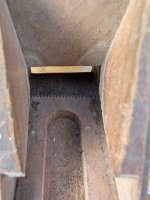
11815.jpg

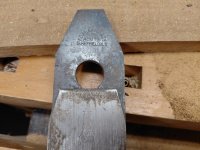
Finally for now, a photo of the back of the blade (which is marked “Goldenberg 42 Acier Chrome A Garantie" or “Guaranteed Chrome Steel") & the cap iron (which just has the answer to the ultimate question on it):

11817.jpg
 
The ripples are a result of the triangular grooves being cut at a slight angle to the plane, if you look down the sole you can see them as triangular grooves.
I have a very long jointing plane that is the same, Goldberg if I remember correctly.

Pete
 
Al, you are doing exactly the right thing. There may be naysayers out there, claiming that you can build and furnish a house with just an axe, but there are so many different tools out there that it just makes good sense to buy one of each type and compare them, and take careful notes on what the subtle differences are, and why you need to have all of them, so as to be ready to make whatever you need to make... and there's absolutely no risk that your little shed will need its own outbuildings to house the new acquisitions, or that you'll move to a house with a playroom in the basement and line the walls with shelves and boxes and drawers of tools...

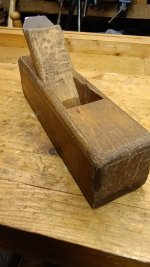
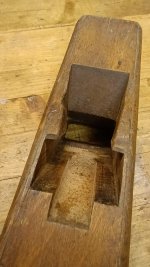
How can I be so sure? Because, some time back in the 90s, on holiday in Brittany, I went out on a borrowed bike and found a nearby vide-grenier, and managed in my old schoolboy French to ask <C'est combien, le rabot?> and understand that the friendly Breton only wanted €3, so I came back with this!

IMG_20260919_170006271.jpg

IMG_20260919_170021217.jpg

IMG_20260919_170042022.jpg

IMG_20260919_170110312.jpg

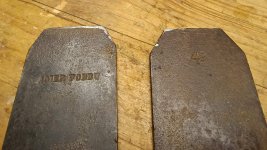
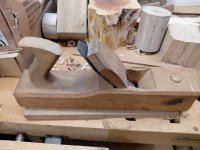
Mine is very much the twin of yours, with the same combination of woods (I think probably beech on the body with cormier (service tree) for the sole, with the same routed grooves for the glue). It's the same size and has the same size iron and cap iron, except that I have the most basic, unbranded ones.


IMG_20260919_170124927.jpg

IMG_20260919_170138609.jpg

It also shares the historically interesting, but awkward, lack of anything to join the iron and cap iron together. This was definitely an example of French makers continuing to offer the older pattern alongside the improved one, presumably to appeal to the customer who didn't trust new things or just wanted to save a few centimes.

I don't have a Goldenberg catalogue to hand, but here's a page from a 1931 French catalogue which lists this style of plane in various options, top right hand corner, models 3612 and 3614-5. You can see that they were offered in hornbeam, holm oak, or service tree wood, and you could choose a model "sans vis" - without screw - or with a "vis longue". This was a long screw, in line with the iron, with a knurled nut that could be turned to adjust the position of the cap iron. (There are some photos of rusty ones here https://www.lairdubois.fr/pas-a-pas/838-restauration-doutils.html .)

Harder to make than the simple screw and attached nut favoured elsewhere - but a nice side project for a woodworker with metalworking skills! ;)


Vulcan.jpg
 
Last edited:
I don't think it's anything particularly special & I doubt I'll end up using it that much, but sometimes we must allow temptation to get the better of us!

“I can resist anything except temptation!” - Oscar Wilde
 
Are European planes less likely to have a wee striking knob on the front?
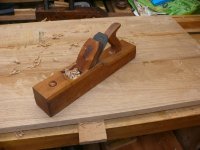
This is my inherited woodie plane which is normally used just as a scrub plane.

20260921_113325_resized.jpg

20260921_113241_resized.jpg
 
Are European planes less likely to have a wee striking knob on the front?
This is my inherited woodie plane which is normally used just as a scrub plane.

View attachment 58724

View attachment 58723
Well, that depends whether your plane is continental or British.

Looking at it a bit closer, the iron is clearly from Sheffield, and BPM says Francis George Pearson was in business from about 1856 to 1957. But what about that column trademark on the cap iron?

That mark was the subject of a long quest on UKW, where several of us knew that we had seen it but couldn't link it to a maker.

The puzzle was eventually solved. If you look at the base of the column, it contains stylized letters FWE. That stands for Frederick William Emmerich, a company which started in Germany in 1852. In 1932 a subsidiary was established in England.

After some international difficulties, the German company became known as ECE (from the initials of the founder's wife, Emmy Caroline Emmerich). They still make wooden planes - you can see their current offerings here


Their planes don't have strike buttons, as they no longer make simple wedged planes. Instead, they use their own patented "Primus" adjuster, which doesn't need a hammer.

Over in England, I'm not sure of the exact history of the company post-war, but there's definitely a connection to Emir Ltd, who were based in Maidstone, Kent. They made tools for woodwork, upholstery and bookbinding, mostly aimed at schools and colleges. They ceased trading only quite recently - 2025 I think.

Schools often chose the "razee" style of plane where the stock is cut down at the back - like yours - as it was better suited to users with smaller hands. I expect they liked the strike button too, as it would have preserved the plane body from the worst abuses.

I have - and use - a very similar jack plane made by them, and although it has a Hildick iron, it has the same FWE cap iron as yours.

P1090510.JPG

Does yours say "Emir" on the toe and have a mark on the heel showing the width?
 
Last edited:
Well I never. A long time since I last used it. No sign of EMIR just a circle and a 2 (for 2") it also still has the price label, 13/6; which I would rather not remove but I doubt there is room for EMIR to be written underneath
The plane would have belonged to my maternal grandfather and bought at a guess in the 50s. Would 13/6 have been the going rate? in the 50s for such a plane?


edit
A quick google suggests 1950 prices between 10s and 25s
 
Would 13/6 have been the going rate? in the 50s for such a plane?

edit
A quick google suggests 1950 prices between 10s and 25s
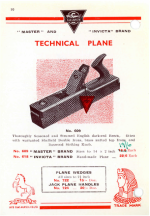
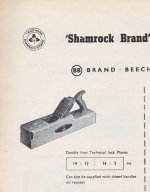
I've done a bit of virtual shopping for you. Here are a few sample catalogue entries.

AB Salmen (who had taken over Charles Nurse's plane making business,) from 1949: - 18s 6d and increased by a shilling some time later

salmenjack.png
Marples 1959, from their partly machine made BB range:

marples1959.jpg

48 shillings and 3 pence, according to the accompanying price list!

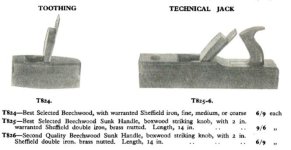
And from a Gardiner of Bristol catalogue dated October 1959:

gardiner1959.jpg

So, my guess is that either your plane purchaser drove a hard bargain, or that specimen was from a few years earlier than you thought.

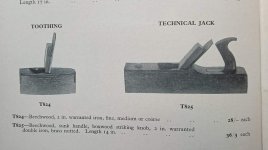
Here's the relevant page from the Gardiner catalogue issued in 1940 - significantly cheaper and with a choice of quality levels:

gardiner1940.jpg

I don't expect you'll be needing to go take the makers to court if your iron turns out to be a lowly unwarranted one and your beechwood wasn't as good as it could have been!
 
Back
Top