

This isn't going to be fine woodworking and it will only include three simple joints, but I've not posted any projects for quite a while, so here goes.
Some years ago, long enough ago for me to have forgotten how many, I was walking home when I spotted that someone in our street had left some rather nice looking wood outside for anyone who wanted it. It was the top of a round table, about 4 foot diameter. I rolled it into our house and added it to the stash of useful bits waiting to turn into useful projects. Who can resist solid hardwood? Not me!
I don't know what species it is, except that it looks like something that would be prohibited under CITES nowadays. I'd guess it was made somewhere like Thailand or Vietnam, using simple tools and methods. The table would have had a central column (which was missing) and there was a frame under the top that would have tipped up vertically or locked into horizontal for use. I've used most of the chunky frame for making wooden clamps of various sizes, but not yet used the round top. Now a family member needs a dining table, so it's time to revisit this salvaged treasure.
Here's the back view - you can see the colour of the bare wood where I've removed the frame -

and here's the front.

It's all covered in some sort of dark shiny finish, which seems quite tough but is deeply scratched here and there. The first step was to get the old finish off and replace it with something that won't darken it so much.
I didn't really need to strip the back but I decided I would, as an experiment to find what was the most efficient way to get the finish off. I don't expect anyone will be surprised that I tried several different cabinet scrapers, a Skarsten scraper, a Stanley no 80 and the Record equivalent.
Here's the Stanley 80 reducing the finish to white dust (does that help identify it?)

and here's the superior Record taking proper shavings off the wood.

I decided that was the best method.
I don't have much in the way of powered sanding - most of the time I use a Mirka Abranet hand pad connected to the vacuum cleaner. But I do have an old orbital sander of some sort that was given to me. I think it probably came from B&Q. It seems to be ok for evening out the surface on the underside, even if the handle is broken and I have to tape the extraction hose in place.

With that side done, I turned over to what will be the top. I hope you agree it's in need of improvement, but it felt a bit like vandalism when I started taking stripes of varnish off.

Then I made a discovery. I remembered Bill Carter's "blunt chisel" method. You grind a 90 degree end on an old chisel and use it like an engineer's scraper. It's like having a plane with a very high pitch. But rather than getting my blunt chisel out of the box where I keep it, I picked up a cabinet scraper and turned it round, using the un-burred end, which was as square as when it left the factory. If I jabbed at the varnish, it just crumbled away, the whole thickness at once.

(I used the bit of paper-binding plastic that normally goes on the top edge of the no 80 blade, to prevent the other end of the scraper digging in to my hand.)

This method was quicker and easier than using the scraper. I soon had the top clear of old varnish. I went over it all with the Abranet pad and some 80 grit mesh.
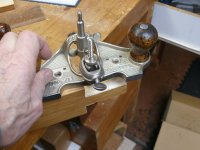
To clean up the edge, I couldn't resist the chance of using a compass plane, though a block plane or sanding would have been just as good.

And then, part way through writing this up, I read Andy B's post in Steve's thread where he wrote:
"Cabinet/decorators scraper with just a filed square edge is very adept at shifting stuff when used flat on a surface."
That's very good advice!
Some years ago, long enough ago for me to have forgotten how many, I was walking home when I spotted that someone in our street had left some rather nice looking wood outside for anyone who wanted it. It was the top of a round table, about 4 foot diameter. I rolled it into our house and added it to the stash of useful bits waiting to turn into useful projects. Who can resist solid hardwood? Not me!
I don't know what species it is, except that it looks like something that would be prohibited under CITES nowadays. I'd guess it was made somewhere like Thailand or Vietnam, using simple tools and methods. The table would have had a central column (which was missing) and there was a frame under the top that would have tipped up vertically or locked into horizontal for use. I've used most of the chunky frame for making wooden clamps of various sizes, but not yet used the round top. Now a family member needs a dining table, so it's time to revisit this salvaged treasure.
Here's the back view - you can see the colour of the bare wood where I've removed the frame -
and here's the front.
It's all covered in some sort of dark shiny finish, which seems quite tough but is deeply scratched here and there. The first step was to get the old finish off and replace it with something that won't darken it so much.
I didn't really need to strip the back but I decided I would, as an experiment to find what was the most efficient way to get the finish off. I don't expect anyone will be surprised that I tried several different cabinet scrapers, a Skarsten scraper, a Stanley no 80 and the Record equivalent.
Here's the Stanley 80 reducing the finish to white dust (does that help identify it?)
and here's the superior Record taking proper shavings off the wood.
I decided that was the best method.
I don't have much in the way of powered sanding - most of the time I use a Mirka Abranet hand pad connected to the vacuum cleaner. But I do have an old orbital sander of some sort that was given to me. I think it probably came from B&Q. It seems to be ok for evening out the surface on the underside, even if the handle is broken and I have to tape the extraction hose in place.
With that side done, I turned over to what will be the top. I hope you agree it's in need of improvement, but it felt a bit like vandalism when I started taking stripes of varnish off.
Then I made a discovery. I remembered Bill Carter's "blunt chisel" method. You grind a 90 degree end on an old chisel and use it like an engineer's scraper. It's like having a plane with a very high pitch. But rather than getting my blunt chisel out of the box where I keep it, I picked up a cabinet scraper and turned it round, using the un-burred end, which was as square as when it left the factory. If I jabbed at the varnish, it just crumbled away, the whole thickness at once.
(I used the bit of paper-binding plastic that normally goes on the top edge of the no 80 blade, to prevent the other end of the scraper digging in to my hand.)
This method was quicker and easier than using the scraper. I soon had the top clear of old varnish. I went over it all with the Abranet pad and some 80 grit mesh.
To clean up the edge, I couldn't resist the chance of using a compass plane, though a block plane or sanding would have been just as good.
And then, part way through writing this up, I read Andy B's post in Steve's thread where he wrote:
"Cabinet/decorators scraper with just a filed square edge is very adept at shifting stuff when used flat on a surface."
That's very good advice!

 As you know it can be troublesome to glue but a wipe over gluing surfaces with meths or acetone usually does the trick and your normal PVA glue of whatever denomination will work. I suggest gluing a trial bit of oddments together to test it out, but let the glue fully cure. Finish wise it's dead easy and Osmo -PolyX with wax over the top will work a treat - Rob






 .
.


