• Hi all and welcome to TheWoodHaven2 brought into the 21st Century, kicking and screaming! We all have Alasdair to thank for the vast bulk of the heavy lifting to get us here, no more so than me because he's taken away a huge burden of responsibility from my shoulders and brought us to this new shiny home, with all your previous content (hopefully) still intact! Please peruse and feed back. There is still plenty to do, like changing the colour scheme, adding the banner graphic, tweaking the odd setting here and there so I have added a new thread in the 'Technical Issues, Bugs and Feature Requests' forum for you to add any issues you find, any missing settings or just anything you'd like to see added/removed from the feature set that Xenforo offers. We will get to everything over the coming weeks so please be patient, but add anything at all to the thread I mention above and we promise to get to them over the next few days/weeks/months. In the meantime, please enjoy!

Quick and easy round table

AndyT

Old Oak
Joined
Nov 23, 2020
Messages
3,631
Reaction score
1,407
Location
Bristol
Name
Andy
This isn't going to be fine woodworking and it will only include three simple joints, but I've not posted any projects for quite a while, so here goes.

Some years ago, long enough ago for me to have forgotten how many, I was walking home when I spotted that someone in our street had left some rather nice looking wood outside for anyone who wanted it. It was the top of a round table, about 4 foot diameter. I rolled it into our house and added it to the stash of useful bits waiting to turn into useful projects. Who can resist solid hardwood? Not me!

I don't know what species it is, except that it looks like something that would be prohibited under CITES nowadays. I'd guess it was made somewhere like Thailand or Vietnam, using simple tools and methods. The table would have had a central column (which was missing) and there was a frame under the top that would have tipped up vertically or locked into horizontal for use. I've used most of the chunky frame for making wooden clamps of various sizes, but not yet used the round top. Now a family member needs a dining table, so it's time to revisit this salvaged treasure.

Here's the back view - you can see the colour of the bare wood where I've removed the frame -

P1100276.JPG

and here's the front.

P1100275.JPG

It's all covered in some sort of dark shiny finish, which seems quite tough but is deeply scratched here and there. The first step was to get the old finish off and replace it with something that won't darken it so much.

I didn't really need to strip the back but I decided I would, as an experiment to find what was the most efficient way to get the finish off. I don't expect anyone will be surprised that I tried several different cabinet scrapers, a Skarsten scraper, a Stanley no 80 and the Record equivalent.

Here's the Stanley 80 reducing the finish to white dust (does that help identify it?)

P1100277.JPG
and here's the superior Record taking proper shavings off the wood.

P1100278.JPG

I decided that was the best method.

I don't have much in the way of powered sanding - most of the time I use a Mirka Abranet hand pad connected to the vacuum cleaner. But I do have an old orbital sander of some sort that was given to me. I think it probably came from B&Q. It seems to be ok for evening out the surface on the underside, even if the handle is broken and I have to tape the extraction hose in place.

P1100279.JPG

With that side done, I turned over to what will be the top. I hope you agree it's in need of improvement, but it felt a bit like vandalism when I started taking stripes of varnish off.

P1100287.JPG

Then I made a discovery. I remembered Bill Carter's "blunt chisel" method. You grind a 90 degree end on an old chisel and use it like an engineer's scraper. It's like having a plane with a very high pitch. But rather than getting my blunt chisel out of the box where I keep it, I picked up a cabinet scraper and turned it round, using the un-burred end, which was as square as when it left the factory. If I jabbed at the varnish, it just crumbled away, the whole thickness at once.

P1100291.JPG

(I used the bit of paper-binding plastic that normally goes on the top edge of the no 80 blade, to prevent the other end of the scraper digging in to my hand.)

P1100292.JPG

This method was quicker and easier than using the scraper. I soon had the top clear of old varnish. I went over it all with the Abranet pad and some 80 grit mesh.

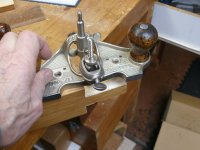
To clean up the edge, I couldn't resist the chance of using a compass plane, though a block plane or sanding would have been just as good.

1773517706876.jpeg

And then, part way through writing this up, I read Andy B's post in Steve's thread where he wrote:

"Cabinet/decorators scraper with just a filed square edge is very adept at shifting stuff when used flat on a surface."

That's very good advice!
 
Nice start Andy. I just resurrected my older version of a compass plane to the 'Tool Wall' in the 'shop outside. If the timber comes from that part of the world as you suggest, there's a good chance it's teak; certainly the right colour when the icky varnish has been removed - Rob
 
Thanks Rob. I'd not thought of teak, as I was only familiar with straight grained stuff used in decking or mid-century veneers, but looking online, you could be right. The boards are 14" wide, which could make this quite a valuable find!

And if it is teak, I think I shouldn't be using water-based poly, so maybe my tin of Osmo Poly-x is the right stuff yet again?
 
Thanks Rob. I'd not thought of teak, as I was only familiar with straight grained stuff used in decking or mid-century veneers, but looking online, you could be right. The boards are 14" wide, which could make this quite a valuable find!

And if it is teak, I think I shouldn't be using water-based poly, so maybe my tin of Osmo Poly-x is the right stuff yet again?
Agreed Andy, if it is Teak, that's a real find! One of my fave timbers and if you like sharpening plane irons, it'll be one of yours too :ROFLMAO: As you know it can be troublesome to glue but a wipe over gluing surfaces with meths or acetone usually does the trick and your normal PVA glue of whatever denomination will work. I suggest gluing a trial bit of oddments together to test it out, but let the glue fully cure. Finish wise it's dead easy and Osmo -PolyX with wax over the top will work a treat - Rob
 
Leaving aside the top for a bit, I turned my attention to the legs and underframe.

Another reason to start making this table is that its future user recently found some rather useful looking bits of oak, left out for anyone who wanted them. Why buy wood when you can find it for free in the wild?!

Here they are, leaning up against the old kitchen cupboard/lathe support in the workshop:

P1100297.JPG

They are designed to fit together like this, to support a big rectangular table:

P1100298.JPG

That looks a daft design to me, and not what is needed, even if it was shortened.

I spent quite some time thinking about how I could use some of this wood as conventional, square legs, joined together with ordinary rails. As far as I can see, if you put a square of four legs under a round top, the legs need to be quite close to the edge of the circle, to make it stable enough. If you go for mortise and tenon joints at every end, on a table this big you end up needing about 14 foot of rail material. Although I have a few bits of oak, I don't have enough matching stuff to do that.

After a few days I had another idea, which will come clear in due course.

My first task today was to shorten the long bar between the corners, on each frame. Here's one of them ready to cut, with a matching corner bridle joint marked out in the usual way:

P1100299.JPG

and some cutting...

P1100300.JPG

and then a bit of a surprise!

P1100301.JPG

What I had taken to be a bridle joint in solid oak was actually a loose tenon in softwood, with oak veneer all round!
There was even end-grain veneer on the outside of the joint:

P1100302.JPG

which has a rather odd grain pattern if the top and bottom bits are supposed to be the ends of the same piece! Obvious when you realise what's happening, but it fooled me. (I had noticed that the wood was quite light, but put that down to it being some quick-grown commercial variety and very dry.)

I suppose this sort of thing is common now and economically practicable with highly mechanised manufacturing. Wood salvagers beware!

I decided that it didn't actually matter for the design I had decided on. Fortunately, these bits are not scratched or damaged and don't even need refinishing. Especially when they will be in the dark, underneath a table top. (That might become a theme in this thread...)

I cracked on with some more ordinary sawing to cut a new joint on the bit that I had shortened and open out the cavity on the top of the leg part.
It's a bit awkward working on something partly assembled but it was ok if I made an effort to tidy up often enough.

P1100304.JPG

I did what I could to make the new joint match the dimensions of the old one.

P1100305.JPG


P1100306.JPG

levelling off to size with a router

P1100307.JPG

and with a bit more gentle tweaking I managed to make it fit:

P1100308.JPG

I had deliberately not cut that leg part short yet, in case I messed up the joint - there's enough length there to allow a second attempt.
You can also see that there's a place where a thick metal bracket would have been, that will need patching. There should be plenty of usable offcuts to do that.

With the first joint successfully cut, I shortened the leg to the right sort of length for a dining table (28½ inches)

P1100310.JPG

and then used a bit of the offcut to fill in the gap where the half-lap had been:

P1100311.JPG

This took quite a long time, with lots of sawing, paring, planing and rasping.

The bottom of the old joint was not level, and too deep for the router

P1100312.JPG

so you get a clumsily posed shot of a rather nice paring chisel which I made do with instead ;)

P1100313.JPG

And this is where I got to, not yet glued, filled or re-touched but good enough to go in the dark, underneath a table top.

P1100314.JPG

Obviously, this all needs to be done over again on the other end of this bit, and on the other frame, so the next post might not be for a while, especially if the weather outside warms up as promised!
 
That's some sneaky softwood hiding the manufacturers had done. I'd be quite annoyed if I discovered that (even in free wood)!
 
That really is sneaky! I'm impressed by the end grain veneer though, even if the grain didn't match!

I'm interested to see where you're going with this.
 
Thanks for showing the use of the cabinet scraper's end Andy. Never thought of it before.
It's great when you can make something useful from salvaged wood!
 
I've now completed work on patching all the old halving joints. I've also shortened the other long rail and re-cut the corner joint. I won't repeat everything (to everyone's relief) but here are a few more photos to show the way I go about this sort of thing in my crowded, untidy workshop.

One challenge of working with part-assembled bits is the extra room they take, especially when you don't have much headroom:

P1100317.JPG

But it's ok, there is just enough clearance:

P1100316.JPG

so I haven't broken any of the lights, or the gas pipe that runs across the ceiling... ;)

Sometimes the bits stick out awkwardly:

P1100318.JPG

and sometimes they go the other way:

P1100319.JPG

I'm not complaining though - I set it up like this and I've got used to it over the years.

I know that some people read my threads just to spot the old tools I use and I am aware that so far on this I've only used a few common, basic tools. But when it was time to plane a few wispy shavings off the oak veneer patches, I decided it was a suitable job for my most precious plane. It's not very old - it was made in 1985 - but it is special:

P1100320.JPG

P1100321.JPG

It's one of the great Bill Carter's and was a present from my dear old friend Ted, who I'm reminded of whenever I use it.

If you're not familiar with Bill and his work, take a look at the mouth on this skewed-iron beauty:

P1100324.JPG

and also read his website and watch his YouTube channel. He knows that many of the wonderful planes that he has made never get used, but is always pleased to see that some of them certainly do.

Having patched the gaps and levelled off the patches, I used a little bit of filler to deal with the remaining gaps.

P1100327.JPG

and then sanded it down, then gave any pale parts a wipe over with some linseed oil to blend the colour together.

To join the four legs together I had originally thought of making a conventional square of rails, but I think I said already that I didn't have enough matching wood. The obvious alternative is to make two double legs which cross in the middle with a half lap joint, so that's what I did next.

This is all very ordinary work - mark out with a knife, saw down, add some internal stopping cuts. Chisel out, big chunks at first, then thinner, then finer until it all fits.

P1100329.JPG

P1100330.JPG

P1100331.JPG

Frankly, I'd sooner have done this in solid wood, not resiny knotty pine, but it was ok. Here it is nearly finished to full depth, having a trial fitting:


P1100333.JPG

You may have spotted a little wobbliness on one of the joints. Here it is, getting cured:

P1100336.JPG

P1100335.JPG

There's just one clamp on it, which is the old-fashioned option of a pair of cast iron heads on a stout bit of hardwood. And thanks to @Steve Maskery for teaching us all about the Square of Thales!


Final lap coming soon. Meanwhile, there are bonus points for spotting a tool that wasn't meant for woodworkers. So who else would have used it?
 
Nice tries, but I didn't mean the roofer's square. The brush sort of qualifies as an answer - it's an old wallpaper hanging brush that I use for sweeping shavings away - but there's another interloper tool lurking there somewhere...
 
Is it the turned mallet with ferrules?

There's also a bow saw, for tree pruning. That might not qualify as woodworking, possibly.

You may have the only wall-papered workshop on the forum. :)
 
Is it the turned mallet with ferrules?

That's the one!

Back in the early 80s I was working in a hospital. The old building I was in had a drawer of various useful tools. When it was scheduled for demolition we had to clear it out. Rather than chuck everything into the skip, we shared out the contents of the drawer and my share included that mallet.

Now that there are thousands of old catalogues available on-line, it's become much easier to identify old tools. Here's my mallet, as featured in a 1,674-page 1906 catalogue from Down Brothers, a big surgical suppliers in Leeds. I don't expect this example is quite that old but I can't say for sure. I don't think it would survive being autoclaved after use!

b21503084_0126.jpg

Full book here, to help identify other odd items:

 
Fascinating. Imagine looking up from the wooden table you were being held down to by 4 or more burly assistants to see that mallet amongst the tools the surgeon was preparing to use on you whilst you were fully conscious!
 
A bit more progress to report. I glued up the other joint and trimmed both of them down tidily. When I set one on top of the other, I noticed something I wasn't expecting -

P1100340.JPG

I seem to have cut one side ¼" too short, or maybe the other side ¼" too long. Oops!

P1100342.JPG

Never mind, it's easily fixed and gives you another example of how a bigger workshop would be nice (but isn't very likely.)

P1100343.JPG

Anyway, I was soon onto the exciting stage of drilling some holes so as to fix these legs to the table top.

I did do a little experiment with an electric drill in a stand, which looked like this, proving that I have no quarrel with power tools and modern stuff:

P1100337.JPG

However, I decided that it would be too much of a faff to get the legs propped up and clamped down safely just to get them under the power drill, so I decided to use some other options instead.

So it was time for this nice set of Russel Jennings bits, which is nearly complete with originals of the same sort of date, bar a few substitutes.

P1100350.JPG

P1100349.JPG

I did compromise towards modernity by choosing what I believe is a 20th century brace rather than a 19th. This is a "Toga" which was the own-brand of Buck and Hickman, one of our biggest and longest lasting tool distributors.

P1100352.JPG

P1100353.JPG

I have a few of the old red B&H catalogues, but they seem to use a different numbering system and not list this model.

There is a 1938 "Toga" catalogue here


but frustratingly although it lists braces numbered T1124, T1126 and T1127, there's no T1123 shown. Anyway, it's a perfectly serviceable tool and for once the ratchet feature is actually useful, as I decided to put screws quite close to the ends of the rails. Here I am making one of the counterbores with a 7/8" bit and a Stanley depth stop:

P1100345.JPG

I found it quite easy to stay straight, with a convenient reference piece just where it was useful. Here's the result:

P1100347.JPG

That was followed up with a smaller bit, which I took nearly all the way through, stopping when the leadscrew emerged underneath.

P1100348.JPG

That's in a Stanley 144, which seems to have been a Chapman style that Stanley took on when they bought the company as their entry to the UK, back in 1936. I have found it in catalogues up to 1964, but only in the UK. Another decent tool.

With the holes made in the supports, it was time to bring the table top back onto the bench and mark where more holes were needed. That's quicker and easier to type than it was to do, but I managed it, without breaking anything. The top was resting on a big circle of thick cardboard to protect it.

P1100355.JPG

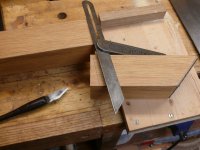
I positioned the frame centrally, by shifting it around until the distance from the edge of the frame to the rim was the same all round, measured with a combination square. I marked through the holes with a brad point drill bit, then pulled the frame aside and used an 8mm brad point bit in a power drill to make five blind holes in the right places. I was very glad of the depth stop!

Each one got a little bit of a countersink in my usual way.

P1100357.JPG

I then inserted some M6 threaded inserts into the holes. I found it easier to start these if I used a hex bit in a screwdriver rather than just the usual L-shaped Allen key.

P1100358.JPG

Each one then got a suitable length M6 screw and washer.

P1100359.JPG

I reckon that the M6 screws have about 2mm leeway in any direction in their 3/8" holes, and the washers have about the same. I think this should be enough on this top but time will tell. Joining the table together this way makes it easy to transport in a domestic car, with no need for a van. It seems to be quite steady.

I considered trying the legs in each of the possible positions but decided it was too much faff, so I just numbered them in place for re-assembly as shown, which I know works.

With that done it was time to remove all the screws again and have another big tidy up.

I then went over the underside of the table with some 180 grit Abranet (hand pad + vacuum cleaner) and wiped on some Osmo Poly-X satin. I chose that because I have some in hand which is old but probably ok, and because it should at least be good enough for the underneath. If there are any issues, I'll get some new stuff. It certainly brought out the rather nice grain:

P1100360.JPG

P1100361.JPG

So, when that's dry and I can give the other side a few coats, this table will be finished. It's been an enjoyable little build and satisfying to use salvaged materials yet again.
 
The depth stop is interesting, I have never seen one around here for sale!
Andy, what is your ceiling height?
Looking good(y)
 
The depth stop is interesting, I have never seen one around here for sale!
Andy, what is your ceiling height?
Looking good(y)
The depth stop is a Stanley #49, listed by them as an "adjustable bit gauge" and apparently made from 1905 to 1961. I bought it just because I thought it was a cleverly thought-out shape, a tribute to the pre-computer skills of the old draughtsmen, pattern makers and iron founders. But it clamps securely to most types and sizes of augur bit and is an effective and reliable tool when the need arises.


My ceiling height is about 6'3" at the right hand end of the bench and a little bit more at the left hand end - Victorian builders were not too bothered about making floors flat or horizontal! Fortunately, I'm of average height and it's not a problem, except on bigger projects.
 
The depth stop is a Stanley #49, listed by them as an "adjustable bit gauge" and apparently made from 1905 to 1961. I bought it just because I thought it was a cleverly thought-out shape, a tribute to the pre-computer skills of the old draughtsmen, pattern makers and iron founders. But it clamps securely to most types and sizes of augur bit and is an effective and reliable tool when the need arises.


My ceiling height is about 6'3" at the right hand end of the bench and a little bit more at the left hand end - Victorian builders were not too bothered about making floors flat or horizontal! Fortunately, I'm of average height and it's not a problem, except on bigger projects.
Reminds me of a home we owned in Toronto, built in 1907. The basement floor slopped to a floor drain and also a low ceiling of 6' 4".
Over time I did renovations which included a rec room, laundry room with a toilet and a walk out.
It is odd how one can adapt to an area with a low ceiling.
 
I can adapt to a low ceiling, but turns out I can’t adapt to a low doorway as the dents in my forehead and scrapes on the top of my head will attest. I dream of the day I’ll take a recip saw to my workshed, slice it horizontally all the way around, and jack up the upper half another foot so that I can walk through the door unharmed.
 
Goodness me, Andy.......your collection! I've never heard of those auger depth stops, and I've never seen spur auger bits in their original box (and how lovely is that box!!). And that's before we come to the 3 or 4 different braces used just in this single episode. Marvellous.
 
Nice workshop, Andy.
Mine gets just as cluttered, must clean up daily.
Yours is a 'work' shop, not a show shop, as is mine.

Thanks!
I ought to do something about the mess of bits of wood behind the bench. They're lying on an old sofa frame that I stripped down years ago, then decided not to reupholster. Somehow it's not quite made it to the top of the to-do list! The boxes/drawers hold an assortment of very useful little offcuts 😏
 
Thanks!
I ought to do something about the mess of bits of wood behind the bench. They're lying on an old sofa frame that I stripped down years ago, then decided not to reupholster. Somehow it's not quite made it to the top of the to-do list! The boxes/drawers hold an assortment of very useful little offcuts 😏
A couple of years ago I nearly asked the collective about all the bits of wood that have a purpose that are strewn across our benches, but it seemed a bit naff and I thought I might be the only one!
 
When I turned the table top over to oil the 'show' side I noticed that somehow, despite my precautions, it had gained a new scar:
P1100362.JPG

Not good! I decided to try and steam it out. A while ago, my wife was given a cheap Chinese-made miniature iron. Apparently they get used by people making their own greetings cards or artificial flowers. So far it's been used once, by me, to stick back some veneer that had started to lift off. I thought it might work on this, so I put a bit of damp rag over the dent and ironed it for a little while:


P1100363.JPG

This picture is of the same spot at the same angle, with the last trace of damp to show you where the dent was:

P1100364.JPG

and here it is, under two coats of oil. The mark is still there and probably visible on a big screen if you stare hard, but for all practical purposes it has disappeared. A very simple and satisfying fix.

P1100366.JPG

Time to call this one done. But I won't be delivering it just yet, so for a little while it can rest here to let the oil fully cure. (Ignore the extra vertical bits of wood - they are the legs of a high bed, soon to be moved on.)

I think that at a total cost of zero for the materials and a couple of pounds for the long screws, it will do!

P1100368.JPG
 
Well done with the scar. That's the same process I used when I ding my instruments during the build. I try not to, but hey ho.
 
That's a great result, thanks for posting the WIP Andy. I really enjoyed reading that. It always amazes me how much a bit of steam can do to get rid of dents.
 
Back
Top