• Hi all and welcome to TheWoodHaven2 brought into the 21st Century, kicking and screaming! We all have Alasdair to thank for the vast bulk of the heavy lifting to get us here, no more so than me because he's taken away a huge burden of responsibility from my shoulders and brought us to this new shiny home, with all your previous content (hopefully) still intact! Please peruse and feed back. There is still plenty to do, like changing the colour scheme, adding the banner graphic, tweaking the odd setting here and there so I have added a new thread in the 'Technical Issues, Bugs and Feature Requests' forum for you to add any issues you find, any missing settings or just anything you'd like to see added/removed from the feature set that Xenforo offers. We will get to everything over the coming weeks so please be patient, but add anything at all to the thread I mention above and we promise to get to them over the next few days/weeks/months. In the meantime, please enjoy!

3mm x 3mm x 1m Groove

Windows

Old Oak
Joined
Jan 25, 2022
Messages
1,433
Reaction score
433
Location
Cumbria & West Kent
I’m making a flyscreen and I want to attach the mesh to the frame using spline in the American style. For this I need a small groove in the wood. But I don’t have many tools here: a dozuki, mallet, a few chisels (smallest chisel is 4mm), record 405 (no blade for cutting such a small groove). I might be able to find other bits and bobs, but given these limitations, how would you go about creating a 3mm x 3mm groove about a meter long? Shape of the groove doesn’t matter too much, just needs to be slightly smaller than the spline.
 
If you envision making more of these grooves, I'd be tempted to make a blade for the 405 out of a piece of 3mm square HSS bar, you won't be able to adjust it conventionally and it'll be a bit of a pain to set up initially but it will be a lot easier than other methods.

A bit more spendy, but I think this will work with the 405, you could lap one edge if you require an exact 3mm groove: https://www.axminstertools.com/veri...utm_content=2266&tagrid=51649491&glCountry=GB

Alternatively, find a piece of 3mm wide metal, clamp a straight piece of timber to your workpiece as a fence and run the 3mm piece of metal along the work and fence in a scraping motion, very slow and quite hard work but it will do the job in a pinch.
 
I'd tempted to make a scratch stock from a stanley knife blade given the limited tools you have. this does assume you have one with you though, obviously, and you don't list it in your tools. seems the cheapest item to buy along with a file to my mind.
 
Depends on how precious your dozuki is. I would make a L shaped block with the dog leg acting as a guide and depth gauge and sized to give me the edge side cut of the groove and then screw the saw blade to it and use it as a kerfing saw and then add a spacer behind the blade to give me the other side of the groove and then chop out witht he back face of a chisel.
 
A real faf and probably not a doable proposition but one way is to take a groove out with the blade you do have and then glue a small strip back in leaving you the groove you require. Ian
 
A scratch stock would work. But I'd go with Alan's (Droogs') method, personally.
 
It's a shame that you do not have a 3mm chisel as Paul Sellers has a good video on making a plough plane using a chisel as the blade. A scratch stock would do it.... an old jigsaw blade is a possible blade source.
 
If your405 has a 1/8" cutter you could grind 0.2mm off it at ane end and make a dual-size cutter. If it lacks any cutters at all, this is the time to make or buy some.

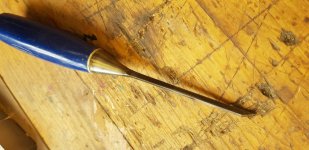
Personally, this looks like a good excuse to buy a 3mm chisel - it's more useful than you might think.

But if you want a one-off without shopping, you could make a chisel-in-a-block plane with a suitable 3mm diameter screwdriver sharpened, or a stout woodscrew. If you put the screw through the block first, you can use the wood as a handle while grinding. It would even be adjustable!
 
The problem with a 3mm chisel is in my experience they are a bit too springy for this type of job (or at least the ones I have are). I do not think I cut create a neat groove with mine. That might reflect on me rather than the tool! There is a saying about that.
I would use a plough plane.
If you want to spend mega bucks on it, Veritas' router plane accessories include cutters for stringing (inlay). That would get you started with sharp edges and then plough out the depth.
 
Thanks for all the ideas. I experimented on scrap using the slightly too large chisel between saw kerfs, but it was a faff so, for today, I just went with attaching the mesh to the frame with duct tape. I found creating a too-large groove with the chisel pretty quick and easy though, so I ordered a smaller chisel to arrive tomorrow and will do the next frame with that. The 405 does have all its blades, but don’t have access to any tools for adjusting them. I found maybe 8 different card scrapers in my mum’s garage (she used to do furniture restoration), but no hacksaws or similar.

Still, I now have a couple of simple fly screens: found some 34mm x 12mm x 2400mm rectangular beading here and used that with half laps - shoulders cross cut on the dozuki and chiselled down from the ends. All put together on a 40 year old black and decker workmate. One is for an upper sash and just squeezes behind the front bead if angled carefully. The other is for a lower sash and sits flush in the space formed by the front bead with its top-back resting against the open sash and nestled in its handle.

The mesh is supposed to be fine enough that it reduces pollen. Anyone have any experience of pollen mesh? I have my doubts.
 
Windows":2ili9v5r said:
The 405 does have all its blades, but don’t have access to any tools for adjusting them.

I must be imagining this job wrong. Does it really need a 3mm groove not 3.2mm?
 
Probably sub-3 mm would be ideal. The spline is quite thin. There’s tolerance because the goal is to squish the spline and I don’t know what channel size is supposed to be, but 3mm is probably close to upper limit. I think I only have the basic set of 405 blades? I have a box that appears to be full, but smallest is 3/16”.

I see mentions of 1/8” cutter as standard online. I’ll have to have another look.

Edit: Nope. It’s got an 1/8” bead, but otherwise 3/16” is the smallest I’ve got.

Edit2: I see that I am indeed mistaken in thinking we had all the cutters. It’s missing the 1/8”.
 
Just to provide a summary somewhere, I've now created a few of these window screens and this is what I ended up using:

1. 16 x 38mm 2.1m Planed Redwood from Travis Perkins
2. 4mm rubber window screen spline
3. Pollen screen/flyscreen mesh
4. Glue or screws

Each screen is specific to a particular window - they all attach differently: wedged in the wooden opening in front of a sash, captured by the handle of a sash, trapped from above by the body of a sash, or fitting in the channel used for secondary glazing - so no fixings to attach the screen to the window - just gravity or wedging was enough.

In terms of tools, I used:
1. Dozuki for cross cuts
2. 3/4" chisel for doing half laps
3. 3mm chisel for doing the groove for the spline
4. Spline roller tool for shoving the spline in the groove

The inside of the groove is 1cm in from the inside of the screen, 3mm wide, and maybe 5mm deep.

After a few of these I was able to chisel the grooves fairly efficiently. Key is that the groove is not going to be seen and as long as it's fairly close to size it's going to hold the spline. I drew or scored a single line (scoring turned out not to be essential) for the channel then pared with the 3mm chisel to get the channel. As long as I went with the grain everything worked out great. The exact depth of the chanel and the texture of the sides are not important to the function and not visible so no need to be super neat.

I tried a few different ways of attaching the screen as well as the spline+channel method. Spline+channel was easily the best quality in terms of getting a nice tension on the screen and easy to try again if the tension wasn't right first time. The time it takes to cut the channels is the downside of that method.
 
Back
Top