- Joined
- Jul 21, 2014
- Messages
- 10,414
- Reaction score
- 165
About 4 years ago I posted this viewtopic.php?f=20&t=387
on some of the maths behind setting out curves that are sections of circles but this post will be a bit more about application to a task and ending up with a neat method involving no maths at all.
I'm sure many of you sat in geometry lessons in your teens and wonder what is all this stuff for and when would I ever want to prove so and so's theorem in real life and yes I agree. However every now and then the results (not the proof!) come in handy in woodwork, metalwork and construction jobs.
This is all about one property of circles and chords. A chord is simply a line starting on the edge of a circle and going to another point on the edge of a circle (circumference). A special case of a chord which passes through the centre of the circle is a diameter. That's the definitions out of the way.
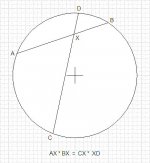
Here we have a couple of chords of a circle that cross each other at point X. The magic theorem is written below and holds true for any pair of intersecting chords. This might be handy for all sorts of things but becomes good for a common application when we add some restrictions on the chords shown below.

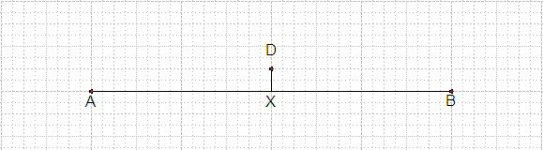
Here we make one chord be a diameter and the other one cross it at right angles ie the angle at X is 90 degrees.
The formula is the same but as AX=XB we can re-write it slightly.
So if we want to mark out a curve on a job to give a more pleasing line from A to B following the circle we need to know where the centre of that circle is in order to draw it.
Lets pick some numbers. I'm making a curved rail for a footstool that will be 500mm long ie AB=500 and I'd like the deviation of the curve from the boring straight line AB to be 25mm ie XD=25
From the formula we have that 250 * 250 = 25 * XC so XC= 250*250/25.
Nice easy numbers as it happens and XC = 2500mm. The diameter of the circle CD is therefore 2525mm and the centre of the circle lies 2525/2 = 1262.5mm from each of A, B and D.
So to mark out that curve is just about feasible on a big bench or wait till the mrs is out and use the living room floor.
The more gentle the curve you want the bigger the dimensions get.
Lets say you want to curve the long edges of a dining table 2m long and have it 50mm wider in the middle.
So AX =1m and DX = 0.025m Plug those into the formula and you get CX =1*1/0.025 =40m !! the diameter becomes 40.025 and the radius = 20.0125!
For some of us, our gardens are even big enough to mark that one out!
Next time I'll describe a method to set that curve out that involves no calculations and can be done in a realistic space.
Hope this is of interest so far.
Bob
on some of the maths behind setting out curves that are sections of circles but this post will be a bit more about application to a task and ending up with a neat method involving no maths at all.
I'm sure many of you sat in geometry lessons in your teens and wonder what is all this stuff for and when would I ever want to prove so and so's theorem in real life and yes I agree. However every now and then the results (not the proof!) come in handy in woodwork, metalwork and construction jobs.
This is all about one property of circles and chords. A chord is simply a line starting on the edge of a circle and going to another point on the edge of a circle (circumference). A special case of a chord which passes through the centre of the circle is a diameter. That's the definitions out of the way.
Here we have a couple of chords of a circle that cross each other at point X. The magic theorem is written below and holds true for any pair of intersecting chords. This might be handy for all sorts of things but becomes good for a common application when we add some restrictions on the chords shown below.
Here we make one chord be a diameter and the other one cross it at right angles ie the angle at X is 90 degrees.
The formula is the same but as AX=XB we can re-write it slightly.
So if we want to mark out a curve on a job to give a more pleasing line from A to B following the circle we need to know where the centre of that circle is in order to draw it.
Lets pick some numbers. I'm making a curved rail for a footstool that will be 500mm long ie AB=500 and I'd like the deviation of the curve from the boring straight line AB to be 25mm ie XD=25
From the formula we have that 250 * 250 = 25 * XC so XC= 250*250/25.
Nice easy numbers as it happens and XC = 2500mm. The diameter of the circle CD is therefore 2525mm and the centre of the circle lies 2525/2 = 1262.5mm from each of A, B and D.
So to mark out that curve is just about feasible on a big bench or wait till the mrs is out and use the living room floor.
The more gentle the curve you want the bigger the dimensions get.
Lets say you want to curve the long edges of a dining table 2m long and have it 50mm wider in the middle.
So AX =1m and DX = 0.025m Plug those into the formula and you get CX =1*1/0.025 =40m !! the diameter becomes 40.025 and the radius = 20.0125!
For some of us, our gardens are even big enough to mark that one out!
Next time I'll describe a method to set that curve out that involves no calculations and can be done in a realistic space.
Hope this is of interest so far.
Bob