• Hi all and welcome to TheWoodHaven2 brought into the 21st Century, kicking and screaming! We all have Alasdair to thank for the vast bulk of the heavy lifting to get us here, no more so than me because he's taken away a huge burden of responsibility from my shoulders and brought us to this new shiny home, with all your previous content (hopefully) still intact! Please peruse and feed back. There is still plenty to do, like changing the colour scheme, adding the banner graphic, tweaking the odd setting here and there so I have added a new thread in the 'Technical Issues, Bugs and Feature Requests' forum for you to add any issues you find, any missing settings or just anything you'd like to see added/removed from the feature set that Xenforo offers. We will get to everything over the coming weeks so please be patient, but add anything at all to the thread I mention above and we promise to get to them over the next few days/weeks/months. In the meantime, please enjoy!

A quick bench hook thing

Dr.Al

Old Oak
Joined
Dec 31, 2020
Messages
3,893
Reaction score
2,815
Location
Dursley, Gloucestershire
Name
Al
I couldn't find a general "Stuff you have made today" thread like the one on mig-welding.co.uk, so I guess the etiquette here is to make a new thread with things?

Made myself an oak (ridiculous I know, but it's what I've got) back-to-front overdesigned bench hook:

bench_hook_front_800.jpg

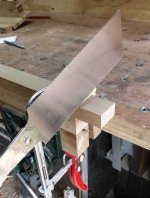
The right-hand end is use with backless Japanese (pull) saws - either in the slot, which is the width of my Japanese saw's kerf or on the end (which has magnets glued into it to keep the saw running true):
bench_hook_end_800.jpg

The other end also has magnets set into it but has a slightly lower top: this can be used (with the jig the other way round) with a western saw. The relieved end is to account for the back of the western tenon saw.

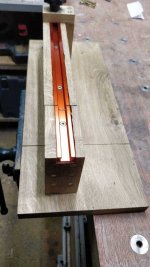
The T-track in the top allows me to use a stop if I want to cut multiple pieces to the same length. Probably a bit pointless; I installed the T-track as an easy way to hang it underneath my bench so it's immediately available and figured while I was at it I'd make a stop.

As with my MDF shooting board, the "cleat/hook" on the bottom isn't actually a cleat, it's four 20 mm dowels:

bench_hook_base_800.jpg

Three of them go in the jaws of the vice under normal use (the vice doesn't have to be tightened) so the moving jaw of the vice counters the pulling action of the saw. Using dowels means I can put it in a different place (or turn through 90°) if I want by putting the dowels into the dog holes on the bench.
 
I'll be very interested to see how this works out in practise, over time. Over the years my bench hooks have become less and less sophisticated because you start destroying them as soon as you start using them. I'm curious as to how much use you get from the T track element of the design.

I don't use Japanese saws, so I'm only guessing here........but with the work presumably being on the far side of a high "wall", won't you have great difficulty in seeing what you are doing?
 
I might be wrong, Mike, but my god school master taught me that you should be seeing the two adjacent sides being cut to maintain a straight cut. For a pull saw, aren't they the top and the the side closest to you?
 
Well yes, Malcolm, but they're the same two lines you need to see when using a western saw. I'm just not sure how you see any lines at all with this arrangement. I'm not being critical, BTW. If this set up works then great. It's just so different from mine that I don't quite understand how it is going to work.
 
Mike G":3fbzmycc said:
I'll be very interested to see how this works out in practise, over time. Over the years my bench hooks have become less and less sophisticated because you start destroying them as soon as you start using them. I'm curious as to how much use you get from the T track element of the design.

I don't use Japanese saws, so I'm only guessing here........but with the work presumably being on the far side of a high "wall", won't you have great difficulty in seeing what you are doing?

Like you, I'll be interested to see how it works out. I've got some little magnetic guides I made a while ago. The 90° one in particular gets used all the time:

magnet_saw_jigs_800.jpg

They've all got hooks for the workpiece and then the saw 'sticks' to the magnet and really helps me saw straight! The dovetail one can be used for marking out as well as cutting; the 90° one has got an undercut that prevents that but stops the saw teeth from beating it up. The 45° one was a triumph of optimism over achievement...

It's true that I can't really see what I'm doing while the cut progresses (although it shouldn't be too bad with the magnetic one as you can see round the corner a bit - I haven't used them yet as the magnets only arrived today and t he glue is still drying). Setting it up is fine though as you can look over the top (it's right at the front of the bench so this is easy) and line it up. Once it is in the right place, I hold it firmly and rely on the jig to make me cut square! The idea being I don't really need to see what's going on.

Experience will show whether this works or not, but the first few attempts have been pretty good; certainly a lot better than I can do without a jig.

As for the T-track, yes: it's almost certainly a daft idea, but I had the T-track lying around and wanted a way to store it in a very narrow little channel under the bench. It's an awkward little space as it's narrower at the top than lower down, so having this hanging from it's T-track actually fits rather perfectly. Being a track type thing, I can slide it in and out really quickly. The end stop probably won't get a lot of use, but it can be mounted on the unused side when not in use so it doesn't get in the way.
 
Dr.Al":10nu94vf said:
It's true that I can't really see what I'm doing while the cut progresses (although it shouldn't be too bad with the magnetic one as you can see round the corner a bit - I haven't used them yet as the magnets only arrived today and t he glue is still drying). Setting it up is fine though as you can look over the top (it's right at the front of the bench so this is easy) and line it up. Once it is in the right place, I hold it firmly and rely on the jig to make me cut square! The idea being I don't really need to see what's going on.
That makes perfect sense to me. I made a saw guide for cutting dovetails. Now I don't even bother using a dovetail template to mark the sides of the tails, so it doesn't make any difference if I can see or not because I have no line to follow anyway. I mark the tail spacing on the end of the board and I mark the shoulder lines so I know when to stop sawing. After that I just put my saw at a mark on the end of the board, slide my saw guide up to it and cut down the side of the guide. I can see a similar approach working with a bench hook.

My bench hooks are always rough and ready. But then, any tool or jig I make is rough and ready; I want to make things and I am not particularly interested in making things that make things. The only exception is if I want to practise a joint before using it on a real project I might incorporate it into something I convince myself will be useful in the workshop.
 
Interesting concept Dr Al, can’t quite get my head round the intricacies of the 3 additions so perhaps a few photos of you cutting things with the different elements attached would be good pls. Ian
 
Just4fun":36bhupti said:
My bench hooks are always rough and ready. But then, any tool or jig I make is rough and ready; I want to make things and I am not particularly interested in making things that make things. The only exception is if I want to practise a joint before using it on a real project I might incorporate it into something I convince myself will be useful in the workshop.

I really enjoy the process of making the jigs (possibly even more than I enjoy making the final pieces). I like the challenges associated with making sure the jig is absolutely spot on (as otherwise everything made with the jig will have inherent errors). Believe it or not, I think of this bench hook as quite rough and ready. The fence bit was a bit of oak worktop offcut that I left at its original size. The base bit was from a longer length that I cut in half, but other than fixing them together, drilling the holes for the magnets and cutting the slot for the T-track, there wasn't much to it. If you ignore magnet glue drying time, it took me about an hour to make it.

I realise it could have been quicker with a bit of plywood and two bits of wood attached for a cleat and fence, but I think you need more than that for a pull-saw bench hook as (as Mike G said) you can't see what's going on so you need to be able to rely on the jig to make the cut be square.
 
Cabinetman":2h2an1nq said:
Interesting concept Dr Al, can’t quite get my head round the intricacies of the 3 additions so perhaps a few photos of you cutting things with the different elements attached would be good pls. Ian

I'm not sure there's much in the way of intricacies, but I've tried to take some photos. They're entirely posed and use clamps where I usually wouldn't bother. The clamps are there because I don't have enough hands to take a photo as well as hold the jigs! I also haven't bothered to take a photo of the mitre jig - it doesn't work that well anyway to be honest as the angle is so shallow that the saw can ride along the wood.

Right, let's start with the crosscut jig. Here it is clamped up and ready for a Japanese saw:

sawjigs_setup_for_japanese_saw_crosscut_800.jpg

As I said, in practice I'd usually just hold it in my hand (and in practice it can be the other way round if desired - with the 'fence' bit on the front edge - as long as you hold it firmly).

With a Japanese saw in place:

sawjigs_japanese_saw_crosscut_800.jpg

The magnets hold it flat and square (although you can't see the handle in this photo, I'm not holding it - the 6 × 3 mm magnets are holding the weight of the saw), so when you pull on the saw, it naturally cuts square.

Turning it around like this:

sawjigs_setup_for_western_saw_crosscut_800.jpg

Means I can use my Western tenon saw (a fairly cheap one that I don't like very much) with it:

sawjigs_western_saw_crosscut_800.jpg

I don't usually do this as I much prefer my Gyokucho Ryoba.

The dovetail saw goes on the end of a bit of wood like this:

sawjigs_setup_for_dovetail_800.jpg

It doesn't have the undercut that I put on the crosscut one (to be honest, the undercut probably isn't necessary, it just stops the wood pushing the saw out where the teeth are kerfed). The lack of an undercut means you can use it for marking out dovetails if desired (it's a 1:7 angle).

Here it is with a saw in place:

sawjigs_dovetail_800.jpg

I've got a Shogun Dozuki (Japanese dovetail saw) but I don't really like it as much as my (eye-wateringly expensive) Pax dovetail saw, so I haven't used the dovetail jig the other way round (although there's no reason you couldn't).

The dovetail one is slightly more awkward to use when you're using the left-hand side (as you look at it) as your hands are crossing if you hold it in your left-hand and cut with your right, but there are easy alternatives for this: either hold the saw in the left hand, clamp the jig in place and work one-handed, or turn the workpiece around and work from the other side.

Urgh, this forum software makes adding images hard work...

Does all of that make sense? Have I actually answered the question you were asking or have I completely misunderstood?!
 
Agree about image posting ;) Roll on new software.

Re the saws, I use a mix of Japanese and Western hand saws. For dovetails I find a Japanese saw unnatural, especially as the small saws with many teeth, tend to have a back stiffener. Mine do. I agree that a good quality back saw is much better for dovetails. I nearly always use a Veritas dovetail saw.

Personally I prefer to see the cut fully, and invariably cut by eye to a marked line. Clamping on a magnetic guide would slow me down a lot as I would expect to stick a plank (or pair) in the vice and do all of the cuts in a minute or two.

All this said, I am very interested in your approach to work, tools and jigs and am open minded about changing my methods and trying new things. With fine work (which I am trying to move towards) precision is more important than speed.
 
Yes that covered it nicely thank you very much, I was thinking you were going to use them with your bench hook Doh!
You could make a left-hand one for dovetails then you wouldn’t have to cross your hands I suppose? Ian
 
Dr.Al":1c7sahb9 said:
I really enjoy the process of making the jigs (possibly even more than I enjoy making the final pieces). I like the challenges associated with making sure the jig is absolutely spot on (as otherwise everything made with the jig will have inherent errors).
Oh I quite understand the attraction of that and I wouldn't knock it, it just isn't my approach. Yes, I make jigs & tools accurately, but I accept crude solutions that might make others cringe.
 
AJB Temple":vomxo745 said:
Clamping on a magnetic guide would slow me down a lot as I would expect to stick a plank (or pair) in the vice and do all of the cuts in a minute or two.
Agreed, but to be fair Dr.Al does say he doesn't usually use clamps and with no clamping I believe sawing with a guide is probably not significantly faster or slower than cutting by eye. I cut dovetails with a self-made guide and I don't see any noticeable speed gain or speed penalty.
 
Probably many of us have a personal system for dovetails that gets us the right side of the line to get us tight joints. With a template I am pretty sure I would screw up positioning. But that's me being set in a method.

I am still using the hardwood bench hook I made as a kid, though it is a trifle battered now.

(To batter a trifle you must first freeze the trifle and refrigerate the batter. It's an upmarket delicacy in Scotland, for those who eschew beaten up mars bars).
 
Just4fun":2a4zp90t said:
Dr.Al":2a4zp90t said:
Oh I quite understand the attraction of that and I wouldn't knock it, it just isn't my approach. Yes, I make jigs & tools accurately, but I accept crude solutions that might make others cringe.

I'm in the Dr Al camp here, I love making jigs because they focus the mind - do it right once and you make all future tasks a lot easier.

I found some nice jigs for doing dovetails with a router, so I'll be making those. I'm not even sure Dr Al's saw jigs could help my sawing technique though.
 
Just4fun":ej5rnxws said:
AJB Temple":ej5rnxws said:
Clamping on a magnetic guide would slow me down a lot as I would expect to stick a plank (or pair) in the vice and do all of the cuts in a minute or two.
Agreed, but to be fair Dr.Al does say he doesn't usually use clamps and with no clamping I believe sawing with a guide is probably not significantly faster or slower than cutting by eye. I cut dovetails with a self-made guide and I don't see any noticeable speed gain or speed penalty.

Yes, the clamps were just to let me take photos. When I use them I just drop them on the line and start cutting. As I don't have to engage the brain at all when cutting (just let the jig guide me), it's a little bit quicker overall than doing it manually (and much more accurate thanks to my lack of manual skill!)
 
Cabinetman":34qgp9xq said:
You could make a left-hand one for dovetails then you wouldn’t have to cross your hands I suppose? Ian

I'm not sure what you mean to be honest. The issue is that you're trying to cut on the left-hand side of the jig. If you had an inverted version, it would hang off the end of the wood when cutting the left-most dovetail & that really wouldn't work.

I think the easiest option is to just use the right-hand side of the jig, but turn the wood round to get the two angles. I've got some dovetails to cut tomorrow, so I'll give that a try.
 
AJB Temple":6n5qmqz2 said:
Probably many of us have a personal system for dovetails that gets us the right side of the line to get us tight joints. With a template I am pretty sure I would screw up positioning. But that's me being set in a method.

I am still using the hardwood bench hook I made as a kid, though it is a trifle battered now.

(To batter a trifle you must first freeze the trifle and refrigerate the batter. It's an upmarket delicacy in Scotland, for those who eschew beaten up mars bars).

I agree the trifle should be frozen but if you refrigerate the batter it’s going to take longer to cook, I would’ve thought the batter should be at room temperature as you won’t have to raise its temperature as much, it’s a very mootpoint as we’re only talking about a few degrees and I don’t suppose it will make any difference to a connoisseur of battered trifle – do they really eat it?
 
AJB Temple":e2m9eso0 said:
Agree about image posting ;) Roll on new software.

Is an upgrade planned?

AJB Temple":e2m9eso0 said:
Re the saws, I use a mix of Japanese and Western hand saws. For dovetails I find a Japanese saw unnatural, especially as the small saws with many teeth, tend to have a back stiffener. Mine do. I agree that a good quality back saw is much better for dovetails. I nearly always use a Veritas dovetail saw.

My Japanese dovetail saw has a back stiffener too. To be honest, I'm not sure what it is about it I don't like about it. I've tried it freehand & it's much harder to control than the western Pax saw & didn't leave as good a finish. Might be okay with the jig, but I've kinda lost faith in it already!

AJB Temple":e2m9eso0 said:
Personally I prefer to see the cut fully, and invariably cut by eye to a marked line. Clamping on a magnetic guide would slow me down a lot as I would expect to stick a plank (or pair) in the vice and do all of the cuts in a minute or two.

As discussed above, no clamps are involved, so speed isn't really an issue. I'm still learning all this wood bothering malarky having only made my first ever project last June-ish. The jigs are there to allow me to make stuff with hand tools without needing too much skill, while I practise the skills in parallel (and because I like making jigs).

AJB Temple":e2m9eso0 said:
All this said, I am very interested in your approach to work, tools and jigs and am open minded about changing my methods and trying new things. With fine work (which I am trying to move towards) precision is more important than speed.

It's all very much a learning process for me. I'd literally never cut into a bit of hardwood before June last year: my woodworking had been limited to odd bits and pieces with tanalised (not sure how you spell that) timber for planters or whatever, all done with power tools. This whole hand tool joinery business is new and exciting to me!
 
Dr.Al":3t79xack said:
Is an upgrade planned?

Yep, but I wouldn’t start the stopwatch quite yet.

It might not be the fastest or most intuitive but it’s solid and has worked fine up to now.

I know there’s better out there, and we will get round to bringing us right up to date, but it’s not top of the priority list right now.
 
TrimTheKing":1355dwnc said:
Dr.Al":1355dwnc said:
Is an upgrade planned?

Yep, but I wouldn’t start the stopwatch quite yet.

It might not be the fastest or most intuitive but it’s solid and has worked fine up to now.

I know there’s better out there, and we will get round to bringing us right up to date, but it’s not top of the priority list right now.

Great to know, thanks!
 
Back
Top