• Hi all and welcome to TheWoodHaven2 brought into the 21st Century, kicking and screaming! We all have Alasdair to thank for the vast bulk of the heavy lifting to get us here, no more so than me because he's taken away a huge burden of responsibility from my shoulders and brought us to this new shiny home, with all your previous content (hopefully) still intact! Please peruse and feed back. There is still plenty to do, like changing the colour scheme, adding the banner graphic, tweaking the odd setting here and there so I have added a new thread in the 'Technical Issues, Bugs and Feature Requests' forum for you to add any issues you find, any missing settings or just anything you'd like to see added/removed from the feature set that Xenforo offers. We will get to everything over the coming weeks so please be patient, but add anything at all to the thread I mention above and we promise to get to them over the next few days/weeks/months. In the meantime, please enjoy!

A Walnut workout - with added box - finished!

AndyT

Old Oak
Joined
Nov 23, 2020
Messages
3,633
Reaction score
1,412
Location
Bristol
Name
Andy
What's a good thing to do on a wet Saturday morning? Drive to a gym, pay loads to share the air with dangerous strangers? Or get some healthy exercise in your own workshop... No question really - that's not the dilemma.

I have this useful-looking chunk of walnut, kindly given to me a few years ago.

IMG_7496.JPG

A while ago, I noticed it had some flight holes on the surface. Not being sunnybob, I didn't reach for a flamethrower. Instead, I circled all the holes, noted the date and put it back on the rack.

IMG_7497.JPG

About a month later, I looked again and saw that a few fresh holes had appeared. Time to do something about it.

IMG_7498.JPG

I thought it would be a good idea to split the piece into two thinner boards. This would allow me to see how deep the damage goes and maybe get some material suitable for making a Useful Box to Put Things In, or some such quick project that would use the wood effectively. So it was time to get ripping.

Now, I do have a bandsaw, but it only cuts 3" deep and this is over 4". I could call in a favour and get someone else to cut this down on a bigger saw, but I also have a choice of muesli powered ripsaws and frankly, I need a bit of exercise.

I am aware that there has been a lot of online chatter elsewhere about something called a "kerfing plane" as an aid when rip sawing. It seems to lead back to a guy on YouTube called Tom Fidgen, but as far as I can see the idea has a somewhat shaky historical basis. It's not a standard tool that appears in catalogues or instructional texts. However, a while back, Richard Arnold, whose work I really do respect, did an exercise where he set out to test a statement in Walter Rose's book "The Village Carpenter". Rose wrote that making a four panel door, starting from sawn timber and getting out the stiles and rails by hand, was a good day's work. He wrote an excellent article about it in Mortise and Tenon magazine, issue seven. Admittedly, he was only ripping to width in 1½" softwood, but he ploughed a groove on both sides of the wood first and says it makes a big difference to the time and effort required. He thinks this practice is probably one reason why so many old planes have the no 1 iron almost used up.

Because the grain was a bit wavy on this chunk of walnut, I started by marking a pair of lines all round.

IMG_7499.JPG

I then ploughed the groove, about an eighth wide. I failed to take any posed action shots of this step, but you can see the plane in the next photo, where I have not put it away.

Time for a digression/experiment. I've done some deep ripping by hand before and I know it needs a bit of effort, so it makes sense to be efficient. I'd only used ordinary western style rip saws, but a while back someone on another forum offered a good as new ECE framesaw with a coarse rip blade and I was tempted enough to buy it. This was my first proper go at using it.

IMG_7500.JPG

I know they are the normal choice of saw in much of Europe and have been since Joseph's day, but I didn't like it. It's firm, light and comfortable to hold, with a narrow kerf and the blade feels very sharp, but it just didn't remove much wood. I swapped to something more familiar - my G Harding 3½ tpi. (Simon Barley in BSSM says that this is probably a second quality line from about the 1880s, which fits with it having split nuts and a London pattern handle.) Here's a side by side comparison:

IMG_7501.JPG

IMG_7502.JPG

This made much better progress. Some of the difference is probably down to my own lack of experience with the framesaw and some must be because of the coarser teeth, but I think most of it is about the weight of the saw naturally cutting down. There's no need to strain your wrist pushing down into the wood, you really can let the saw do the work while you just push it backwards and forwards.

Anyway, the cut was completed in about half an hour, I worked up a bit of a sweat and felt better for it. :)

Here's the result:

IMG_7504.JPG

The only visible damage is a few very small holes which it would be easy to fill.

IMG_7505.JPG

And here are the two boards side by side after a preliminary clean up with a jack plane. It's clear to me that the insect damage is in the sapwood, which is also a bit softer than the rest. After sawing, the grain was quite torn up on the sapwood - you can still see where in those ripply looking areas.

IMG_7509.JPG

So, what shall I do next?

My inclination is to slap some 5-star wood treatment over all the surfaces, wait a while for it to dry, then make a box with the bits I have. Should I do that?

Should I cut off all the sapwood, throw that away and make a much smaller box with what's left?

Or am I just wasting my time? Will it only be disappointing?

Shall I just take out a subscription to our nearest Bannatyne's and give up now?
And does anyone want to make me an offer for a nearly-new frame saw? ;)
 
Just testing my understanding, so bear with me?
Do you know what the moisture content of the wood is, Andy? If it's above about 12%, I'd be tempted to bring it into the house in autumn to dry with the central heating for a couple of months, once it's on. If I've got this right, they fly in spring/ early summer, so shouldn't cause a problem in the house come autumn. Once the MC is below 12%-ish, they won't survive and your wood is good.
Please correct as appropriate!
 
This is very timely, Andy, as I, too, have recently been given a nice piece of walnut with free holes.
My holes are entirely in a small patch of encroaching sapwood, so I think I'll just cut that patch out. No idea what I shall use the board for, either. I'll take a pic when I go down to the workshop.
S
 
Walnut (and Oak) are diabolical for worm damage and it usually always happens in the sap, but the little blighters will migrate to the heartwood if you leave it long enough. My standard plan of attack with any new boards of either timber is to hack off all the softwood, chop it into little bits and dispose of it either in my neighbour’s wood burner or alternatively in the grey wheely bin.

So, the $64 million dollar question is what to do with yonder lump of nicely book matched walnut? For my money, there’s got to be some sort of box in there somewhere? - Rob

Edit - cut off all the sap, complete with ‘oles and use what’s left of the heartwood. Don’t even think about staining/colouring/filling the sap because you’ll always, but always know that it’s sapwood and you may well live to regret using it.
 
But heres the 60,000 dollar question Andy. Having made new exit holes,
Where are they now? :eusa-whistle:
What other pieces of wood tucked away in dark corners now have new entry holes? :o
That piece of walnut looks about 20 quids worth. Balance that against the future unknown damage of your wood stocks. :eusa-doh: :eusa-doh:

Burning is too good for the little perishers.
 
Hmm... thanks guys.

This bit of wood has been on the rack for about five years, in my basement workshop which is beautifully well ventilated and dry with a quite narrow temperature range - I never get rust on tools, sawdust on the floor doesn't clump. But there are new flight holes from the last month.

I hope that means that the livestock has left, and failed to find any wood cool and damp enough to lay eggs in. I did check for any severed and bloody demi-bodies near the sawcut and there were none.

Cutting off the sapwood makes sense but it would leave so little and if the pests have flown what would it achieve? - I am tempted to douse the lot in treatment and wait and see what happens.
 
Steve Maskery":27zq9y87 said:
Chris152":27zq9y87 said:
Once the MC is below 12%-ish, they won't survive and your wood is good.
I didn't know that. Every day is a school day. Thank you.
If I've remembered the correct figure, thank Richard Jones of another parish, who patiently talked me through this in spite of my various misunderstandings. And I'm sure species vary, but Andy's holes do look very familiar.
 
Chris152":pt2gooew said:
........Once the MC is below 12%-ish, they won't survive and your wood is good......

Or 18/19 degrees C (consistently). So if your house only rarely falls below 18 or 19, it's safe to bring wormy wood inside.

:lol: Not with SunnyBob about though, of course, because your house might go up in flames. Collateral damage and all that. :lol:
 
Mike G":pswo0h5o said:
Or 18/19 degrees C (consistently). So if your house only rarely falls below 18 or 19, it's safe to bring wormy wood inside.

I'm not so sure Mike, I've got a cherry root that's unfinished (as in, no finish on the root) with little wood turned mushrooms on it in the house and I'm 95% certain there are more holes developing in it all the time, I don't think there were any holes in this piece when it originally came in the house either!

I sold off a lot of my turning blanks and small miscellaneous timbers the other day as I had about half a shipping container full and I really wasn't ever going to get around to using it all and a lot of it was infected with furniture beetle, you could see thousands of dead beetles on the floor underneath the blanks. Tested with a moisture meter the average reading was about 12% so fairly dry as far as timber goes, it was mostly the spalted timbers, Oak and Yew Sapwood, Butternut, and pieces of Horse Chestnut that were heavily infected with the beetle, anything that had been doused with PVA in the past didn't have a single beetle hole in it.
 
Well, thinking it all through I have decided, just for once, to do what I was told rather than what I first thought of... :?

So I cut off the sapwood, giving me another go with the still-no-fun framesaw:

IMG_7511.JPG

IMG_7512.JPG

then planed the good stuff down to 2 1/4" wide:

IMG_7513.JPG

so it looks like this

IMG_7514.JPG

I then put the wormy sapwood IN THE BIN! (it did feel a bit odd, throwing away wood, but I managed it) and liberally soused the good bits in all-purpose everything killer.

I'll let it dry so it's safe to go in the same room and try to work out a suitable design, maybe a pencil box for some of those little freebies you used to be able to get from Screwfix or Ikea... ;)
 
Excellent that man! So now you’ve a pair of book matched, decent bits of walnut to work with and have binned all the gash stuff: it does feel weird to discard it but it’s (IM very ‘umble O) the right thing to do. Believe me, it’s even harder when you’ve paid hundreds of spondulics for wood and you then have to get rid of a sizeable quantity.

Crack on with the box! - Rob
 
Woodbloke":211vg4cj said:
Excellent that man! So now you’ve a pair of book matched, decent bits of walnut to work with and have binned all the gash stuff: it does feel weird to discard it but it’s (IM very ‘umble O) the right thing to do. Believe me, it’s even harder when you’ve paid hundreds of spondulics for wood and you then have to get rid of a sizeable quantity.

Crack on with the box! - Rob

It does feel odd, but having done what I was told and binned the wormy sapwood, I'm carrying on in this obedient streak and have started making the little bits left into a box! And as you all claim to like pictures, I've taken a few...

Here's the starting point - not much to write home about really. I expect some of you would shove these in the firewood pile just to get some space.

IMG_7516.JPG

I've sketched out a design that I hope will work and will use all of this.

The lid will have a panel floating in a mitred frame, so the first step was to pick out two ends with the best grain match and glue them together. Regular readers may recognise the cramps... ;)

IMG_7517.JPG

Then there was some more planing. There had been quite a lot of planing already but I shall spare you some of it. I quite like planing.

IMG_7518.JPG

For the frame around the panel, I split a piece of this two-and-a-bit inch wide stock into two inch-and-a- smidge strips. To minimise wastage I did that on the bandsaw, so I only lost about 3 tads overall.

To make a groove an eighth deep and an eighth wide, I favour a little 043 style plane like this one. This is actually a Rapier, which is just as good as the Record. Bigger planes generally have a deeper fence which gets in the way on small pieces.

IMG_7519.JPG

With the glue dry on the panel, I sawed and planed it to a neat rectangle, with the join in the middle. It also needs a groove all the way round. Planing end grain is no problem, especially on this scale, but I did take the precaution of working up to a bit of scrap wood to prevent any chipping out at the far end.

IMG_7521.JPG

Having done one end, I then remembered Phil P's tip of putting IPA on difficult grain before planing. That's isopropyl alcohol, not a waste of good beer. It works a treat and also gives you a preview of how good the walnut will look under a finish.

IMG_7523.JPG

It even makes the shavings look prettier!

IMG_7524.JPG

The grooves all needed a little bit of cleaning up and tweaking later on - which justifies this artfully posed shot of a Record 2506 doing what it does best.

IMG_7525.JPG

To cut the mitred ends of the frame pieces, I used this simple, cheap but accurate and reliable mitre saw. It really is better than it looks.

IMG_7528.JPG

I should clarify that the saw cuts are only preliminary - all the ends get knifed across like this

IMG_7534.JPG

and then planed back to the mark in a mitre chop, going from rough:

IMG_7535.JPG

to smooth

IMG_7537.JPG

And so we reach this stage, where the bits can be dry assembled and nothing has gone wrong - one of my favourite stages in any project!

IMG_7538.JPG

This will be continued, but may be interrupted by a sudden urge to go outdoors and enjoy the sunshine - I hope you can all bear the suspense! :)
 
AndyT":2pvzuc26 said:
....To cut the mitred ends of the frame pieces, I used this simple, cheap but accurate and reliable mitre saw. It really is better than it looks......

I've got one of those, and yes, you are right. It works really well, and much better than you might expect. The only thing is it is such a big awkward lump of a thing that it gets stored way up high where it is awkward to get to, so it's been a long long time since I did anything other than hand-saw and plane a mitre.
 
Looking good Andy.

I’m not familiar with a mitre chop and when I Google it just get mitre saws turning up. It is obviously an alternative to a donkeys ear shooting board - any chance you could post a picture with a wider view please?

Cheers
 
Blackswanwood":3r1kuks0 said:
Looking good Andy.

I’m not familiar with a mitre chop and when I Google it just get mitre saws turning up. It is obviously an alternative to a donkeys ear shooting board - any chance you could post a picture with a wider view please?

Cheers

It's also called a mitre shooting block.

Here's a diagram

IMG_20210825_210627_DRO.png

and a couple more photos

IMG_20210825_210515_DRO.png

IMG_20210825_210428_DRO.png

It's one of those traditional tools that was almost always user-made. (Mine was, but not by me, I bought it secondhand.)

A moveable jaw slides up to a fixed one and gives an accurate surface to run a plane over.

And Mike, you're right about the storage problem. Here's mine, showing a shocking amount of empty space around it. The saw is flat on a specially shallow shelf above the planes.

IMG_20210825_210337_DRO.png
 
Nice job and all looking good, those woodworm will probably be dead on a windowcill btw, they do seem to head towards light. You could do a Hanrahan " I counted them out and I counted them all back in" Ian
 
The next step on the panel for the lid was to round over the top edges. This is simple - a few strokes with a hollow plane. Here's the one I used:

IMG_7549.JPG

The maker's name is too faint to read but ends in N so might be one of the John Greens.

IMG_7550.JPG

And here's an attempt at a real action shot, taken with camera supported and the timer used. Unfortunately you can't see the work, my left hand is in the wrong place so as not to entirely hide the plane and the distracting background is untidy, but hey, that's the conditions round here ;)

IMG_7540.JPG

This picture should make it a bit clearer on what I am trying to do with this lid. The panel sits above the frame, held by grooves.

IMG_7541.JPG

IMG_7542.JPG

I saw Roy Underhill demonstrate something similar on a toolbox lid and liked the idea. (I just checked and it was here, in 2008 https://www.pbs.org/video/woodwrights-s ... chest-pt2/ - I do take a while to get round to things sometimes.)

To glue up the mitres, I made a little jig with simple wedges. I think it's a good example of why you should keep a selection of offcuts, even if they are quite small. There's a bit of greaseproof paper in there in case of glue squeeze out.

IMG_7543.JPG

I taped the mitres end to end,

IMG_7544.JPG

painted them with liquid hide glue,

IMG_7545.JPG

then wrapped them around the panel, popped it into the jig and tapped up the wedges:

IMG_7546.JPG

A quick check that everything is square

IMG_7547.JPG

and one more arty shot of a corner

IMG_7548.JPG

and that's all for this morning. More another time, when the glue has set and I feel like it. :)
 
AndyT

Firstly, thank you for your wips. I do enjoy reading them.

Secondly, question: did planing/kerfing/whatever you want to call it the groove make the resawing easier? I've just done a few meters of 100mm soft wood with a 3 1/2 TPI rip. No biggie, but one looses quite a lot to the cut once planed back.
 
Tiresias":2iw8k57k said:
AndyT

Firstly, thank you for your wips. I do enjoy reading them.

Secondly, question: did planing/kerfing/whatever you want to call it the groove make the resawing easier? I've just done a few meters of 100mm soft wood with a 3 1/2 TPI rip. No biggie, but one looses quite a lot to the cut once planed back.

Firstly, thanks!

Secondly, I think it was marginal here. I'd say that having a saw with teeth big enough to carry the sawdust away is the most important thing.

Having the clear 1/8" groove certainly made it easier to see where the limits were and I managed to stay within them. I don't think I could deep rip any straighter than within 1/8" any way, so I think the only downside is fiddling with an extra tool, getting it sharp and set right.

Oh and the other big difference is if you are set up so you can put your body above the saw and cut downwards onto a low bench - that helps but needs some extra tricks to keep thin timber on edge.

So I'm not sure if what I did was the best way, but it worked ok on this project.
 
Today's session followed what I did on the lid, using the same methods, so I'll be a bit briefer.

I took the long strip that I had reserved for the sides and ends and marked out mitres on the edge, one at a time, knifing all round and sawing with the same old mitre saw.

IMG_7551.JPG

It's good enough for these two inch cuts but each piece needs planing back to the marks in the mitre shooting block:

IMG_7552.JPG

(I'm fairly sure I have seen this called "mitre chops" and didn't just invent that name. It's similar to "carver's chops", where "chop" means the same as cheek, with the idea that the work is clamped between two cheeks, but it might all be buttocks as I can't find any evidence for the name so far.)

Anyhow, whatever it's called it does make the job easy, provided that the maker did a decent job, which my anonymous benefactor did.

To plane the ends on the lid I just used the old Stanley 4½ that was in the earlier pictures but for the sides I used this Quangsheng low angle jack, with a 25° iron. I bought this quite a few years ago, when there was a lot of chatter about them on another forum - Woodbloke and Alf and Sheffield Tony may well remember it. It was when Matthew at Workshop Heaven first started selling them and the price, given all the advice at the time, was very attractive. It's not often the plane I reach for first but for a job like this it really is excellent.

IMG_7553.JPG

There followed a lot of careful checking of mitres and which way round each piece went for grain continuity, which doesn't photograph well but took me quite a lot of time. Eventually I had my four pieces and could arrange them to look like one piece again. Woohoo!

IMG_7554.JPG

Can you see the join?

IMG_7555.JPG

If the finished corners look like that, I'll be happy and a bit surprised as well.

So, as before, I taped the pieces together

IMG_7556.JPG

and painted the ends with glue

IMG_7557.JPG

It all felt nice and secure with just the tape wrapped all round, but I had my clamping jig ready so I thought I might as well use it, if only to make sure that at least one of the corners was a right angle.

I also added the very insubstantial Stanley picture frame clamp. You just pull the cord tight and wedge it a bit here and there to get extra tension. Every time I use it (about once per decade) I think about making something better, but I still haven't, so there it is. At least it brightens up the picture. ;)

IMG_7558.JPG
 
Aghhhhh.............mitres! The work of the devil. :twisted:
 
Excellent Andy thanks for taking the time to post this. Are you incredibly patient? It looks like one of those projects that really tests it!

I am also making something at the moment out of stashed away wood that I pulled out to find flight holes in. It is some kind of reddish hardwood with rowed grain and the flight holes are bigger than the ones I normally see in old furniture.
 
Well, thank you.

It's easy to be patient on a project like this which is just self-indulgence for the pleasure of it with no need to finish on time or answer to anyone else.

I like to compare this sort of woodworking to travelling. If I just need to get somewhere I can drive or take a train. This is more like a country ramble where I can stop to admire the views or explore a branching path.

I don't even have a purpose in mind for the box, but if one turns up, so much the better. If it all goes wrong, I can find a dark corner for it. ;)
 
Mike G":164bynwp said:
Aghhhhh.............mitres! The work of the devil. :twisted:

Why? They’re easy, provided that you obtain two perfectly matching pairs and that the they’ve been shot in at exactly 45deg as Andy has done here. The Hospice Box finished today was made in exactly the same way (matched pieces taped together, glued and secured in a picture framers band cramp (mine has a sprung steel band so there’s no ‘give’ of any sort)
No different really to making a picture frame - Rob
 
I chose mitres on the lid, to frame the floating panel decoratively. It then felt logical to mitre the sides so the inside of the box will match the lid.

I think on this scale, there's not much to worry about. I've got little mitred boxes from years ago, made much less carefully, that are still ok. Time will tell!

Apologies for any distress caused... ;)
 
I'll carry on posting day by day as progress inches slowly forwards on this little box project.

With the glue set on the main body of the box, it was time to clean it up a bit so that the top and bottom are level and the sides and ends are the same size as the top. This means a bit of careful planing.

You've probably all seen the conventional instructions on this sort of thing, where you sweep around the top edge going all the way round the edge and levelling it. It's hard to do on a big box and even harder on a little one with only a narrow edge to balance the plane on.

I think this job is one of those that shows the benefit of having more planes than some people would think are necessary.

IMG_7559.JPG

I can't remember where or when I bought this little Mujingfang plane. It may have been on eBay, possibly even from Rutlands. It would have been less than £20. I think it's just right for this job. If you can find one similar, buy it. (From a quick look on eBay I only found tiny equivalents too small to be much use. Maybe adding Rosewood to the Cites list has stopped them being available.)

The reason why I like it is that the cutting edge is set right back, so there is a very long toe ahead of the iron, allowing you to maintain registration on a relatively distant surface or edge. Here's a comparison shot with a Stanley no 3, which is about the same length and breadth:

IMG_7565.JPG

That's a huge difference. What's more, the Mujingfang has deeply chamfered edges to the body, which will never bump up against the job and take a chunk out. It also has a very good iron which takes a lovely edge.
I was getting very wispy shavings, cutting cleanly in either direction, even though it's a single iron plane bedded at about 40°.

So I was able to tidy up the edges, sides and ends quite happily. Here it is working on one of the sides:

IMG_7564.JPG

Here's some proof that it needed tidying - this corner looked ok straight off:

IMG_7561.JPG

but this one had a knife mark in the wrong place, so definitely needed some wood to be removed all round:

IMG_7562.JPG

This all took up a pleasant hour or two with some music on.

The other thing I did was to glue up three more little bits of walnut to make the base.

IMG_7563.JPG

When the glue has dried, I'll be able to level them off and trim them to fit, but that needs 24 hours at least, so I have to leave it there for now.
 
The way I use (and Andrew Crawford) to get the top of the box flat is to tape a big bit of sandpaper to a flat surface and rub it back and forth; works a treat. Even better when you’ve cut a box in two and need to match up the lid and the box to obtain a mating fit; difficult at the best of times with a plane but easy by sanding - Rob
 
Woodbloke":2ghdavae said:
The way I use (and Andrew Crawford) to get the top of the box flat is to tape a big bit of sandpaper to a flat surface and rub it back and forth; works a treat. Even better when you’ve cut a box in two and need to match up the lid and the box to obtain a mating fit; difficult at the best of times with a plane but easy by sanding - Rob

Yes, but doesn't that give you scratches across the grain?
 
AndyT":38nnv6kx said:
Yes, but doesn't that give you scratches across the grain?

If you work down through the grits you won’t see them. Once you get beyond 240g it becomes quite difficult to pick them up; at 400g (not that I ever sand that far) they’re all but invisible - Rob
 
Thanks Rob.

I'm ruling nothing out!

BTW, I've looked a bit harder for the plane I used. Mujingfang make planes any way you want them, following traditions from Japan, Hong Kong, Taiwan and even Europe, so be careful of crossed wires in online discussions where people may be talking about several different styles of plane. My one is described as a Taiwanese style and did come from Rutlands. Workshop Heaven used to sell them but I can't see anyone importing them to the UK at present. More info from the Guangdong-based maker's site here
http://www.mujingfang.com/t/eng/default.asp

I also found an interesting old post on Lumberjocks with some pictures from the factory, showing that they are indeed craftsman-made - https://www.lumberjocks.com/topics/987
 
AndyT":2r3wuopp said:
Mujingfang make planes any way you want them, following traditions from Japan, Hong Kong, Taiwan and even Europe, so be careful of crossed wires in online discussions where people may be talking about several different styles of plane. My one is described as a Taiwanese style and did come from Rutlands. Workshop Heaven used to sell them but I can't see anyone importing them to the UK at present. More info from the Guangdong-based maker's site here
http://www.mujingfang.com/t/eng/default.asp

I also found an interesting old post on Lumberjocks with some pictures from the factory, showing that they are indeed craftsman-made - https://www.lumberjocks.com/topics/987

My daughter bought me a Mujiwotsit’s little plane from Rutlands years ago for a Christmas present. Taiwanese I think as it had a oval section cross bar; made from a Rosewood of some description with a a brass wear plate just behind the mouth, which is pretty tight. The blade is set at about 55deg and is very good quality steel that takes a fantastic edge. Nice little plane which gets used now and again - Rob
 
Right, now that you've all bought a few more nice planes, I'll see what else I can persuade you that you need...

I took the glued-up bottom out of the clamps and planed it a bit thinner and a bit flatter until it looked like this, which I think is ok for the unseen bottom of a box:

IMG_7566.JPG

My plan was to rebate it so that half of the thickness is inside the box and half of it is below, but set back a little. It will all come clear later. The first step was to hold the box in place on top of the bottom and mark the size directly:

IMG_7567.JPG

I marked the lines a bit deeper

IMG_7568.JPG

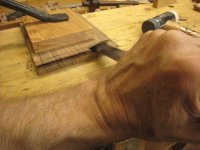
and started rebating, which was a mixture of splitting bits off with a chisel

IMG_7570.JPG

and planing, across the grain

IMG_7569.JPG

and with the grain

IMG_7572.JPG

Old wooden rebate planes must be some of the most useful but overlooked and undervalued planes around. As far as I know none of the YouTube "influencers" has pushed up the prices so there's no reason not to have a selection of sizes and styles. It was the right tool for this job - a fenced plane such as a moving fillister would have been no good as the workpiece was not yet square.

Even so, a nice heavy metal plane set very fine is good for getting all four rebates matching.

IMG_7573.JPG

And here is the bottom in place inside the box. It seems to fit ok, but there's a blunder. The base is a bit too narrow in the width and there's a visible gap.

IMG_7575.JPG

Now, I should perhaps make it clear at this point that yes, I do know that wood moves and that I'm not really giving it anywhere to move to. And maybe in a week or two great chasms will open up as the mitres gape like crocodiles' mouths and the base will force the sides apart like Samson in the temple but on the other hand, this wood is old and dry, the sections are tiny and I think I can take the disappointment if it does all go wrong; it's not much in the greater scheme of things.

So I thought I might as well fill up the gap, by the simple method of getting a bit of walnut veneer from the box of useful pieces of veneer waiting to come in useful.

IMG_7576.JPG

and gluing it on

IMG_7578.JPG

With the excess trimmed off, there was still this much gap!

IMG_7581.JPG

I guess it's my own fault for trying to go straight to the lines rather than sneaking up on them. No matter; I'll just stick a second bit of veneer on the other side. I might end up putting a liner of thin pale wood round the inside anyway, which will cover up any ugliness lurking in the shadows.

Meanwhile, with the glue drying on the bottom again, I turned to the fitting of the hinges. I've not quite finished that, and didn't photograph every stage, so I think I'll mostly let the pictures tell the story.

You can see how I prefer to mark directly, chisel slowly, check and cut a bit more. You'll see steel screws before brass, (which will be fitted to the hinges a bit better at the end), wax on the threads and another blunder which will disappear later.

IMG_7582.JPG

IMG_7583.JPG

IMG_7584.JPG

IMG_7585.JPG

IMG_7586.JPG

IMG_7587.JPG

IMG_7588.JPG

IMG_7589.JPG

IMG_7592.JPG
 
Interesting and enjoyable as always, Andy.

I hate hinges - always seem to require a level of precision that's just beyond my capabilities. I have a blanket box in the workshop that just needs the hinges to finish; been putting off that job for more than two years :eusa-whistle:

I made a small toolbox for modelling tools and paints last year and managed to get a decent result with the hinges, but I wasn't overly bothered about the fit and finish. For small boxes I usually opt for hidden pivot hinges.
 
Go on, sharpen your chisels and have a go!

I can't be the only person on here who rather enjoys fitting hinges etc.
 
Back
Top