• Hi all and welcome to TheWoodHaven2 brought into the 21st Century, kicking and screaming! We all have Alasdair to thank for the vast bulk of the heavy lifting to get us here, no more so than me because he's taken away a huge burden of responsibility from my shoulders and brought us to this new shiny home, with all your previous content (hopefully) still intact! Please peruse and feed back. There is still plenty to do, like changing the colour scheme, adding the banner graphic, tweaking the odd setting here and there so I have added a new thread in the 'Technical Issues, Bugs and Feature Requests' forum for you to add any issues you find, any missing settings or just anything you'd like to see added/removed from the feature set that Xenforo offers. We will get to everything over the coming weeks so please be patient, but add anything at all to the thread I mention above and we promise to get to them over the next few days/weeks/months. In the meantime, please enjoy!

Back bevels.

Mike G

Petrified Pine
Joined
Jul 30, 2014
Messages
12,506
Reaction score
3,093
Location
Suffolk
Name
Mike
What do we know? I've never done one.

In amongst a job lot of planes I picked up on Facebook Marketplace many months ago there were some spare irons, one of which is quite corroded on the back. The only thing it would be any use for is a back-bevel. Now, I'm sure you know I'm not a purist when it comes to bevel angles, but just give me a clue. Is it a primary and secondary like some of you guys do on the front, or is it just a secondary? I picture just the latter, else having a close-set cap iron would be ruled out, but of course I am only guessing.

For the sake of clarity, I'm not talking about thingemejig's "ruler trick". I'm talking about a proper back bevel for final smoothing of difficult timber.
 
Mike G":1v4j4e26 said:
What do we know? I've never done one.

In amongst a job lot of planes I picked up on Facebook Marketplace many months ago there were some spare irons, one of which is quite corroded on the back. The only thing it would be any use for is a back-bevel. Now, I'm sure you know I'm not a purist when it comes to bevel angles, but just give me a clue. Is it a primary and secondary like some of you guys do on the front, or is it just a secondary? I picture just the latter, else having a close-set cap iron would be ruled out, but of course I am only guessing.

For the sake of clarity, I'm not talking about thingemejig's "ruler trick". I'm talking about a proper back bevel for final smoothing of difficult timber.

Primary only as the cutter then acts like a scraper plane blade - Rob
 
Woodbloke":x6lwj2d0 said:
......Secondary only as the cutter then acts like a scraper plane blade - Rob

So, at 30 degrees? That would suit me, as that's roughly what I use on the front of the iron (I don't use a secondary angle, but sharpen the whole bevel to the angle a secondary bevel would be).
 
Lurker":1343teoh said:
....St David of Charlesworth was a fine woodworker and teacher but the ruler trick was a work of the devil.

I couldn't agree more.

Fun fact.....I played my cricket as a lad at a club within sight of his workshop.
 
As you know, hand tools aren't really my specialty but back bevels are absolutely minute, you only need to do 1mm of back bevel or less to get the required effect. The iron is already set at 45-degrees relative to the sole so whatever angle you add onto the back of the iron increases the cutting angle. Really, any more than a 15-degree back bevel is going to be extremely difficult to push through the timber and you're beginning to get into scraper territory.
 
Mike G":ylt1b88f said:
So, at 30 degrees?
Take the effective cutting angle you want, subtract the frog angle, and that's the angle of your back bevel. In a standard pitch plane, a 30 degree back bevel will give you a 75 degree cutting angle, which is higher than I've heard of anyone using regularly and is almost scraper territory. As far as I'm aware a 60 degree cutting angle, so 15 degree back bevel, will do just about anything you'll want a high angle plane to do.
 
Yep, that makes sense. Very useful, thanks.
 
Phil Pascoe":1gcx0yd4 said:
If it's not a laminated iron, if the other side is cleaner reverse the bevel?

Interesting thought, Phil, thanks. I'm not sure I could bring myself to remove that much tool steel, though, and a back-beveled iron might occasionally be handy. Somehow I seem to have become a plane-magnet, and I certainly don't need any of them just as copies of ones I've already got. But something with a back-bevel is an intriguing option.
 
Saves all the malarky of trying to explain it:

IMG_0701.jpeg

Dead easy, nowt difficult or even the 'work of the Devil' - Rob
 
Phil Pascoe":2kwbltat said:
If it's not a laminated iron, if the other side is cleaner reverse the bevel?

I was caught out by this with an Acorn #3. Surely not a laminated iron ? So I flipped it over and re-ground it. No edge keeping at all. Indeed it was laminated. Flipped it back, and re-ground again. The good news is that in the process of all that grinding, I removed the pitted bit which was where the cap iron had been making contact, and there's still plenty left of the iron for the use I'm ever likely to give it.
 
I have two simple questions about this topic: were I to put a back bevel on the iron of my freshly sharpened 4 1/2, would I notice a better quality of finish on any of the following:

a. Cherry.

b. Walnut.

c. Pine.

d. American Tulip or whitewood (or other names).

Secondly, are there any woods which would demand a back bevel before one even touched them?

If the answers to a-d are "no" and the answer to the second question is "none", then I don't think I need to bother with one.
 
Andy, isn’t the usefulness of a back bevel more to do with unruly grain in any wood rather than a specific wood type ?
 
My answer to that Andy is that it's not the species of tree, it's the nature of the piece of timber. If you have a gnarly piece of something with reversing grain and some knots, and you fail with all the other tricks in your book, the only thing you've got left is a belt sander and a scraper. A plane with a back bevel, as I understand it, would be an alternative weapon in your armoury.

Personally, I've always opted for a scraper. I can't help myself, even on easy-to-plane timber, as a final pass to remove any remaining tool marks. Scraping, however, can be a bit hard on the hands, whether you push or pull (particularly if you push). To be able to use a plane for most of the work would just be more comfortable. However, that isn't my motivation particularly. I have an iron which would go in the scrap bin unless I put a back bevel on it. It's pitted. So, I can now keep the iron, and next time I find a difficult piece of wood (or I edge-join two boards but with the grain running in opposite directions), I'll try it to see if it suits me.
 
Interesting!
I have quite a few spare planes, so can I take this to an extreme and turn a bog standard Stanley into a scraper plane by having a near vertical edge?
 
Phil Pascoe":2r8hu0kb said:
It's only the first few mm that are relevant - can't you just flatten that part and forget the rest?

It's that area which has the most pitting.
 
Windows":1zz2jr5z said:
Why is scraping hard on the hands?

Particularly when you are pushing you are also flexing the scraper, deliberately. This gets hard on the thumbs, but if you do it for a long time, it's also hard on the fingers. And the scraper gets hot, too. Too hot to hold comfortably. I mean, let's not overstate this. On a small board, scraping is no issue at all. Scraping the top of a dining table, though, is an altogether different matter.
 
Thank goodness for Rob's picture: I was picturing this all wrong.

I am not much of a hand planer (electricity was invented for a reason) so if the grain is awkward I tend to use the Mirka + scraper. So, just for my edification, is the back bevel (which is located at the front of the edge) just a steep grind to stop the front of a normal plane blade from digging in?
 
Can you not cut a curve in a piece of wood and shape some handles on it, then shove the scraper into the cut and hold the wood while scraping? I’ve never done scraping, so I’m sure there’s something I’m missing?
 
Lurker":1ogym7aa said:
Interesting!
I have quite a few spare planes, so can I take this to an extreme and turn a bog standard Stanley into a scraper plane by having a near vertical edge?

I don't think that's the point, Jim. The idea is still to use it as a plane, but just to have a higher angle of attack. A scraper is 90 degrees or more, and I don't think that is generally the idea. I think the following is the sort of thing we're aiming for:

Im0DTCY.png

My caveat to all that is that I am asking, rather than telling. This is new territory for me. Having a flat back to my irons has been sacrosanct thus far.
 
Windows":b410lm49 said:
Can you not cut a curve in a piece of wood and shape some handles on it, then shove the scraper into the cut and hold the wood while scraping? I’ve never done scraping, so I’m sure there’s something I’m missing?

There's a tool that does that very job, only it uses a thumbscrew to put the tension on the blade:

slesVAC.png

eq89OT2.png

I can't remember what it's number is without going out to the workshop.
 
Is scraping still hard on the hands using that? Sorry for the dumb questions. I want to do some scraping in the near future to remove some mould from some plywood, so it’s on my mind.
 
No, no, it's a doddle with that. The only downside is that it can judder and leave parallel marks on the surface of the wood.

A scraper might not work on plywood, unless it has a hardwood veneer. Many or most plys have a softish fibrous texture and scraping just tears up streaks of fibre.
 
Mike G":2bcknzh5 said:
I can't remember what it's number is without going out to the workshop.
No.80 -linky. Amazingly I could remember the number without looking.

All the toos and froes of back bevels, on the other hand, I've utterly forgotten. Thank goodness. :lol:
 
AJB Temple":1sr16lka said:
Thank goodness for Rob's picture: I was picturing this all wrong.

I am not much of a hand planer (electricity was invented for a reason) so if the grain is awkward I tend to use the Mirka + scraper. So, just for my edification, is the back bevel (which is located at the front of the edge) just a steep grind to stop the front of a normal plane blade from digging in?
Thanks Adrian; I was hoping that at least somebody would appreciate it. There's a whole lot of unnecessary faff going on to explain what's really a very simple concept. As Mike has said, the back bevel is there to deal with difficult, unruly grain, so in a standard No.4 plane (say) it acts as a scraper and it's very easy to achieve.

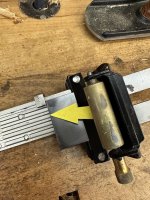
First and foremost, take your blade and put it upside down into the honing guide (if you use one). You'll see here:

IMG_0703.jpeg

...in this example that I've picked a bevel of 40deg, so that now when it's turned over:

IMG_0705.jpeg

...at the tip of the yellow arrow a back bevel of 40deg will be honed. When said blade is put back into the plane, the effective pitch of the blade is now the frog angle (45deg) plus the back bevel (40deg) so you're now planing with a blade set at 85deg to the surface of the wood.

Rocket science it ain't - Rob
 
AJB Temple":t2g1w3ox said:
Thank goodness for Rob's picture: I was picturing this all wrong.

I am not much of a hand planer (electricity was invented for a reason) so if the grain is awkward I tend to use the Mirka + scraper. So, just for my edification, is the back bevel (which is located at the front of the edge) just a steep grind to stop the front of a normal plane blade from digging in?

It's just done to increase the cutting angle to reduce tear-out, yes.

The more fashionable thing these days is to use a bevel-up plane and keep an iron sharpened at 50 degrees or so, which when added to the 12 degree bed angle of a BU plane gets you around 62 degrees effective cutting angle. The back bevel is essentially doing the same thing on a 45-degree bedded Bailey, but since a 15 degree single bevel would be too fragile, you turn the iron into a double bevel with your normal pitch on the bottom and 15 degrees on top.

As for the scraping question, a #80 is night and day compared to a card scraper held in the hand, but still takes more effort to push or pull than a plane, and as Mike says it'll judder and leave unsightly marks the moment it dulls slightly. I also find sharpening it to be more effort than stropping a plane iron, and it has to be done at least as frequently.

The way I see it is that you've got a spectrum of (hand tool) options, starting with a regular smoothing plane, then adjusting that plane to have the closest possible chip breaker and tightest mouth opening, then adding a back bevel or increasing the angle on a BU plane, then a scraper, then coarse abrasives. Each one will deal with trickier grain than the one before, but also takes a bit more effort to do so. More options means you can choose the one that will cope with what's in front of you at the least cost in time and energy.
 
Mike G":29fikmk0 said:
There's a tool that does that very job, only it uses a thumbscrew to put the tension on the blade:

slesVAC.png

eq89OT2.png

I can't remember what it's number is without going out to the workshop.

Stanley no 80 or Record equivalent. Really useful and not expensive.
 
I remember well my old woodwork teacher, he had spent most of his working life making shop and bank counters and fittings, his thumb ends were permanently bent back from using scrapers day after day.
Very good teacher, I learned a great deal from him.
Ian
 
Mike G":165xnsfc said:
My answer to that Andy is that it's not the species of tree, it's the nature of the piece of timber. If you have a gnarly piece of something with reversing grain and some knots, and you fail with all the other tricks in your book, the only thing you've got left is a belt sander and a scraper. A plane with a back bevel, as I understand it, would be an alternative weapon in your armoury.

Personally, I've always opted for a scraper. I can't help myself, even on easy-to-plane timber, as a final pass to remove any remaining tool marks. Scraping, however, can be a bit hard on the hands, whether you push or pull (particularly if you push). To be able to use a plane for most of the work would just be more comfortable. However, that isn't my motivation particularly. I have an iron which would go in the scrap bin unless I put a back bevel on it. It's pitted. So, I can now keep the iron, and next time I find a difficult piece of wood (or I edge-join two boards but with the grain running in opposite directions), I'll try it to see if it suits me.

Thanks, that's clear now. So far I've been lucky with grain. I once had to plane a piece of wild oak where the grain was all over the place and got there in the end by taking very thin shavings. I suppose that if I were to have a go at one of those difficult tropical hardwoods, then I'd have to consider a back bevel.
 
Thank you, Mike G, Alf, AndyT, Ian and everyone else. I did an experiment and the ply is standing up quite well to along the grain scraping, so that should work to remove the surface mould and I'll prime and paint once better weather hits.
 
Back
Top