• Hi all and welcome to TheWoodHaven2 brought into the 21st Century, kicking and screaming! We all have Alasdair to thank for the vast bulk of the heavy lifting to get us here, no more so than me because he's taken away a huge burden of responsibility from my shoulders and brought us to this new shiny home, with all your previous content (hopefully) still intact! Please peruse and feed back. There is still plenty to do, like changing the colour scheme, adding the banner graphic, tweaking the odd setting here and there so I have added a new thread in the 'Technical Issues, Bugs and Feature Requests' forum for you to add any issues you find, any missing settings or just anything you'd like to see added/removed from the feature set that Xenforo offers. We will get to everything over the coming weeks so please be patient, but add anything at all to the thread I mention above and we promise to get to them over the next few days/weeks/months. In the meantime, please enjoy!

Bandsaw woes

Joined
Apr 3, 2021
Messages
301
Reaction score
63
I am in the process of sorting out some oak sleepers from some raised beds we had in the garden. The wood had rotted in places in the garden so I have replaced them, but stored the old sleepers under cover over winter to allow them to dry out. I am now in the process of cutting and planing them down to get some useable bits out.

I am finding that I am having problems with my bandsaw when trying to cut them down into about 2” planks from some 4ft lengths that I have trimmed the outsides off. I have run them through the thicknesser after taking the outside off to ensure a flat surface and then using the bandsaw fence when I cut them.

The bandsaw is a relatively new Jet 14inch one, with plenty of capacity. I am finding that the blade wanders off to the side away from the fence and it becomes increasingly difficult to get the wood to go through as it gets tighter. I have been using a 25mm blade tensioned correctly according to the meter on the machine. The blade guides seem okay, so I am not sure what I am doing wrong.

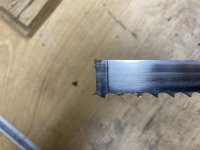
The blade seems to have been pushed so far to one side that it hit the metal insert in the table and has damaged the teeth on on one side of the blade so it definitely won’t cut straight now. Having managed to do this on two blades now it is getting expensive and I am keen to learn what I am doing wrong, so any suggestions would be welcomed.

Many thanks,

Mark
 
Is your blade parallel to the fence? Not normally such an issue on the narrower blades but when you're getting into 1" and above it can make a large difference if the back of the blade starts to rub on either side of the cut which will cause it to wander either way.
 
I'm no band saw expert but I do have a Jet 14" saw.

A few thoughts..

Think I tried a 3/4" wide blade in it once and it wasn't really up to tensioning it properly so ever since I've never used anything wider than 1/2". I never look at that tensioner scale as it is too crude. As to 1" wide I'm sure my saw wouldn't like it.

You don't say what teeth pitch etc the blades are. Ripping along the grain needs the right blade.

I've seen the wandering you mention. Usually blade not sharp or under tensioned. Also had problems in the past with clearance of - I'll say saw threads rather than sawdust as they are little stringy bits - bunching underneath the workpiece and lifting it + causing drag.. which makes you push harder and encourage wander. Worse with softer woods.

You say sleepers - if they are old railway sleepers some of them can be woods that blunt blades.

Out of thoughts now :)

Over to the bandsaw experts.
 
I have found that Bandsaws rarely cut parallel to a fence, find the line that the blade cuts to and make the fence parallel to that. Draw a line 2” from the edge of a piece of thin ply and start to cut to that line, stop the saw half way through but keep the ply still, that’s your line to set against.
Ian
 
I think Robert's on the right track on several points. I doubt that size a machine could properly tension a 1" blade. If the teeth are too small, they will immediately clog with sawdust when sawing thick wood. (Example: I had a 1-1/2" wide, 4 tpi blade on my 30" saw that clogged up right away when trying to resaw some 6" wood. 2 tpi worked fine though.) If you're getting stringy bits in your cut, they could be snagging on your throat plate.

All of these can be exacerbated by feeding too fast. You could also be accidentally feeding with some side pressure.

If you hadn't said that you'd used two blades already, my first guess would be that your blade was dull. But since your on at least your second and probably third blade, this may not be the case.

Try cutting more slowly, and when the cut is done look to see if the cut surfaces are bowed. If so, probably your blade is dull or you don't have enough tension.

How thick is the wood? How many teeth per inch on the blade?

Kirk
 
Whose blades are you using ? TPI as has already been said.
 
I agree with everything Robert has said, and would add that the number of teeth in the work is important. If there are too may, then the gullets will clog and the blade won't work properly. There is no 14" modern bandsaw that I know of which can correctly tension a 1" blade, and you can rip perfectly satisfactorily with a narrow blade. So I would immediately swap to 1/2" or 10mm blade, 3 TPI max, and I would remove the fence. Crank up the tension as tight as you can go. Draw a line and follow it manually. Slowly.
 
Loads of excellent advice; in short use a 10 or 12mm, very coarse (3tpi), blade cranked up to maximum (disregard the setting on the machine), make sure it's dead parallel to the fence and feed very slowly - Rob
 
Cabinetman":1thv7l1f said:
I have found that Bandsaws rarely cut parallel to a fence.

I found that with mine but after watching the Alex Snodgrass video and setting up my saw as he says it worked fine.

[youtubessl]CFZOlNsAgBU[/youtubessl]

I’m currently using Hakansson Silco blades at the moment and they’re very good. Several places sell them.
A 1/2” 3 TPI Skip tooth should do the job.

https://www.hakansaw.com/en/suitable-fo ... als-silco/


.
 
+1 for the Snodgrass method: it was recommended to me by the guy I bought my bandsaw from and I've never had any issues with the cut wandering.
 
I think it's all been said but you haven't stated what thickness you're trying to cut and as most sleepers tend to be at least 200 x 100 I'd hazard a guess it's 200mm or thicker you're trying to cut, is that right?

In any event old oak can be damned hard and sleepers are not graded timber so the grain is possibly wild and knotty, it may also still have a higher moisture content than you think. I never use the fence if I'm cutting thick hardwood unless resawing thin slices and always a smaller blade with a low tooth count. I'm not saying I'm right, just what works for me.

I'd also take stated capacity figures with a pinch of salt as a general observation though I don't know anything about your model saw.
 
Another vote for Snodgrass - works for me. Also for more tension and that probably means narrower blade to avoid breaking the saw, the correct tension for 1" blade is awesome, I broke a casting in mine trying to use a 1" blade. Also for fewer teeth to avoid clogging, ideally no more than about 4 in the work at any one time.
 
I dont recall if it was Messers Snodgrass or Maskery or indeed a demonstrator at a record power exhibition.
Possibly the latter which started with a gentle cut with all the guides set back from the blade and the tracking adjusted until the cut stayed parallel to the fence with no drift. Then and only then were the guides moved back in close to the blade but ensuring that no guide change the blade position top or bottom.
The guides are just that. To guide the blade and never to change its path

This has always worked well for me.
Bob
 
Your post gives away the clue.
You say the blade has gone sideways enough for the teeth to be squeezed flat.
The big thing with bandsaw blade adjustment is the rear bearing.
First I agree, 1" blade is ridiculous. I have a 1/2" blade hanging rusty on the wall because I regularly cut hard wood with a 3/16" blade on my axminster 350 bandsaw and it cuts dead on with the fence for the entire length of whatever plank I'm cutting.
Get a new blade no bigger than half inch, back off ALL the bearing guides. adjust the blade position and tension until it is running true and not fluttering
Adjust the side guides (after switching off, yeah?) until they are very close but not touching the blade, and the blade is a third of its width IN FRONT of them. Then bring the rear bearings forwards enough that they dont quite touch the blade. Check by pushing the blade back with your fingers that the blade hits the back bearings BEFORE the teeth reach the side bearings. The whole point of the rear bearings is to stop the teeth being flattened. Then, with the safety arm all the way up, grab the blade in the middle of the run and try to twist it. You should be able to twist it about 45 degrees. If it doesnt move at all, its too tight, if you reach 90 degrees its too loose.

After that, its all down to feed rate. Old oak will take a long time to cut. I've just been cutting 150 mm white oak, and to cut 700 mm of that I'm taking a few minutes at least. Trying to go too fast will make the blade wander.
 
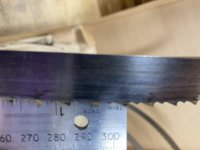
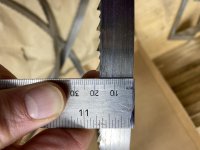
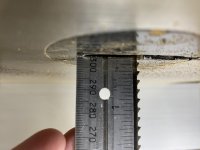
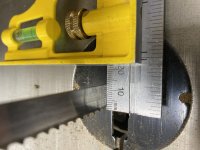
Thank you all for the all the advice. I went out to the garage tonight to take some pictures and measure the blades. I have learned that I am useless estimating in imperial measurements! The bandsaw is actually a 15inch model. The blade I started cutting with is actually about 19mm, skip tooth, 3 teeth per inch if you only count the big teeth. The brand new blade I replaced it with when the first one was obviously not working was a 13mm 6 tooth per inch blade. Both were from Tuff Saws.
86CA7E6C-44F8-4113-9E82-2019362D287B.jpeg
C8A1C37B-B9EB-47C2-BF74-F529A7A424BE.jpeg
DF91ECF7-C8C9-4AA4-A9E6-4D3F2D043BFC.jpeg
B3673F43-12E2-4FC6-BAB4-8FF972926A9D.jpeg
BAF36916-943C-45E2-9A2B-0BC7B145B960.jpeg
8231093E-FAE4-4D7C-9094-B31D25C881D6.jpeg
097C07FF-A083-4BC0-A665-FD003FC201F9.jpeg
6EDFAE44-C316-46FF-81B6-DA15475CE0BE.jpeg

I think the way forward is to order some new blades from Tuff Saws and then have a go at the Snodgrass method over the weekend and see if I can get it working better without righting off the blades.

Many thanks,

Mark
 
Hi Mark
The wheel dia isn't the saw's capacity, that is determined by the maximum size material you can cut with the top guides at their highest point, i.e. amount of useable blade left exposed but other factors such as motor size, speed, size and type of blade, blade tension, rate of feed, and characteristics of the wood all are very important.
 
Reading your measurements that would be a 400 bandsaw (mm) in most of the world :D and that looks suspiciously like a 12.5 mm blade (1/2") which will do all that you want once the machine is set right.
Alex snodgrass tutorial is the best, and will work on 99% of machines for 99% of the people.
Just remember that back bearing has to protect the teeth, and slow is better than fast when it comes to feed rate. If you go too slow you will see burn marks on the cut. Too fast and the blade will wander.

Is that a metal throat plate? That seems crazy. Look on ebay for a 3D printed plastic one. I consider them disposable items as I make bandsaw boxes and regularly cut very sharp curves.
 
Weekend_Woodworker":34mvpfr1 said:
I think the way forward is to order some new blades from Tuff Saws and then have a go at the Snodgrass method over the weekend and see if I can get it working better without righting off the blades.

Many thanks,

Mark

Seriously, try a Hakansson Silco blade, you won’t be disappointed.
 
Weekend_Woodworker":ixwhed9d said:
I think the way forward is to order some new blades from Tuff Saws and then have a go at the Snodgrass method over the weekend and see if I can get it working better without righting off the blades.

Many thanks,

Mark

Diamond Ground blades from Axminster are just as good as Tuff stuff and I've used both - Rob
 
That bearing appears to be somewhat loose in the wheel to me.
I'd try and see if that might be your issue, should any play not be apparent by other methods.
You might not even have to remove the table to check, and put some tape on the table instead.

Pick a spot on the wheel and see if the opposite end of the wheel gives you the same reading.
SAM_7270.JPG
This is what you don't want to see.
SAM_7207.JPG

Use a pen and not a pencil, or you just might get multiple false readings, DAMHIK.
SAM_7225.JPG

If this results in a single line, and not a pair of them... then you could see if the lower wheel matches using a longer beam with the table removed.


This issue only seems to be popping up in recent times, as I haven't come across
any older threads of this occurrence, say beyond a few years ago...
With that said, a few indications are out there which suggest the same, though this was seemingly not investigated as far as I can make out.

Hoping this ain't the case for you aswell.
All the best
Tom
 
So on Rob’s recommendation I have bought a couple of Axminster blades to try. I have watched the Snodgrass video a couple of times and had a go at following it this evening. Unfortunately it is a bit late to turn it on and test it so that will have to wait for tomorrow. I fear I had the thrust bearings set too far forward on the blade causing it to veer off. We will see tomorrow.

I was also wondering if I would be better off with a zero clearance insert plate, but not sure if there is a good material, or way to make one. I see quite a lot are 3D printed, but I don’t have a 3D printer.

Best wishes,

Mark
 
If you want a zero clearance insert 3D printed, I could print one for you. You would need to provide a dimensioned sketch for me to work with.
 
If you dont take up DaveL's kind offer, I've bought bandsaw inserts off ebay. The last time the guy offered to make them to my specs.
But theres no point at all in "zero clearance" on a bandsaw. The very first time you cut a curve you will chew it wider.
 
Bandsaw inserts are easy to make. I just found a piece of plastic of suitable thickness and turned it to the right diameter on the lathe. You could do it by hand though after scribing it with a compass.
 
As an update the saw worked a treat yesterday. I resawed a meter long plank that was 2cm wide into two even halves. I think the key thing was that I had put the thrust bearing too far forwards.

Dave thank you for the very kind offer of printing an insert. I have found some other YouTube clips of how other people have made them so will try and give that a go first. Unfortunately I got tied up making some board for my wife’s bee hives yesterday, so didn’t get a chance to have a go.

Thanks,

Mark
 
I have been finishing off resawing the oak, but was surprised when there was a loud bang and I found the blade had snapped. It is the first time I have ever had a blade snap. It has clearly broken at the weld site. I can’t believe I have over tensioned the 19mm blade. Is this down to poor blade manufacture or is it something else? I noted that the weld was much more obvious on the Axminster blade than on any of the Tuff saw blades I have had. Any insights or advice greatly recieved.
IMG_1296.jpeg

Many thanks,

Mark
 
Blades do break, but that looks to me like you have the side guides rubbing on the blade. They should be clear of the blade while the machine is running, only touching the blade if you are cutting a curve, or are putting too much pressure onto the wood causing the blade to flex.
If they touch the blade constantly then heat builds up and weakens the metal.
When you cut, watch the side guides. If one starts turning, reduce the pressure on the wood and you will see it stop. Thats the correct feed rate.
 
I think Bob has raised a likely scenario.
My BS came with metal side guides and I replaced them with hard wood ones, that way any issues doesn’t wreck a decent blade.

Took about 15 minutes to make a set of four plus two sets of spares.
 
Thanks, good point Bob, I have solid carbon? Guides and have never considered the heat aspect, must say my bs is pretty easy to use, also I have a tablesaw so it doesn’t get a lot of abuse.
 
Great advice here, I think Sunny Bob nailed it re breakage cause, and I agree with Mike too that for a sleeper or any large dimension oak like this, I disregard the fence and hand feed very slowly. I also use front and back rollers to help keep heavy and long stuff level on the table.

I too have a Jet (18") and the fence is not it's best feature. The bigger saw will tension a 1" blade - but only just about and it would be impossible on a 14".
 
Cabinetman":38xzc8ep said:
Thanks, good point Bob, I have solid carbon? Guides and have never considered the heat aspect, must say my bs is pretty easy to use, also I have a tablesaw so it doesn’t get a lot of abuse.

Guides are an underestimated and under appreciated part of bandsawing. They show you everything you're doing wrong.

Wide blades arent absolutely necessary I use a 3/16" blade on my 350 (14") bandsaw for EVERYTHING :o I can cut a bandsaw box, and go straight to cutting 8" high bubinga planks into strips (quite thin strips actually 8-) ) with no change over. I prefer roller bearings over solid blocks because its so obvious when they start to spin, you need to slow down and straighten up.
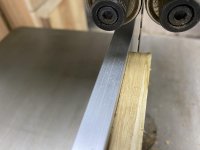
Of course this system doesnt work in a commercial environment, when it takes me 5 minutes or more to saw a 3 foot length. :eusa-naughty: A green oak log might take me a whole day :lol: :lol:
 
IMHO every BS spec is lying to get a sale.
If you use the next width down from the quoted maximum as your maximum you can’t go wrong.
 
Thank you for all the advice. I thought I had got the guides set up well having followed Alex Snodgrass carefully, including taking the table off to set them. I was admittedly using the fence, as the surface wasn’t good enough to draw a line on to try and follow.

I sent an email to Axminster customer service noting that the blade had broken and asking if this was common and had a very quick response back saying it was uncommon, but they had dispatched me a replacement blade which is due to arrive this morning. I must say I am very impressed at the customer service from Axminster.
 
I wouldnt argue with Alex :eusa-naughty: :D
With experimentation you can get the fence to work properly, for some strange reason they almost never work from the factory. Make sure it is parallel to the edge of the table. Then the blade position affects the cutting angle. If it tries to cut towards the fence, move the blade back a touch. Away from the fence, forwards a touch.
 
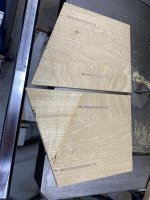
Well I set up the new blade again following the Snodgrass approach, including taking off the table. I then found an off cut to resaw to test on the fence. I am very pleased with the result which looks quite even.
CD9A3CC5-DB49-403D-9B3C-27E9EBA83FC2.jpeg
2FB895CB-190B-43A3-804F-85EFE0ED5732.jpeg
440D5DC9-7159-42A3-804F-BF3CFA1BBAEF.jpeg
57B3EB71-ED13-4B40-8DFE-43B2C2CE560A.jpeg
57971342-706E-4BA7-8700-71E88E15A34D.jpeg
 
Now you can enjoy your bandsaw :D :eusa-clap:
Stick with that blade size whenever possible now. you dont need a half dozen different widths and teeth layouts.
 
Back
Top