• Hi all and welcome to TheWoodHaven2 brought into the 21st Century, kicking and screaming! We all have Alasdair to thank for the vast bulk of the heavy lifting to get us here, no more so than me because he's taken away a huge burden of responsibility from my shoulders and brought us to this new shiny home, with all your previous content (hopefully) still intact! Please peruse and feed back. There is still plenty to do, like changing the colour scheme, adding the banner graphic, tweaking the odd setting here and there so I have added a new thread in the 'Technical Issues, Bugs and Feature Requests' forum for you to add any issues you find, any missing settings or just anything you'd like to see added/removed from the feature set that Xenforo offers. We will get to everything over the coming weeks so please be patient, but add anything at all to the thread I mention above and we promise to get to them over the next few days/weeks/months. In the meantime, please enjoy!

Bedside Table

Dr.Al

Old Oak
Joined
Dec 31, 2020
Messages
3,561
Reaction score
2,240
Location
Dursley, Gloucestershire
Name
Al
I think I've chosen my next project: it's time to make a new bedside table. For most of the 20 years I've lived in this house, I had a pine three-drawer chest that I inherited from my parents and used as a bedside table. It was quite deep and didn't leave much of a gap between the corner of the chest and the corner of the open door, but it wasn't too much of a problem and it did the job. Two years ago, my partner had a bad car accident and had to move around on crutches. There was no way she was going to be able to get into the bedroom (past the bedside table) so the chest of drawers got relegated to the spare room.

As a short-term solution to provide a reasonable height shelf for the sunrise alarm clock etc, I replaced the chest of drawers with two motorcycle panniers, one on top of the other. Two years later and my bedside table is still two motorcycle panniers! It's probably about time I did something about it.

I've been pondering on design ideas for quite a long time. A couple of years ago Matt Estlea released a video series on making a shaker style table and I like the design of it (although I'm not sold on the somewhat ornate top). The shape of Matt Estlea's table wouldn't suit the position and I want something quite a lot bigger (to roughly match the height of the mattress).

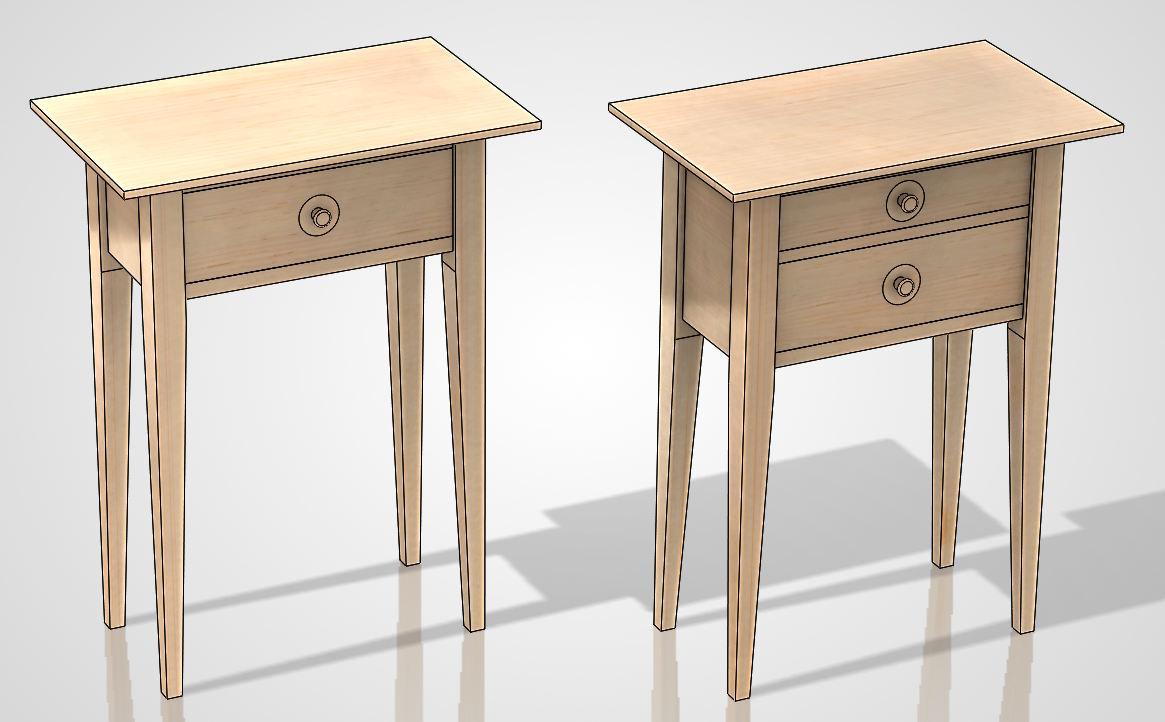
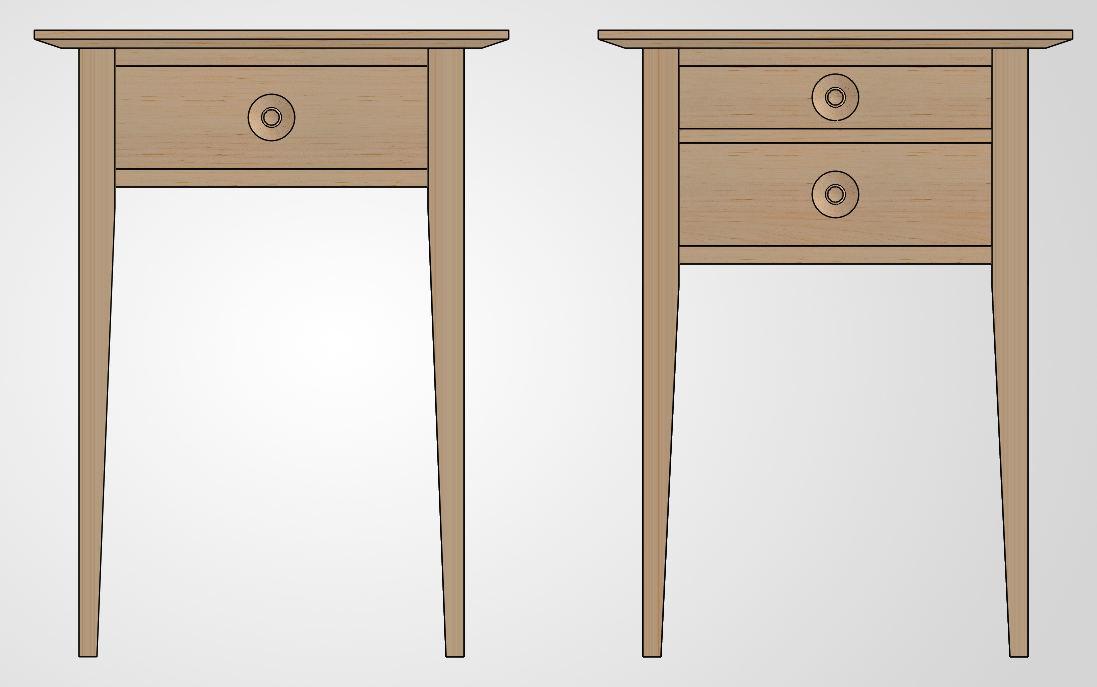
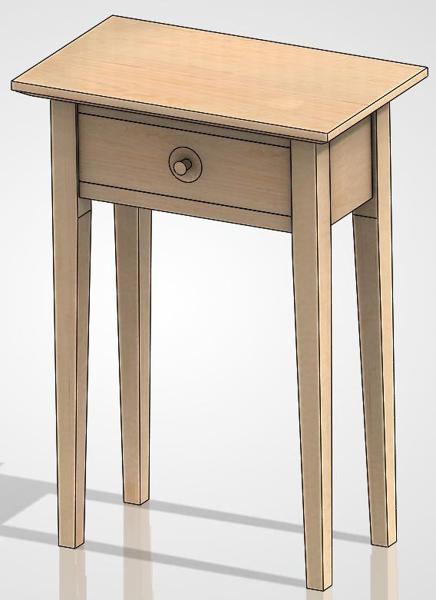
This is what I've come up with as a first stab at a design:
2026-05-08-01-bedside-table-design_600.jpg


I'd very much welcome comments / suggestions on how it looks. I've modelled the top as solid but it'll probably be a panel glued out of two planks. The top is 24 mm thick but with a substantial chamfer on the underside to make it seem a bit thinner. For a sense of overall scale, the top is 300 × 500 mm and the overall height is about 700 mm. The legs are 40 mm square at the top, tapering down (on the inside faces only) to 26 mm square at the bottom.

I haven't decided what wood to make it from but I'm probably leaning towards Sycamore, Sweet Chestnut or Oak. Oak would match the bed, but I don't see that as an essential requirement. There's an American Black Walnut shelf thing that currently sits on the panniers and I expect I'll move it onto the new table, so there will definitely be a mixture of wood species regardless of what I choose to make it from.

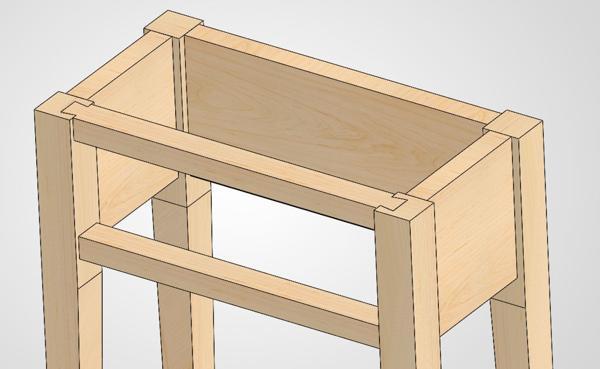
If I hide the drawer and the top surface from the model then the structure becomes a bit clearer I think (note that I haven't modelled the planks that the drawer will run on yet:
2026-05-08-02-top-hidden_600.jpg


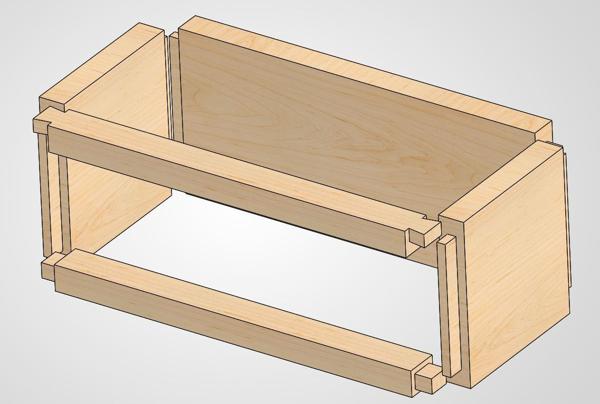
With the legs hidden, all the planned joinery is visible:
2026-05-08-03-joinery_600.jpg


Mortice and tenons for almost everything and a dovetail lap joint for the top rail at the front, much the same as Matt Estlea did in his video series if I'm remembering rightly (it was quite a long time ago that I watched it). I might change the panel tenons into haunched ones, if only because I've never tried cutting one.

Again, any suggestions for design changes would be very welcome. It'll be a while before I start work on it (I need to buy the wood first and I've got some busy weekends coming up) so there's plenty of time for design changes.
 
Great choice for a project.

I had a lot of fun making one of very similar pedigree back in 2017-18, which was written up on another forum. (The pictures aren't there any more but I will upload a few when I can find them and I can provide full details if you want.)

I used walnut, which was a good choice. It works really well with hand tools and let me extend my experience by cutting some quite small scale joints. It also meant that the pieces could be thinner than I might have dared - the legs tapered down to only 19mm square at the feet.
 
Great choice for a project.

I had a lot of fun making one of very similar pedigree back in 2017-18, which was written up on another forum. (The pictures aren't there any more but I will upload a few when I can find them and I can provide full details if you want.)

I used walnut, which was a good choice. It works really well with hand tools and let me extend my experience by cutting some quite small scale joints. It also meant that the pieces could be thinner than I might have dared - the legs tapered down to only 19mm square at the feet.
If that's the one that's in the dining room where we had lunch a few years ago, it's very a very elegant bit of work and I think I commented so at the time. A pic(s) of that piece wouldn't come amis Andy?

Basically a good, if simple design Al but I think by now you're more than capable of a bit of 'blue sky thinking' entailing a more taxing, difficult piece...my two euros - Rob
 
Great choice for a project.

I had a lot of fun making one of very similar pedigree back in 2017-18, which was written up on another forum. (The pictures aren't there any more but I will upload a few when I can find them and I can provide full details if you want.)

I used walnut, which was a good choice. It works really well with hand tools and let me extend my experience by cutting some quite small scale joints. It also meant that the pieces could be thinner than I might have dared - the legs tapered down to only 19mm square at the feet.
Thanks Andy. I'd definitely be interested in seeing the pictures. Was that American or English walnut? I had considered walnut (I agree that's it's lovely to work with) but thought it might be a bit too dark for where it'll live. I also rather enjoyed working with Sycamore on the Mini-Moravian bench (and Sycamore seems to be readily available at Wentwood).
 
Basically a good, if simple design Al but I think by now you're more than capable of a bit of 'blue sky thinking' entailing a more taxing, difficult piece...my two euros - Rob
What did you have in mind? I don't mind the idea of trying something more taxing, but I definitely prefer the look of a fairly simple clean design.
 
I must admit that I'm a little bit tempted to use it as an excuse to try some of the weird and wonderful Japanese joints showcased by @GaryR (although I've no idea which ones yet), especially if I can do so safe in the knowledge they'll be hidden by the table top when the project's finished 😆

Maybe it's time for a browse of Yasua Nakahara's book 🤔
 
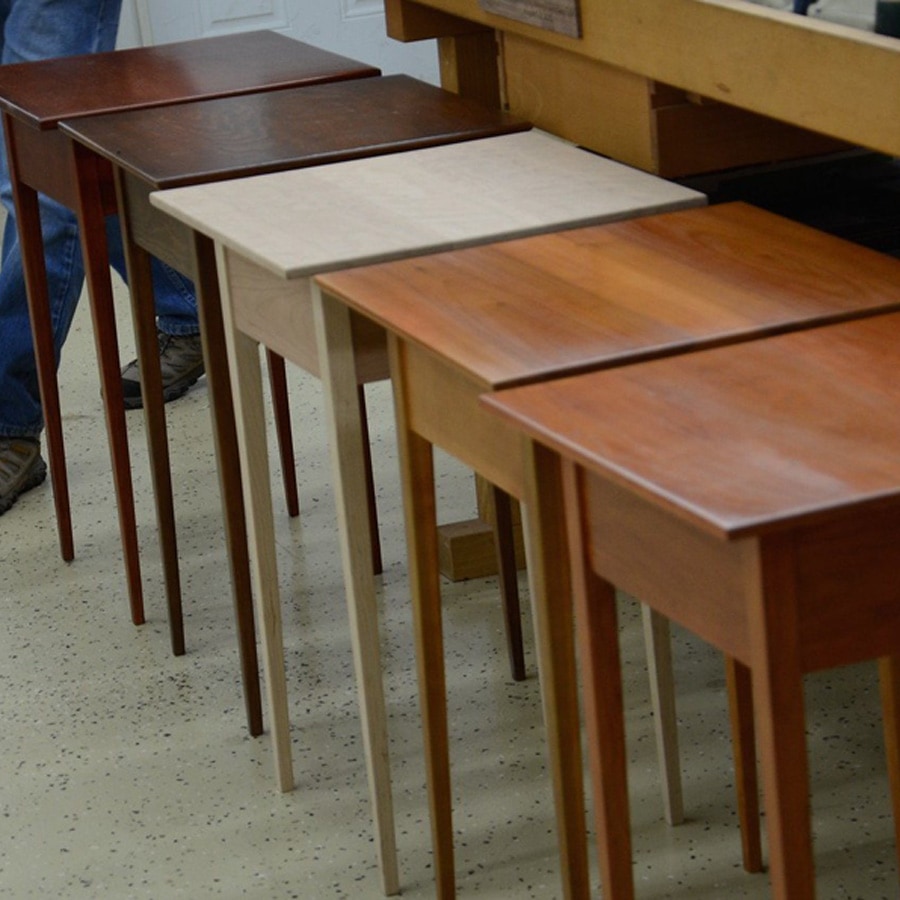
I have made several of this style of table. My versions are deeper with the top approaching square and with thinner legs. I'll get some pictures later today. I can't think of any Japanese joinery that would improve on straightforward M&T joinery, but there are some different approaches to drawer joinery that you could play with if you didn't want to use dovetails there.

I have an acquaintance who has made about 100 of this style of table and given them all away! He teaches a class on making it.

 
Thanks Gary. I'd be very interested in the pictures. I don't want to make mine any deeper (for the same reason I switched from a chest of drawers to a stack of motorcycle panniers!) but any and all photos for inspiration are definitely welcome.

Design (aesthetics) is the part of woodwork I find most challenging really: knowing what will look good & what's a good size (relative & absolute) for the various components.
 
Here are some pictures as requested.

The finished article:

finished2.jpg

finished4.jpg

underside.jpg


twin tenons

twinm+t1.jpg

paring1.jpg

Lots more available. Somewhere I have the original article that Custard gave me, with the dimensions.
 
2569652B-C2D8-4C3F-8F33-2216E03035D5_1_201_a.jpegA5CDC9C3-2AF4-4E69-95C9-D401BADE346E_1_201_a.jpeg0E7E7C8A-81A9-4CB4-8835-8ADC62534D6D_4_5005_c.jpeg

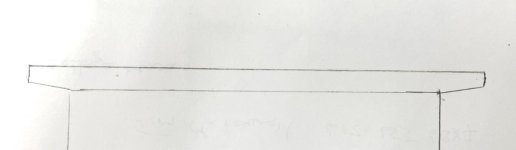
One feature of the Shaker style that isn't clear from the photos is that the tops are thicker than they appear because of a shallow but wide bevel on the bottom side. Like this:

27A9525D-2C38-4339-86E2-FE34AC0A223F_4_5005_c.jpeg


Of course, there is no particular reason to adhere to such a minimalist Shaker style unless you want to.
 
Al, a further variation on the same theme, Federal style with added veneering and stringing. I also made the basic model as an apprentice piece 50 years ago which currently resides in my son's house. It is such a classic table and easy to adapt to suit your needs. Enjoy.
IMG_1896.jpeg
 
Al, I think you've got that design dead right. There are good reasons why pieces of furniture are the way they are, and deviating from those good basic designs on every-day items can feel forced. For me, "elegant" and "practical" win over "arty" in these sort of circumstances.
 
These are very nice. Classic.

The best bedside table I’ve used had the top, the drawer, and a shelf. A shelf is good for storing tissues which is helpful for allergy sufferers like me. You don’t want to display the tissues on the top, or make them hard to get to in a drawer, so an open shelf in addition is very welcome. Can also be good for drinks.

Top for book, phone, lamp
Drawer for spectacles, pills
Shelf for tissues, drinks
 
Here are some pictures as requested.

Lots more available. Somewhere I have the original article that Custard gave me, with the dimensions.

Thanks Andy, that's really useful (and it looks lovely). How thick are the top and sides?

One feature of the Shaker style that isn't clear from the photos is that the tops are thicker than they appear because of a shallow but wide bevel on the bottom side. Like this:

View attachment 54542

They look really elegant, thanks Gary. I'd already designed in a bit of a bevel:

1778307579997.png

Do you think it needs more? For that matter, do you think it would be better to narrow the base a bit (i.e. have more overhang at the top)?

Of course, there is no particular reason to adhere to such a minimalist Shaker style unless you want to.

I think as a general rule I like fairly minimalist styles.

Al, a further variation on the same theme, Federal style with added veneering and stringing. I also made the basic model as an apprentice piece 50 years ago which currently resides in my son's house. It is such a classic table and easy to adapt to suit your needs. Enjoy.

That's an impressive piece, thanks for sharing Pac.

Al, I think you've got that design dead right. There are good reasons why pieces of furniture are the way they are, and deviating from those good basic designs on every-day items can feel forced. For me, "elegant" and "practical" win over "arty" in these sort of circumstances.

Thanks Mike.

Lovely project to undertake.

Your design looks good to me. You could perhaps make the legs a little more delicate?

I would like to make them more if the collective wisdom of this forum thinks I can get away with it. At the moment they're 40 mm square at the top, tapering down to 26 mm square. I can't see any reason why I can't make the taper steeper and hence get down closer to Andy's 19 mm square at the bottom. Do you think the top end needs thinning too?

I couldn’t manage without three drawers :eek:

The chest of drawers that used to be there had three drawers. One of them had a box of tissues in it, which has moved onto my new bedside "table". The other two are still full of the clutter that was in them when it was the bedside table and I don't think I've gone into the spare room to open any of the drawers in the last two years.

Whatever I do, it's going to look better than the panniers anyway :LOL: :

1778307786870.png
 
I think there is a balance to be struck with the taper on this table. On fine furniture it is nice to see a taper down to 19mm, but I always think it looks very delicate. Whereas 25-30mm at the bottom looks much stronger and practical. At the top of the leg I would keep to 40-44mm square as there is a lot of joinery going on. Personally for a bedside table I think your sizing is spot on.
 
@PAC1 similar to that design above has been in my head for a while - that is my next project. A lovely piece of work.
 
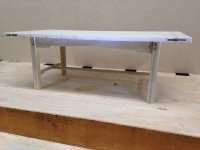
I recommend making maquettes/models, starting at half scale, to try out different design options. Scrap wood, hot melt glue, no joinery. Then take pictures of the model from different angles and no background so you can examine the model without the influence of scale cues in the background. Here's one I made for coffee table. The maquette is about 8 inches tall.
D37F0965-6A10-4273-B6FF-9C06166252B6_1_105_c.jpeg


For determining the amount of overhang, I usually start with an overhang equal to the width of the leg. That usually looks good and you are close to that with your sketch now. For thickness, half the width of the leg is also a good place to start. 40 mm leg = 20 mm thick top. Note "place to start." You may decide to end up somewhere else.
 
Well, one thing's decided: I now know what I'm going to make the table from.

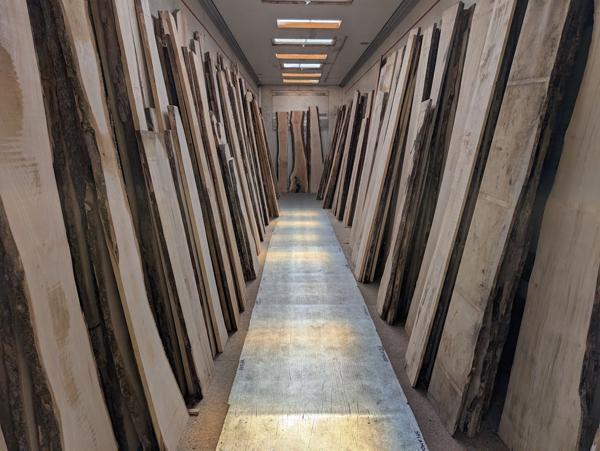
This morning I had a trip over to my favourite timber yard:

2026-05-09-01-wentwood-timber_600.jpg


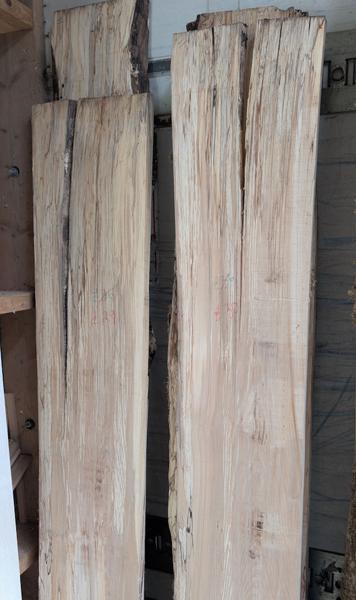
They had loads of stock of Oak, Sweet Chestnut & Sycamore plus a few bits of Yew, Ash, Sequoia and these lovely looking bits of Spalted Beech (which I didn't buy, despite being tempted):

2026-05-09-02-spalted-beech_600.jpg


After browsing the stocks for quite a while, I ended up coming home with a healthy stash of Sycamore in a few different thicknesses. I bought way more than I need for the bedside table (I could probably make four of them!) but I figured it would all get used on something eventually. I really enjoyed working with Sycamore when I made the Mini-Moravian bench and was really happy with what that looked like once finished so hopefully this Sycamore will live up the same standards.

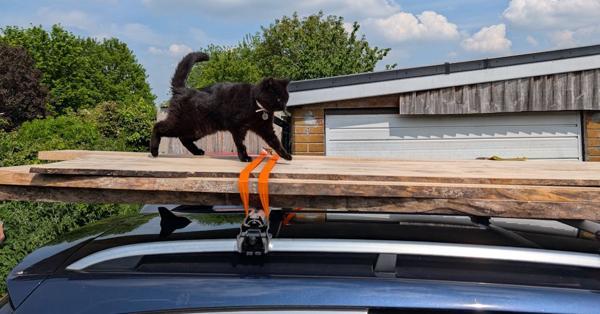
It seemed to pass the first inspection from our little 21-year-old:

2026-05-09-03-sycamore-inspection_600.jpg


I see a lot of hand planing in my future...
 
Very nice table @AndyT and as I remember it! @Dr.Al requested suggestions as to design ideas, but what I do is to scan Pinterest for inspiration, bearing in mind that there's nothing new in woodwork design that hasn't be thought about decades or even centuries ago. F'example, this is the Pinterest board I created when I was researching the 'Overflow Bookcase' project, so by picking around ideas I was able to come up with something that was acceptable to me and more importantly, SWIMBO. On that board you ought to be able to see the Japanese themed design that I adapted - Rob....who's taking a break from garden landscaping!
 
Looking back at my table, I see that I was closely following a design in Thomas Moser's book "How to Build Shaker Furniture". It's also featured in a magazine article by Christopher Schwarz available here: https://www.popularwoodworking.com/wp-c ... 4-Seg2.pdf which Custard pointed me to. The article has full dimensions and some good advice on stock selection.

The legs actually go down thinner than I remembered - to 5/8" which is about 16mm. The top is 19mm thick, bevelled down to 12mm. I made mine rectangular not square and I did a "proper" drawer with a cedar bottom set into slips and sides made from quarter sawn oak.

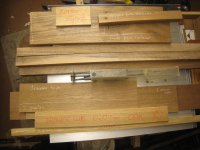
This photo may be useful for checking whether you need a return trip to the forest - it's the wood I used for mine, piled up on my table saw (which spends more of its time as a table than a saw.)

table_wood.jpg
 
Thanks Andy. I'd be gobsmacked if I need a trip back to Wentwood for this one.

Some of the wood I bought was a bit over 20 mm thick & (pre-planing) looks like it might be quite pretty post planing, so I might try a bit of that for the top based on the thickness of yours. I've got enough of several different thickness that I can take some risks & know I've got plenty of spare wood.
 
The tables I made were also Thomas Moser's design from the same book.

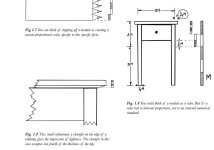
A bit more on design, I'm a fan of the books by Tolpin and Walker who describe classical ways of figuring architectural and furniture proportions. Here is a relevant figure from their most recent book, "Good Eye," which examines furniture designs specifically. Their approach is to define a "module" for the piece, here 1/6 of the height, and the overall proportions are 5:3. The rest of the proportions are integer multiples or fractions of the module. (In this case, I would have made the drawer height one module rather than how they show it.)

Screenshot 2026-05-09 at 1.55.44 PM.JPG
 
Back
Top