Dr.Al
Old Oak
I've been hand planing (and scraping) some stubbornly grained wood recently and its got me thinking about one thing that I've never quite understood about how to work mostly with hand tools.
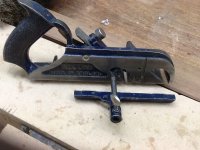
I've got two planes with fences: a number 78:
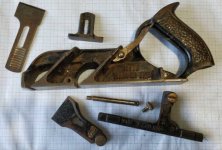
and (most of) a Stanley 50:
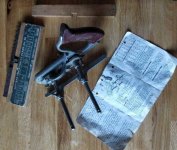
(both photos taken just after receiving them; they've had a bit of TLC since then). The #78 is one of my favourite planes and gets used for all sorts of things: despite having two #311 shoulder planes (having snapped one in half and then brazed it back together after replacing it), I usually reach for the #78 for shouldery things by preference and I occasionally also use it as a sort-of-scrub plane.
This question, however, relates to using both planes in the more conventional way - as planes with a fence that you bear against one side of the work to either plough a shallow (imperial :evil: ) groove or to cut a rebate. The thing I haven't managed to get my head round is why both of these planes are designed such that the fence can only be mounted on one side.
How are you supposed to cope with grain direction with these tools? Obviously you can try to plan the workpieces such that the grain is in the right direction for when you come to plough your groove, but that's not always going to be possible (think boxes made in one piece with both the base and the top let into a groove). You could also follow it with a router plane to tidy up the tear-out it makes, but that seems to defy the point of having these dedicated tools somewhat. I guess the bottom of a groove is often hidden, but rebates can be quite visible. Is there something I'm missing?
When I made my grooving planes, I made them in pairs to get round the problem, but that doesn't help with the more adjustable and hence more versatile #50 and #78.
I've got two planes with fences: a number 78:
and (most of) a Stanley 50:
(both photos taken just after receiving them; they've had a bit of TLC since then). The #78 is one of my favourite planes and gets used for all sorts of things: despite having two #311 shoulder planes (having snapped one in half and then brazed it back together after replacing it), I usually reach for the #78 for shouldery things by preference and I occasionally also use it as a sort-of-scrub plane.
This question, however, relates to using both planes in the more conventional way - as planes with a fence that you bear against one side of the work to either plough a shallow (imperial :evil:
) groove or to cut a rebate. The thing I haven't managed to get my head round is why both of these planes are designed such that the fence can only be mounted on one side.How are you supposed to cope with grain direction with these tools? Obviously you can try to plan the workpieces such that the grain is in the right direction for when you come to plough your groove, but that's not always going to be possible (think boxes made in one piece with both the base and the top let into a groove). You could also follow it with a router plane to tidy up the tear-out it makes, but that seems to defy the point of having these dedicated tools somewhat. I guess the bottom of a groove is often hidden, but rebates can be quite visible. Is there something I'm missing?
When I made my grooving planes, I made them in pairs to get round the problem, but that doesn't help with the more adjustable and hence more versatile #50 and #78.