Trevanion":g23emmua said:
sunnybob":g23emmua said:
Just remember that 3 thin cuts will always give you a better finish than one big swipe. In hard woods, I never take off more than 2 mm at a time, and a finishing cut will be a half mm.
That’s not incorrect Bob, but it isn’t true for every situation either. Although it sounds counterintuitive some timbers that are prone to tearing out a deeper cut can actually help prevent the fibres being torn out, by having a deeper cut the finished cut surface is supported by the timber behind it and doesn’t get torn out, whereas a very thin cut has no support behind the cut surface and can be prone to tearing out.
I think this is true, and the geometry of the cutter makes a huge difference too. I recently had to cut some seat stringers to replace the rotted ones in my mum's garden seat, so "S" curves in hardwood. Using up scraps I had three pieces of something Mahogany-ish, one of something Teak-ish (glued-up lengthwise from two slats), and an unused 1/2" Silverline template follower (bottom bearing) that's been sitting around from when it was "last few, must go" at Toolstation some years back.
I am careful with RPMs, also the feed speed. I test, etc.
Bandsawn to within around 2mm of the line/template, It did cut the Mahogany, but with a lot of vibration, and yes, tearout. When I started on the Teak, I was sensible enough to realise what was happening and stop before getting to the wanted part of the workpiece. Very nasty vibration, and equally nasty result.
The rest of the story is predictable: Wealden web site; bought one of these:
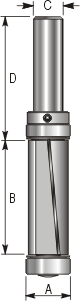 https://www.wealdentool.com/acatalog/Online_Catalogue_Down_Shear_Trim_23.html
It's a monster, but it does work superbly.
The Teak looked like it had been planed (which I very cautiously tried to do, but couldn't but spoil it - so I stopped).
Interestingly, although I had a very sharp plane iron, I couldn't do much to the mahogany tearout either, and ended up sanding it. I am morally certain this was down to the damage done by the Silverline cutter, as I have a de-arrising cutter (again from Wealden, which I used on all the pieces, as they might well get enquiring fingers. That worked beautifully on the Mahogany, even though it had a few bits of tearout near the edges.
So apart from the cutters (the biggest difference, obviously), the other big thing was the amount being taken off. I was more cautious with the bandsaw when cutting the Teak, so it was a deeper 'trim' run against the template. I think that helped. There was one spot where there was a distinct sharp angular change in the profile, at one end, and that came out sharply on the Teak, but rounded/torn on the Mahogany.
Just my twopence.
E.


