• Hi all and welcome to TheWoodHaven2 brought into the 21st Century, kicking and screaming! We all have Alasdair to thank for the vast bulk of the heavy lifting to get us here, no more so than me because he's taken away a huge burden of responsibility from my shoulders and brought us to this new shiny home, with all your previous content (hopefully) still intact! Please peruse and feed back. There is still plenty to do, like changing the colour scheme, adding the banner graphic, tweaking the odd setting here and there so I have added a new thread in the 'Technical Issues, Bugs and Feature Requests' forum for you to add any issues you find, any missing settings or just anything you'd like to see added/removed from the feature set that Xenforo offers. We will get to everything over the coming weeks so please be patient, but add anything at all to the thread I mention above and we promise to get to them over the next few days/weeks/months. In the meantime, please enjoy!

Block Plane

I'll offer this as someone with no knowledge of engineering and metalworking.

Would the thickness of a plane blade only become a factor if it flexes or in some other way goes out of true due to it being too thin to be mechanically stable? Or is it a general truism that greater thickness leads to more structural stability? It certainly seems intuitively so.

On the other hand, we all know that old Record and Stanley blades can certainly cope well with e.g. pine and other common (soft)woods.

So are thicker blades simply the icing on the planing cake?
 
What say ye about planing crossgrain, what do you think works best?
I have a wee shoulder plane bedded at maybe 18 degrees, which seems to take a cleaner shave off a tenon cheek than a well set Bailey does.
I don't hone it very steeply.

I should have edited my post, but what I was meaning to say, shooting long grain is fairly straight forward, but if ever you need to dimension something like a plug for covering up a single flaw,
by planing crossgrain,
that small bit of tearout seems to make things quite a bit more difficult, and can wipe out your lines.
Sometimes I pick up the end grain shooter by mistake, which is worse again,
and its a PITA to adjust the panel plane to 90 for shooting.

Seems I have want for my LN afterall,
A mini Bailey for chamfers on long grain would be nice too, as I don't like the idea of swapping irons in planes.

Going to ponder making a shooting board which can be flipped over for both planes 8-)
Maybe some of you folks might have thought of that already?

Tom
 
I'd reckon the thicker iron has some merit.
If you take some woodies for example, seems to me most of the users have thick double irons
but those unloved transitional plane all seem to have thin ones.
Seems to me you can take a good deal heavier cut with a woodie, compared to a Bailey,
that must say something?

Tom
 
Blackswanwood":2ci2t2kk said:
My understanding is that a thicker blade is less prone to vibration.

Surely the most important factor with vibration is that the blade is seated perfectly upon the casting and fully supported with no gaps underneath where the blade can bend during the cut causing chatter? I would suppose a thicker blade would negate that by virtue of being less likely to bend when not supported properly.
 
Blackswanwood":317vo9n9 said:
My understanding is that a thicker blade is less prone to vibration.

Fair enough but from which source ? I sometimes think that these 'ideas' develop a life of their own.
 
Just looked at my block plane a 60-1/2 type
The blade is about 2mm thick and supported about 3mm back from the cutting edge. I just don't see how that is going to vibrate to any degree.

I'm with Roger and the oxygen free copper analogy.

Bob
 
9fingers":1h46q7vq said:
...

I'm with Roger and the oxygen free copper analogy.

Bob

You forgot that it's got to be stropped on the thigh of a dusky maiden :D
 
It would be great if the various opinions could get together for a WH2 plane off.

Each come with their block plane of choice and a suitable untamed piece of wood. Wood and planes get passed around and then voted on.
 
TomTrees":2zaxa2jd said:
Bill Carter published a recent video of a plane and remarks on the thicker than normal iron...
"It works a blooming treat"
I've cut to that part in the vid https://youtu.be/w4hSLV2MCmE?t=192

Thanks for posting that. And, how did you get the link to start at that point? :D

It seems to me that the thinner a piece of metal is the more likely it is to vibrate under the same conditions as something thicker. I’m guessing the real reason old plane irons were so thin is because tool steel was more expensive years ago than it is today. It’s certainly seems much easier to make given the stock prices I’ve seen? The Japanese tool makers seem to have the right idea. Back a thin piece of high carbon steel with a thick piece of Iron? There are some contrarians out there but I’ve not seen anything to convince me. Just because you can make something work well doesn’t necessarily mean it’s a good design, or indeed, can’t be improved. I’m sure the Ford Model T was very good in its day but thankfully car design didn’t rest there on its laurels.

I’m putting a potential purchase on the back burner as I’m wondering how difficult it would be for me to make my own plane given I have some machine tools. I’d probably need to buy an Iron though if it’s to be successful. Don’t watch this space, it could take me some time! :lol:
 
Woodster":1pe9wthx said:
It seems to me that the thinner a piece of metal is the more likely it is to vibrate under the same conditions as something thicker. I’m guessing the real reason old plane irons were so thin is because tool steel was more expensive years ago than it is today. It’s certainly seems much easier to make given the stock prices I’ve seen? The Japanese tool makers seem to have the right idea. Back a thin piece of high carbon steel with a thick piece of Iron? There are some contrarians out there but I’ve not seen anything to convince me. Just because you can make something work well doesn’t necessarily mean it’s a good design, or indeed, can’t be improved. I’m sure the Ford Model T was very good in its day but thankfully car design didn’t rest there on its laurels.

I’m putting a potential purchase on the back burner as I’m wondering how difficult it would be for me to make my own plane given I have some machine tools. I’d probably need to buy an Iron though if it’s to be successful. Don’t watch this space, it could take me some time! :lol:

It's not only the Japanese that do that. All of the older English irons you'll see in old wooden planes will be of laminated steel construction, a high-carbon steel forge-welded to a low-carbon steel backer, even Stanley and Record were using laminated irons up until about the 50s when it became cheaper to make the whole iron out of tool steel. You'll see it if you sharpen a Record "Best Crucible Cast" iron (the older ones with the square shoulders) up to a high polish, on the bevel you will just about make out the line between the harder high-carbon steel and the softer low-carbon.

Here's an image I've stolen off the web that came from a Stanley advertorial:

07E925AA-479C-4162-BE35-AB17CA20B1BC.jpg


Sometimes I wonder whether that's where the secondary bevel originated from, use a coarser stone to cut through the softer backing, then use a secondary bevel on the harder steel as so not to contaminate your fine stone with soft steel powder.
 
RogerS":9t7pklm4 said:
Blackswanwood":9t7pklm4 said:
My understanding is that a thicker blade is less prone to vibration.

Fair enough but from which source ? I sometimes think that these 'ideas' develop a life of their own.

Okay - built up over a period of time and based on a mixture of what I have heard from people I would respectfully consider more learned that me and my own experience.

As I recollect when I did a weekend’s fettling course (c. 10 yrs ago) with Chris Tribe it was first discussed. It was then reinforced by David Savage (and several of his makers) when I did a course at his workshop. I swapped the iron in my Record No6 as a result and immediately got less chatter. It’s entirely possible I did something else at the same time without noticing (got better at sharpening?) which made a difference but on balance I think there is a logic to a thicker iron being less prone to vibration/chatter. Other things though such as a a better and well fitting chip breaker, improving the seating of the face of the frog or a better edge will also help.

Apologies if you feel I have implied that a thicker blade is a silver bullet Roger - to put it more accurately I believe it’s one of a number of factors that reduce vibration/chatter and as HRH may put it opinions will differ!
 
Blackswanwood":g61hp4jz said:
....... I swapped the iron in my Record No6 as a result and immediately got less chatter.......... on balance I think there is a logic to a thicker iron being less prone to vibration/chatter...

I haven't the least doubt that you're right, Robert. But chatter with a No. 6? I've never heard of that happening.
 
Mike G":34vjbqgh said:
Blackswanwood":34vjbqgh said:
....... I swapped the iron in my Record No6 as a result and immediately got less chatter.......... on balance I think there is a logic to a thicker iron being less prone to vibration/chatter...

I haven't the least doubt that you're right, Robert. But chatter with a No. 6? I've never heard of that happening.

:lol: Mike - my son tells a story of the afternoon he learned new swear words while watching me try to get said plane to work as it should do. FWIW full marks to Chris Tribe who showed me how to sort it with the most important lesson being to experiment and find a way of sharpening that works for you and don’t give a monkeys about what the purists say!
 
Blackswanwood":2g732pxs said:
Mike G":2g732pxs said:
Blackswanwood":2g732pxs said:
....... I swapped the iron in my Record No6 as a result and immediately got less chatter.......... on balance I think there is a logic to a thicker iron being less prone to vibration/chatter...

I haven't the least doubt that you're right, Robert. But chatter with a No. 6? I've never heard of that happening.

....find a way of sharpening that works for you and don’t give a monkeys about what the purists say!

Or the thickness of the blade ? ;) :)
 
Chatter is a really odd thing, sometimes. I have 3 spokeshaves which are indistinguishable from each other. They are all but identical. But I can guarantee that at least one of them will chatter on any given piece of work. There's no good reason why one should do it and not the others, but it happens. Nothing wrong with the spokeshave, really, because like as not it will work perfectly on the next piece.
 
Mike G":3l0z7kc6 said:
Chatter is a really odd thing, sometimes. I have 3 spokeshaves which are indistinguishable from each other. They are all but identical. But I can guarantee that at least one of them will chatter on any given piece of work. There's no good reason why one should do it and not the others, but it happens. Nothing wrong with the spokeshave, really, because like as not it will work perfectly on the next piece.
I've had similar experiences.

There's bound to be a complete physical explanation, probably at the level of quantum mechanics but FWIW I reckon that in such cases it could be down to the ergonomics of the handles/grips. Maybe there's a fractional difference between them in different tools but the woodworker's grip stays the same and so maybe this results in a small difference in the attitude of the tool to the wood. On the other hand, I could be simply overthinking it ...
 
Mike G":24xleiqv said:
Chatter is a really odd thing, sometimes. I have 3 spokeshaves which are indistinguishable from each other. They are all but identical. But I can guarantee that at least one of them will chatter on any given piece of work. There's no good reason why one should do it and not the others, but it happens. Nothing wrong with the spokeshave, really, because like as not it will work perfectly on the next piece.


You need some low angle wooden ones, or a Ron Hock blade and make your own.
Preston spokeshaves are far less chattery than the Stanley/Record ones.

A good bed filling will help most spokeshaves perform better.

Pete
 
The amount of chattering you get when using wooden spokeshaves from my experience seems to be very much dependant on the density of the wooden handle and the blade it has been coupled to. I have a few pairs wooden shaves in S M & L sizes for flat bottom and just a single for rounded sole in each size. I have found that the round soled shave don't seem to have a chatter problem - ever. However, when I first got the flats a couple of them (one large, in particular) was very prone to it. So much so it prompted me to get a second set of shaves and I then played about and swapped the irons over. Voila, no more chatter. I did investigate a bit and found the chattering combination to be a few grams lighter that the non. Once the blades were swapped there was just a 1g difference between them.

Not got round to trying it but have often thought that perhaps giving the wooden handles a few weeks of immersion in some BLO etc would help to mitigate or eliminate the density problem by changing the resonance of the wood
 
Pete Maddex":1yp20mgt said:
....You need some low angle wooden ones....Pete

That's what I've got, Pete. Yhey're great, but one of them, different every time, will generally chatter on most jobs with deep curves.
 
Good video Dan.

All this stuff now largely superseded by hand held electric planes like the little Festool though. :eusa-shhh:
 
I saw that video a while back so I won’t watch it again but didn’t he say the whole blade on the Stanley is tool steel unlike the picture posted earlier of the laminated blade?
 
Woodster":2d57mxtv said:
I saw that video a while back so I won’t watch it again but didn’t he say the whole blade on the Stanley is tool steel unlike the picture posted earlier of the laminated blade?

How long is a while back? It’s only been uploaded for a few hours :eusa-think:
 
Trevanion":17b2hkmb said:
Woodster":17b2hkmb said:
I saw that video a while back so I won’t watch it again but didn’t he say the whole blade on the Stanley is tool steel unlike the picture posted earlier of the laminated blade?

How long is a while back? It’s only been uploaded for a few hours :eusa-think:

It must have been another one I was thinking of as my history suggests I watched it yesterday or the day before. Either way I watched it before you posted the link.

Of the two suppositions you’ve posted which one do you think is most likely? :eusa-think:
 
Woodster":1g1qplti said:
I saw that video a while back so I won’t watch it again but didn’t he say the whole blade on the Stanley is tool steel unlike the picture posted earlier of the laminated blade?

He did, and went on to say that you could use the blade right down to the end, and he described why it was an innovation at the time. He even shows some advertising from the launch era.
He likes hock blades as do several folks here, whose opinion I trust.
I quite like his style, not too enamoured about most stuff on y tube but might check out some of his other stuff.
 
Woodster":42n6bbbp said:
It must have been another one I was thinking of as my history suggests I watched it yesterday or the day before. Either way I watched it before you posted the link.

Yes, you're right, it's been up for a couple of days, my mistake! :oops:

Woodster":42n6bbbp said:
Of the two suppositions you’ve posted which one do you think is most likely? :eusa-think:

A supposition in regards to iron construction or iron thickness? I posted the video as more of a point about iron thickness but I can see how you can get the iron construction query from it so I'll answer both anyway.

I re-watched the video and Rex does indeed say that the iron is made completely of high-carbon steel, so I've actually gone out of my way to research this a bit further because I was curious as he's not usually wrong and quite well read-up on whatever subject he's talking about and interestingly I've found out that earlier irons made by Stanley were indeed solid tool-steel and they actually started laminating the irons in the 1920s as a cost-cutting measure and then went back to solid tool steel in the 1950s.

Regarding iron thickness, it's obvious that a thicker iron is going to deal with chatter and other issues better than a thin iron, but it is the wrong solution for the root problem which is a poorly set up plane. If the plane is set correctly with a thin iron that is properly supported by the frog of the plane it should work as intended just as well as one with a thicker iron. If the thin iron is supported properly and clamped in place solidly it becomes homogenous with the frog and in effect, theoretically turns it into a thicker iron by virtue of that support behind the cutting edge, if there's a shaving trapped between the blade and frog or if the frog is twisted you are going to get chatter, a thicker iron will help remedy this but it's solving the symptoms and not the problem.

Lurker":42n6bbbp said:
I quite like his style, not too enamoured about most stuff on y tube but might check out some of his other stuff.

I rather enjoy his videos, even as a machine man I find them worth watching as they're not over-the-top and are quite informative despite being himself being a self-proclaimed amateur woodworker. Just an easy watch.
 
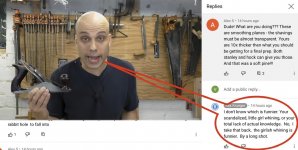
I’ve seen a few of his videos but I admit I don’t find him as convincing as some other YouTubers. I happened to look at the comments on that particular video and he let himself down badly with some very childish comments.

7C3969BE-F81E-40C9-9462-E98CE9096438.jpeg
 
Back
Top