• Hi all and welcome to TheWoodHaven2 brought into the 21st Century, kicking and screaming! We all have Alasdair to thank for the vast bulk of the heavy lifting to get us here, no more so than me because he's taken away a huge burden of responsibility from my shoulders and brought us to this new shiny home, with all your previous content (hopefully) still intact! Please peruse and feed back. There is still plenty to do, like changing the colour scheme, adding the banner graphic, tweaking the odd setting here and there so I have added a new thread in the 'Technical Issues, Bugs and Feature Requests' forum for you to add any issues you find, any missing settings or just anything you'd like to see added/removed from the feature set that Xenforo offers. We will get to everything over the coming weeks so please be patient, but add anything at all to the thread I mention above and we promise to get to them over the next few days/weeks/months. In the meantime, please enjoy!

Bois de Steve

Would not surprise me if their is a scheme for oaks though as the French produce a huge amount commercially.
 
Have your spoken to your Mairie Steve? How is that area designated on the plan cadastral?
Have natural protected hedges been ripped out?
We had a géomètre (surveyor) round here a few weeks back as part of the field next door is up for sale. He was not at all happy as a few boundary changes had been made and not recorded.
The Mairie might have information on regional schemes available for rewilding, regeneration etc
 
I've just planted a few fruit trees as feathered maidens. One is a fan, two are cordon's and the last is a semi-dwarf bush. The supplier's own website was a wealth of information as was the RHS's.
"Feathered maidens" ? One is a 'semi-dwarf bush' ? :eek: You've been watching 'those' channels again, you naughty boy smile.png
 
Yesterday, my friend Jeff came round with a Yew sappling "If" in French. It has a good root system on it. So it can live in this pot until we get the rest and start to plant. It should do well as it is not the only If in the area.
20250122_145902 (Medium).jpg

Well, it's a start!
S
 
You probably already know Steve but Yews don't like to be in very wet ground. So choose where you plant with care and if necessary create a mound to plant in. They are hardy but we learnt the hard way on heavy clay that gets wet for long periods in winter.
 
I'm going to collect the new oaks tomorrow.
"Do I need to bring a trailer?"
"No, they are inches tall, not feet, they are all in a bucket".
This might be an even longer project than I anticipated! Apparently oaks have a massive tap root, so even small trees need machinery to dig them out intact. I didn't know that. But at least seedlings are more likely to take to a new home than an established sapling, I guess.
Watch this space!
S
 
It would take about the same time if you harvested a bucket of acorns from local oaks, and poked thm in quite shallow holes all over the place with a dibber. Leaf pairs will appear quite soon on a lot of them and then any that are in the wrong place can easily be dug out and relocated.
 
I don’t know anyone who needed a few beech saplings to complete a small hedge around his composts bins so went into the local forest and dug up a few . They are now at the required hedge height of about 5’ and he can’t tell the difference between the bought ones and those he found.
 
Not sure if that is a good idea to promote. At least around here that is an offence. It is treated as theft if you get caught.

Also be aware that hedges are mainly grown of 2 species: carpinus betulus and fagus sylvatica. The last one is what you'll find in your local forest. That is the plain beech tree we all know. You just prune it to keep it small.
 
Last edited:
I don’t know anyone who needed a few beech saplings to complete a small hedge around his composts bins so went into the local forest and dug up a few . They are now at the required hedge height of about 5’ and he can’t tell the difference between the bought ones and those he found.

'Found'...
 
Everyone should read this , it's quite wonderful.

If planting in really bad ground, a post hole borer is useful, especially if there's a clay/silt pan to break through. Bore a hole backfill it with reasonable soil and your trees have a chance.

An observation on an earlier post - the human brain doesn't does esily do "random". If you wanted six random numbers out of a hundred numbers and used a random number generator and it came up with e.g. 41, 42, 43, 44, 45 and 46 very few people would accept it was a random selection, but of course it's just as likely as any other combination of numbers. It's why random patterns in tiling etc. are difficult.
 
And, if planting beech, then you should absolutely add some of the root starter they need to prosper. It contains a fungus beech needs to grow a healthy root system.
 
I picked up my new "trees" today. They are, indeed, seedlings rather than saplings. But no matter. I have oak, sycamore and something spiky, probably hawthorn (although if it turns out to be blackthorn I shall be delighted). Jeff and I are gong to plant them out tomorrow. I'll take pictures.
S
 
I'm going to collect the new oaks tomorrow.
"Do I need to bring a trailer?"
"No, they are inches tall, not feet, they are all in a bucket".
This might be an even longer project than I anticipated! Apparently oaks have a massive tap root, so even small trees need machinery to dig them out intact. I didn't know that. But at least seedlings are more likely to take to a new home than an established sapling, I guess.
Watch this space!
S
The oaks I planted were the same size 5 seasons ago. They are 10 feet tall now
 
Maybe should get hold of a few horse chestnuts Steve, I grew some from nuts and now 3ft tall second year.
 
I don't know about Horse Chestnuts, but plenty of Chestnuts grow wild around here. Also Silver Birch and Yew, and some anonymous Spruce/Fir/Pine softwoods.
S
 
Mixed woodland is a cool idea Steve. And get some truffle spores in the ground as well. ;)
 
A couple of letters from today's paper might be of interest, Steve

A gardener’s advice for achieving straight oaks​

SIR – J A Crofts (Letters, February 11) says that arboricultural knowledge such as how to grow straight oak trees has been lost. Not entirely, it seems, since some relevant books were written, including Moses Cook’s The Manner of Raising, Ordering, and Improving Forest Trees (1679).

In a later edition, there is a chapter entitled “Of raising and improving oaks”, in which the author recommends not letting an oak grow crooked, since “I wish all Oaks were fit for Timber”. He explains how, adding that “by this Summer-pruning you may keep your Tree streight”.

Cook was the head gardener for the Cassiobury estate of the Earl of Essex, in Watford.

Robert Carnaghan
Watford, Hertfordshire


SIR – The old method of growing straight oak trees was to make the oak sapling the centre point of a quincunx (that is, in a square with four taller and faster-growing trees, such as conifers, at the corners). As the oak would always be striving to obtain light, it would be forced to grow taller and straighter than it would otherwise have done.

David Alderman
Liphook, Hampshire
 
That is very encouraging, thank you. It's possible, but by no means a given, that I shall make it to see the same. I hope so.
I'm sorry to disappoint you Steve but that's not going to happen. Try as you might, I can confidently state you will NEVER reach 10 feet tall!
 
I recall that when I bought the cladding for my workshop from a local sawmill, the sawyer told me that the log had come from Longleat and that the foresters back then trained, or pruned, the tree, so that when felled the main trunk was straight and had no knots. There were no knots in my cladding at 5.5m long.
 
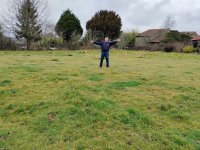
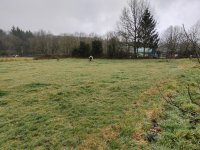
This is the site. It's at the left hand end of the yellow rectangle in the aerial view above.
the site (Medium).jpg

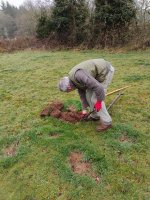
We decided we could get a row of 4 in between the existing orchand and our boundary, so we plonked a stake at each position and started to dig. The ground is wet at the mo, so digging is not so bad. There is a layer of turf to remove first.

jeff digging (Medium).jpg

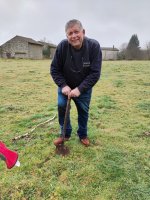
And just to prove that I'd not delegated all the hard graft to Jeff...

steve digging (Medium).jpg

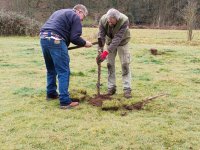
We knocked in the stakes

teamwork (Medium).jpg

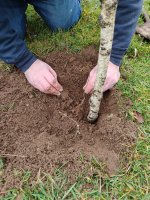
and planted the seedlings with a little sprinkling of bonemeal

the first seedling (Medium).jpg

Some of the seedlings did not have much of a root on them, so we doubled up where that was the case. If they both do well, I can transplant them again next year, I guess.

So, 12 posts and 14 seedlings later, I am Master Of All I Survey!

master of all I survey (Medium).jpg

I've still got another 10 to do but probably next week now. So far, I'm dead chuffed.
S
 

Attachments

  • jeff removing turf (Medium).jpg
    jeff removing turf (Medium).jpg
    310 KB · Views: 2
Are you considering tree guards? I'd recommend unless you know you don't get deer or rabbits.
 
I'm told that the rabbits are extinct due to hunting There are deer in the woods a little way away, but we've never seen them round here. I know it wouldn't be a bad idea.
 
Jeff has suggested I mulch the trees with sawdust, I probably have enough, in bags. Mainly oak and chestnut, a bit of softwood. Is that a good idea, do you think? It's all fresh stuff, not aged and mature. I'm wondering if anything nasty will leech out of it.
Any guidance gratefully received.
S
 
I'm told that the rabbits are extinct due to hunting There are deer in the woods a little way away, but we've never seen them round here. I know it wouldn't be a bad idea.
The biggest cause of loss for me was voles eating the bark around the bottom of the trees. The next was the trees getting mangled in the tree guards. If Deer are a risk then guards would be worth it but the solid guards are homes for voles and the mesh ones mangled trees when they grow through the mesh. It all means you need to check the guards regularly.
 
Jeff has suggested I mulch the trees with sawdust, I probably have enough, in bags. Mainly oak and chestnut, a bit of softwood. Is that a good idea, do you think? It's all fresh stuff, not aged and mature. I'm wondering if anything nasty will leech out of it.
Any guidance gratefully received.
S
Yes mulch is good to keep the grass and weeds down local to the tree roots. Gardeners do not like wood shavings or sawdust because of the ph. However the tallest and healthiest tree in my plantation by a long way was planted where I used to have my annual hedge pruning fire. Just saying. Of course it could be coincidence but…
 
Apparently, it is now illegal to have bonfires, unless it is on agricultural land. Farmers are exempt.

I have read that for the last couple of years, Pampas grass has be deemed to be an invasive species. I has to be dug up and disposed of. We have such a beast. It has the footprint of a car, but if we can't set fire to it, I don't know what we can do. It would need a JCB to dig it out, rather than a bêche.
 
We are not allowed to take sawdust or to the Kompostierungsanlage (composting facility), including wood chips from the P/T. According to the staff at the facility, the sawdust removes too much nitrogen from the soil as it decomposes and it can inhibit plant growth. I had considered using the sawdust from my shop as weed control in selected areas, but the lawn experts told me this would be a bad idea because it takes several years for the soil to recover.
 
Back
Top