• Hi all and welcome to TheWoodHaven2 brought into the 21st Century, kicking and screaming! We all have Alasdair to thank for the vast bulk of the heavy lifting to get us here, no more so than me because he's taken away a huge burden of responsibility from my shoulders and brought us to this new shiny home, with all your previous content (hopefully) still intact! Please peruse and feed back. There is still plenty to do, like changing the colour scheme, adding the banner graphic, tweaking the odd setting here and there so I have added a new thread in the 'Technical Issues, Bugs and Feature Requests' forum for you to add any issues you find, any missing settings or just anything you'd like to see added/removed from the feature set that Xenforo offers. We will get to everything over the coming weeks so please be patient, but add anything at all to the thread I mention above and we promise to get to them over the next few days/weeks/months. In the meantime, please enjoy!

Books on chair design and construction

NickM

Old Oak
Joined
Dec 8, 2020
Messages
1,537
Reaction score
843
Location
Near Basingstoke
Are there any "bibles" on chair design and construction methods which I should be reading before I embark on making chairs to go with the table I just built?

Thanks
 
You might find this helpful

I'm pretty certain that MikeG has posted something related to this in the past covering the range of body sizes and their accommodation in/on furniture. I'll try a search and post back if I can find it.
 
There are many books, but you need to choose your style because most seem to cover just one style or cover bits of chair making. I am yet to find a comprehensive chairmaking book that covers all styles and all techniques. I tend to pick up bits from several books (I have about 10 different books on chairmaking) and then design what I am trying to achieve. It is fundamentally just mortice and tenon joinery with varying degrees of fancy shaping and carving added usually after you have cut the joints into square stock. The important task is to make your joints as strong as possible because there is serious load on a back leg/seat rail joint when it is rocked back on to two legs. That is easy to say but difficult to achieve. A full size drawing is essential.
 
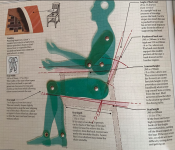
One of the old books in my collection is Collins Complete Woodworkers Manual. Although it doesn't give much detail about styles, what joinery techniques etc. it does have a page outlining some of the basic design aspects - photo below (sorry for the poor quality but it's a large book and won't open flat).
 

Attachments

  • Chairs 3.png
    Chairs 3.png
    594.4 KB · Views: 2
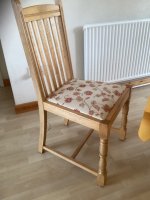
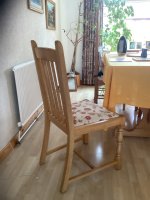
I can recommend the method I used many years back. While looking at what was available in the shops and trying out belonging to others, a work colleague asked me to repair an oak dining chair reputed to have been made in the 1930s.
When the chair was repaired I asked the owner if I could make use of it for a week or so.
It proved popular and comfortable to my wife and myself so I made templates and took sizes before making four copies.
The only alteration to the design was the omission of a shaped central back splat. The rest being identical.
They have now been in use for over thirty years.
 

Attachments

  • IMG_1489.jpeg
    IMG_1489.jpeg
    139.3 KB · Views: 3
  • IMG_1490.jpeg
    IMG_1490.jpeg
    149.4 KB · Views: 2
The 'bible' is the one to go for, either the first edition (which I have) or the current version - Rob

'The Technique of Furniture Making'
As much as this bible is indispensable, it is not encyclopaedic in relation to chairs. In my view it is a section that seems based upon 1970s ideas and little else.
Probably the one I refer to most is Fine Woodworking's Designing and Building Chairs. It does at least set out to explain the design issues and processes fairly generally and then provides a range of styles and techniques. It is not comprehensive but reasonably generic. It is a place to start.
 
In my view it is a section that seems based upon 1970s ideas and little else.
I beg to differ. The current version is the fourth addition (see the linkie) and deals with cnc machining etc to it's pretty much bang up to date - Rob
 
One of the old books in my collection is Collins Complete Woodworkers Manual. Although it doesn't give much detail about styles, what joinery techniques etc. it does have a page outlining some of the basic design aspects - photo below (sorry for the poor quality but it's a large book and won't open flat).
Thanks. I have that book.
 
I can recommend the method I used many years back. While looking at what was available in the shops and trying out belonging to others, a work colleague asked me to repair an oak dining chair reputed to have been made in the 1930s.
When the chair was repaired I asked the owner if I could make use of it for a week or so.
It proved popular and comfortable to my wife and myself so I made templates and took sizes before making four copies.
The only alteration to the design was the omission of a shaped central back splat. The rest being identical.
They have now been in use for over thirty years.
Yes, I'm certainly taking mental notes of every chair I sit in at the moment!
 
I’m convinced it’s the best way to get what you really want!
I failed to mention that all joints are mortise and tenon, not a dowel anywhere!
I made a couple of uncomfortable garden seats to published designs in pine, when my wife sat on a friends bench seat and commented on the comfort, my friend and I stood it end on a plywood sheet to draw round it to ,get an exact copy of the seat and backrest profile. I made that in iroko and it’s still in use thirty years later.
 
I failed to mention that all joints are mortise and tenon, not a dowel anywhere!
It's a myth that m/t's are stronger than a dowel joint. Done properly, a dowel joint breaks under a significantly higher load than a m/t joint. Strange but true - Rob
 
It's a myth that m/t's are stronger than a dowel joint. Done properly, a dowel joint breaks under a significantly higher load than a m/t joint. Strange but true - Rob
I think this might be particularly the case in chairs where you might* end up with angled tenons with grain run out. I haven't decided what I'll do yet. I might try to do one with "proper" M&T joints just to prove to myself I can do it, but I've got at least 6 to make so I can see the domino being brought out to speed things up!

*It's possible to do angled mortises, but much harder I think.
 
I think this might be particularly the case in chairs where you might* end up with angled tenons with grain run out. I haven't decided what I'll do yet. I might try to do one with "proper" M&T joints just to prove to myself I can do it, but I've got at least 6 to make so I can see the domino being brought out to speed things up!

*It's possible to do angled mortises, but much harder I think.
It is possible to do angled mortices. Last time I made a jig to hold the part tilted over and the router sitting level on a box so it plunged vertically into angled wood. But you have to make two a left and a right. Also if the back leg is angled rather than vertical you end up with a compound angle. The box approach works well for this.
 
It's a myth that m/t's are stronger than a dowel joint. Done properly, a dowel joint breaks under a significantly higher load than a m/t joint. Strange but true - Rob
There are plenty of studies supporting this conclusion.
The issue for me is convincing myself it is proper joinery.
I keep telling myself that if JK could use dowels all the time. I should use them where appropriate.
It has not worked yet.
 
Making chairs is quite specialised. When I was working in the trade quite a few years ago, there was one guy who was the 'chair maker' and he did virtually nothing else, so he could set up a morticer and other machinery to do weird and wonderful angled cuts with his eyes closed - Rob
 
There are plenty of studies supporting this conclusion.
The issue for me is convincing myself it is proper joinery.
I keep telling myself that if JK could use dowels all the time. I should use them where appropriate.
It has not worked yet.
I thought as well that the traditional m/t was stronger, but when the 'Dowelmax' system was introduced some years ago, the Canadian firm did some joint testing to destruction, where doweled joints were made with that system (now no longer available in the UK) The videos produced at the time are on UToob somewhere and make enlightening viewing. Derek Jones, the then editor of F&C also used the same hydraulic kit and came to the same conclusions.

It's also true that JK did use dowels quite a lot but not exclusively so; he was quite partial to the odd m/t as well :ROFLMAO: - Rob
 
We’re going a bit off topic here so I apologise.
Growing up there was a lot of Ercol furniture in the home, late 70s early 70s. If memory serves me the use of exposed dowels was prominent and they were left proud of the surface in a squashed pyramid shape.
I like the look of exposed dowels in contrasting timbers and have used them to put cabinet frames together, attaching cabinet tops and in drawer construction all more than 20 years ago and although not subjected to the kind of stress tests that Rob describes they are all as good as they day they were made. Some were made with simple dowel pins others with the aid of a jig name of which escapes me .
Whatever floats your boat I guess.
 
Last edited:
Not to go too far off topic ................

Using dowels:
To join the sides of the beehive boxes.
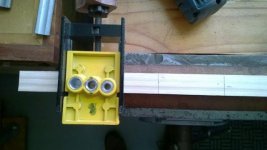
My dowel jig is not made for edge joining but 90 degree joins.

DowelJig.jpg

The dowel positions are marked and indicated which side of the edge.
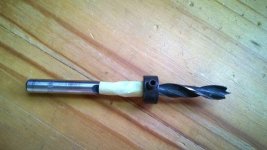
Use the 8mm hole and the drill bit is fitted with a depth stop (found it in a box 2 years too late!)


8mm dril with depth stop.jpg

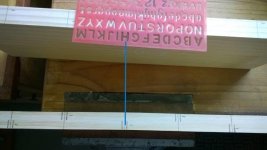
Lining up the hole to the line has been an issue, so I used a template H (8mm wide H) to mark the hole.
Certainly far more accurate. Test fits are ok, so can now glue up.

WP_20240927_002.jpg

Apologies again for thread high-jack. :confused:
 
Back
Top