• Hi all and welcome to TheWoodHaven2 brought into the 21st Century, kicking and screaming! We all have Alasdair to thank for the vast bulk of the heavy lifting to get us here, no more so than me because he's taken away a huge burden of responsibility from my shoulders and brought us to this new shiny home, with all your previous content (hopefully) still intact! Please peruse and feed back. There is still plenty to do, like changing the colour scheme, adding the banner graphic, tweaking the odd setting here and there so I have added a new thread in the 'Technical Issues, Bugs and Feature Requests' forum for you to add any issues you find, any missing settings or just anything you'd like to see added/removed from the feature set that Xenforo offers. We will get to everything over the coming weeks so please be patient, but add anything at all to the thread I mention above and we promise to get to them over the next few days/weeks/months. In the meantime, please enjoy!

Bookshelf design advice

ScaredyCat

Sapling
Joined
Nov 25, 2020
Messages
261
Reaction score
0
Location
North Suffolk
So I'm looking to make some bookshelves, Seems fairly straight forward but I'm wondering if I should make the outer face-frame sides the same thickness as the supporting pieces.

60tspsx.png

The left seems to make it all look a bit too chunky but I'm not sure about the right either..

What's "normal" ?
 
ScaredyCat":3jlsgect said:
....
What's "normal" ?

Whatever 'looks right' ! I prefer the RH side and it looks perfectly fine to me. You could thin down the dividers perhaps
 
It's all personal and there are lots of ways to go about it that can work.

If I was making it, the internal supports would be thin, so as to take the minimum space away from the shelves. I'd also line them up into columns, for max strength, but probably only have one of them. A lot depends on what you make it from.

But that's just me, and I'd probably buy Ikea Kallax, which does the job for much less than the cost of materials - and that's unlikely to be what you wanted to hear!
 
For me, it is the size of the dividers which is wrong, rather than the width of the frame. The shelves themselves can be chunky, for sag mitigation, but the uprigths an be quite slim and still do their job.
S
 
My experience of bookcases as an addict of books on cooking, Japan, gardens, music etc:

Generally they are nowhere near big enough. Books breed. Big books are deeper than people think. Books are very heavy and feeble shelves will sag. Flexibility is good so that you can re-arrange the shelves to suit books of different heights (yours are all much the same and this will look odd with books on the shelves).

I would treat that design as a first thought and then think about what books, what size and what weight you will put on there over the next 10 years.
 
Thanks for the replies.

AndyT":3d2eymj4 said:
I'd also line them up into columns, for max strength, but probably only have one of them. A lot depends on what you make it from.

Ok, my reasoning was that having supports staggered would help limit sag in the shelves.

AndyT":3d2eymj4 said:
But that's just me, and I'd probably buy Ikea Kallax, which does the job for much less than the cost of materials - and that's unlikely to be what you wanted to hear!

Well, yes, but I didn't take up woodworking to save money - I'd have saved more if I hadn't!


Steve Maskery":3d2eymj4 said:
For me, it is the size of the dividers which is wrong, rather than the width of the frame. The shelves themselves can be chunky, for sag mitigation, but the uprigths an be quite slim and still do their job.
S


The dividers are big, there's a 14mm overhang one either side, the actual support is 20mm thick - The reasoning is because I wanted to add some LED lighting and all the wiring would be hidden behind that overhang and coving inside to mount the LEDs at a suitable angle. Not all the shelves (holes) are meant for books, some are for ornaments. Thinning them wont be an issue other than the lighting but there may be ways round that.

b6VFp4P.png

AJB Temple":3d2eymj4 said:
My experience of bookcases as an addict of books on cooking, Japan, gardens, music etc:

Generally they are nowhere near big enough. Books breed. Big books are deeper than people think. Books are very heavy and feeble shelves will sag. Flexibility is good so that you can re-arrange the shelves to suit books of different heights (yours are all much the same and this will look odd with books on the shelves).

I would treat that design as a first thought and then think about what books, what size and what weight you will put on there over the next 10 years.

We have so many books, my wifes's office space is lined with them all full. I'll be making 5 or 6 of these for the hall way which is just dead space we fill with junk and I want to change that. I did measure some of the bigger books and so these shelves are 340mm tall and 300mm deep. I suspect bigger heavier books should be at the bottom and smaller ones at the top so, I could increase the number of upper ones but I don't want it to be difficult to get the smaller books out. I appreciate what you're saying though.


Steve Maskery":3d2eymj4 said:
If I were building a bookshelf like that, I'd make all the shelves torsion-box construction.

I've been playing with the Sagulator to try and work out if this would work ok. I was trying to avoid the torsion box design ;)
 
Interesting to look the folks on Ch4 news, who all (with a few exceptions) are filmed with a backdrop of their bookcases, stuffed full with interesting tomes - Rob
 
image.jpegimage.jpegI am an enthusiastic user of library strip ( Tonk Strip) these allow you to put the shelves at heights that suit the book size and make maximum use of space. I don't use vertical dividers or even book ends, my shelves always seem to be full. The photo shows the use of a return front edge to the sides which holds the sides straight and also looks better than the narrow edge to my eye. The shelves are 22mm thick oak so I don't anticipate any problems with sagging. The unit is one metre wide and two metres high. It has a strip light in the top and a safety chain which is probably not really needed.
 
ScaredyCat":3gcao30b said:
Those tonk strips look interesting, but why is the special router bit needed?
I think there's a groove running down the centre of the cut to accommodate bookcase stud that fits into the small rectangular slots, so the cross section of the cut is a shallow rectangle with a slightly deeper one in the centre...if that makes sense - Rob
 
Yes, it's like Rob said. A special cutter would let you make the cut in one pass, but routing a shallow groove with a deeper, narrow groove in the middle is hardly challenging, whether by power or by hand. So don't be put off.
 
ScaredyCat":z06f6mpg said:
We have so many books, my wifes's office space is lined with them all full. I'll be making 5 or 6 of these for the hall way which is just dead space we fill with junk and I want to change that.

I can hear the fire safety officer starting to get agitated ... shelves full of combustibles in a hallway ?
 
Sheffield Tony":3p8dt1rf said:
ScaredyCat":3p8dt1rf said:
We have so many books, my wifes's office space is lined with them all full. I'll be making 5 or 6 of these for the hall way which is just dead space we fill with junk and I want to change that.

I can hear the fire safety officer starting to get agitated ... shelves full of combustibles in a hallway ?

It's a timber frame house, with walls of wattle and daub. The whole lot is combustibles!
 
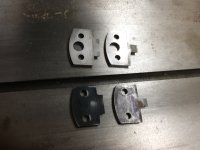
There is a type of Tonk strip that doesn't need a groove but sits on the surface. The drawback to my mind is that it's very visible and you need to cut the shelves short to clear the strip at the ends.that would make return ends on the sides more desirable in order to cover the gaps. The,grooves are easily cut as ready mentioned using a standard cutter and two passes. The method I prefer is using these home made cutters through a spelch board on the spindle.image.jpeg
 
Back
Top