• Hi all and welcome to TheWoodHaven2 brought into the 21st Century, kicking and screaming! We all have Alasdair to thank for the vast bulk of the heavy lifting to get us here, no more so than me because he's taken away a huge burden of responsibility from my shoulders and brought us to this new shiny home, with all your previous content (hopefully) still intact! Please peruse and feed back. There is still plenty to do, like changing the colour scheme, adding the banner graphic, tweaking the odd setting here and there so I have added a new thread in the 'Technical Issues, Bugs and Feature Requests' forum for you to add any issues you find, any missing settings or just anything you'd like to see added/removed from the feature set that Xenforo offers. We will get to everything over the coming weeks so please be patient, but add anything at all to the thread I mention above and we promise to get to them over the next few days/weeks/months. In the meantime, please enjoy!

Box making questions

NickM

Old Oak
Joined
Dec 8, 2020
Messages
1,497
Reaction score
786
Location
Near Basingstoke
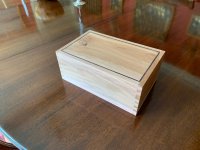
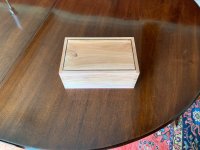
I've started work on another small box.

I'm making this one out of plum from a tree which fell down in our garden last year. I think it's rather attractive wood and is nice to work with. Unfortunately the tree was quite rotten so the box will be rather small!

These are the side pieces (I've employed Rob's coloured stickers approach to see how that goes):
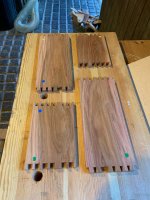
IMG_8356.jpeg

I'm thinking of doing a veneered panel for the lid, which I will make flush with the sides using some inlay strips to hide the join (like I did with the maple box I put up another thread on). This is where I have some questions.

I'd like to have a go at using this piece of the plum to make the lid from:
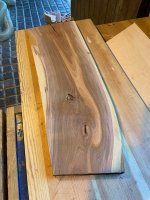
IMG_8358.jpeg

Questions:

1. Assuming I can cut and plane a veneer down to, say, 2mm, should I use 3mm or 6mm ply as the substrate to give a 7mm or 10mm panel (allowing for veneer on both sides)? 7mm feels like a sensible overall thickness but I'm worried 3mm ply is too thin to constrain the wood movement in 2mm thick veneers. (In fact, will 6mm even be OK?)

2. My original plan for the stringing inlay was to use a dark wood (I have a piece of African black wood which I used on my other box). However, I wondered if I could use the very pale sap wood from the plum as it would be nice to make the whole box from the same wood. It feels quite hard, and I'm only looking at 3mm wide strips, but am I asking for trouble? Here are some examples:
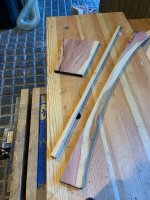
IMG_8357.jpeg
 
If this was still a tree a year ago, isnt it too soon to start veneering with it?
 
sunnybob":1qb313a0 said:
If this was still a tree a year ago, isnt it too soon to start veneering with it?

Maybe...

It hadn't been a living tree for quite some time. I originally cut it into 3/4"ish slices. It dried in a cellar for a long time and had a low moisture content. I then planed it (machine) into thinner pieces (around 15mm). It was then kept indoors for about a month and has remained very flat.

I have therefore impatiently decided to give it a whirl!
 
I don't feel that 3mm ply has the will to resist anything. It can hardly keep itself flat. :lol:

I'd be tempted to use 6mm ply, leave the plum relatively thick and stick to both sides. When fully dry, then put it through the thicknesser swapping sides over every pass to creep up on your final thickness with equal veneer thickness on each side. You should easily get below 10mm over all.

Bob
 
2mm veneer thickness is a touch on the thick side. For a bone dry, really well behaved timber you might get away with it, but otherwise you want to be in the range 1.0-1.5mm. Otherwise the veneer face glued to the ply substrate will be held rigid, and the show face will still be free to shrink ever so slightly, net result is often micro cracking or crazing.

This also solves your problem, two 1.5mm veneers plus a 6mm ply substrate gives you a sensible 9mm thick lid.

Bob has already given a good option for thicknessing.

It's become very fashionable to incorporate the sapwood from some very dark tropical timbers, but those sapwoods are really hard and very durable. The sap from temperate zone fruitwoods are famously prone to warping, rot, and infestation. It's your project so you do as you wish, but in my workshop all temperate sap, with the possible exception of Yew, gets run through the wood burner!
 
Thanks Bob and Custard - that's extremely helpful and just the kind of advice I was after. I don't think machine planing the panel after veneering would have occurred to me! For the stringing, I'll need to decide between dark (black wood) or light (maple).

I don't really have very high hopes for this project, but I don't have anything to lose (except my daughter's goodwill as she quite likes the idea of a box made from pink wood!).
 
Just to add, if you make the veneered panel a bit oversize then just incase the planer decides to pick up on the infeed edge, then you have the ability to trim off any damage.

Bearing in mind I can be a bit unconventional in my techniques, I might glue on the thick veneers onto the ply, trim to exact final length and width after stringing allowance then glue on slightly oversize stringing all round.
Finally glue some sacrifical strips onto the stringing all round.
Plane down in the thicknesser both sides as per my original suggestion keeping a watchful ey on the overall thickness and now you won't be able to see the veneer edge.
Now cut and plane off the scrap edging keeping the stringing equal width all round until the composite panel fits the box.
The scrap edge will have protected the stringing on the trips though the thicknesser. I've seen this technique used to good effect on videos of end grain cutting board makers although not tried it myself.

Bob
 
9fingers":6bngcruq said:
I don't feel that 3mm ply has the will to resist anything. It can hardly keep itself flat. :lol:

I'd be tempted to use 6mm ply, leave the plum relatively thick and stick to both sides. When fully dry, then put it through the thicknesser swapping sides over every pass to creep up on your final thickness with equal veneer thickness on each side. You should easily get below 10mm over all.

Bob

Yep, that's the way I'd go about it as well.

Custard":6bngcruq said:
2mm veneer thickness is a touch on the thick side. For a bone dry, really well behaved timber you might get away with it, but otherwise you want to be in the range 1.0-1.5mm. Otherwise the veneer face glued to the ply substrate will be held rigid, and the show face will still be free to shrink ever so slightly, net result is often micro cracking or crazing.

This also solves your problem, two 1.5mm veneers plus a 6mm ply substrate gives you a sensible 9mm thick lid.

Bob has already given a good option for thicknessing.

It's become very fashionable to incorporate the sapwood from some very dark tropical timbers, but those sapwoods are really hard and very durable. The sap from temperate zone fruitwoods are famously prone to warping, rot, and infestation. It's your project so you do as you wish, but in my workshop all temperate sap, with the possible exception of Yew, gets run through the wood burner!

I've never had any issue of any sort with veneer doing a 'micro craze' thingie and I've been veneering with thick stuff for donkey's years. The Wenger 'Wishbone' desk wot I'm sat at now I made using Brown Oak veneers which are:

IMG_5494.jpg

...3mm+ thick here and there's 4mm Euro Oak backers on the underside; no 'crazing' anywhere in sight either here or anywhere else on the desktop.

I'd go for the thicker approach Nick and as Bob has suggested, sneak up on the finished dimension by taking a very fine pass off each time from alternate sides using your p/t.

Sticky dots are the dogs appendages; I get through bucketfuls now! - Rob
 
I've done a bit more on this. The photos make it look a lot paler than it actually is.

IMG_8362.jpeg

IMG_8363.jpeg

A per the above posts, the lid panel is 6mm play veneered with c.1.5mm veneer on both sides.

This is all a bit of an experiment to make something with wood from my own garden, but so far so good I think.

The next job is to cut the lid off. The eagle eyed amongst you will have spotted the wider dovetail pin which is where I'll be making the cut. Then there will be a bit of planing to be done to (hopefully) end up with even(ish) half pins on the box and lid.

Still plenty of opportunities for it to go horribly wrong, but it's not firewood just yet.
 
By the way, how would the rest of you go about cutting the grooves to let in the stringing?

I've been doing it with a dremmel with a little spiral bit (I think it's just under 3mm). I bought the plastic router base for the dremmel and fashioned an adjustable fence for it. I've used it a couple of times now for this task. It seems to work well enough, but I'm interested in what other options there are for this.

There is a veritas inlay tool which I quite liked the look of, but, like most things, I couldn't find it in stock anywhere and ended up going with the dremmel.
 
Nice job.

I've just bought a 2mm two flute bit from Wealdens for circular groove gutting for my rosettes. I would try that bit in router table with stops set up for the corners. I'd cut probably 1mm depth at a time, or less. I'd have to remember to do, say, the two long sides first and then reset the stops for the two short sides.
 
Thanks Malc

Router table would certainly be a possibility. The downside is that you can't see where you're cutting, but the upside is that by using stops you take the skill out of it (and therefore don't need to see where you're cutting.

Apart from the initial drop on of the dremmel into the cut where it was easy not to go in vertical (a deeper fence on the dremmel would help there), I found it reasonably easy to control when I needed to stop but it's a bit unnerving doing things like that "manually".

I'd quite like to find a good hand tool way of doing it. I find that things go wrong more slowly with hand tools!
 
NickM":mph2ccmn said:
The eagle eyed amongst you will have spotted the wider dovetail pin which is where I'll be making the cut. Then there will be a bit of planing to be done to (hopefully) end up with even(ish) half pins on the box and lid.

I don't do it that way; I stick sandpaper to the outfeed table and sand both bits flat - Rob
 
Back
Top