• Hi all and welcome to TheWoodHaven2 brought into the 21st Century, kicking and screaming! We all have Alasdair to thank for the vast bulk of the heavy lifting to get us here, no more so than me because he's taken away a huge burden of responsibility from my shoulders and brought us to this new shiny home, with all your previous content (hopefully) still intact! Please peruse and feed back. There is still plenty to do, like changing the colour scheme, adding the banner graphic, tweaking the odd setting here and there so I have added a new thread in the 'Technical Issues, Bugs and Feature Requests' forum for you to add any issues you find, any missing settings or just anything you'd like to see added/removed from the feature set that Xenforo offers. We will get to everything over the coming weeks so please be patient, but add anything at all to the thread I mention above and we promise to get to them over the next few days/weeks/months. In the meantime, please enjoy!

Breast Drill Renovation

Dr.Al

Old Oak
Joined
Dec 31, 2020
Messages
3,580
Reaction score
2,282
Location
Dursley, Gloucestershire
Name
Al
Last weekend I was in Lyme Regis. No visit to that part of the world is complete without a trip to the second-hand tool store that forms part of Dolphin Antiques in Beer.

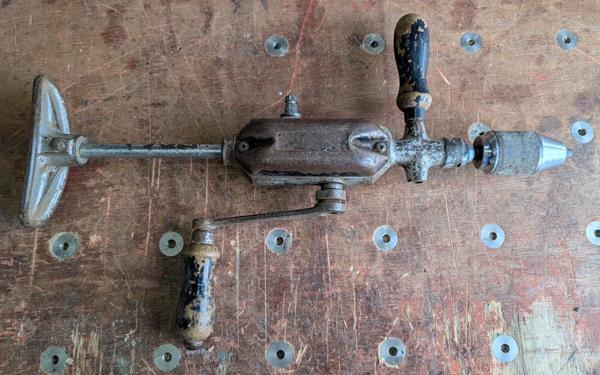
I was relatively restrained (by my standards). I came away with a slightly shabby breast drill and a few countersink bits for my hand brace. This is the breast drill, shown below a hand drill I bought a few years ago:
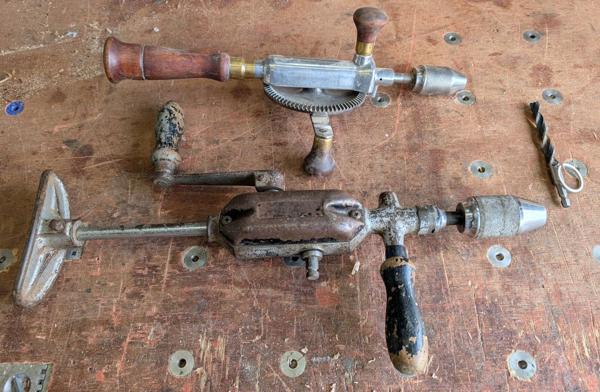
2026-05-22-01-drill-as-bought_600.jpg


The drill is in need of a bit of a TLC. As it's going to be far too hot this weekend to start hand planing timber for my Bedside Table I thought I'd have a go at tidying up the drill instead. The handles are very shabby, especially the front one (which screws in on either side of front section). It has lost its ferrule and has a big crack in the side:
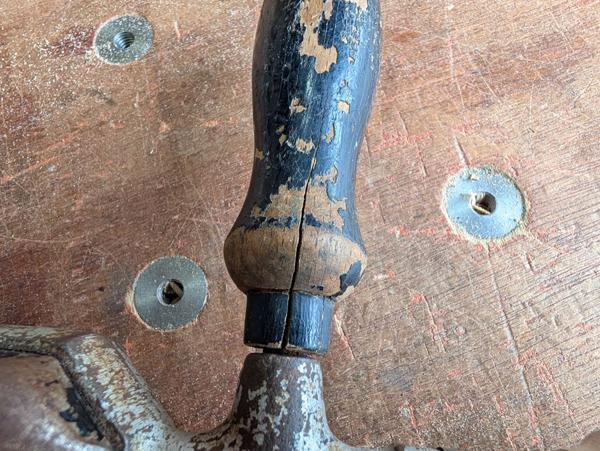
2026-05-22-02-cracked-handle_600.jpg


It's also suffering from woodworm of some sort:
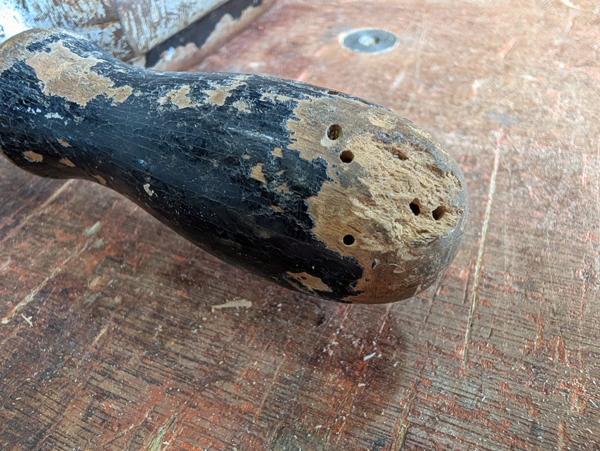
2026-05-22-03-woodworm_600.jpg


The rear handle isn't as bad, but it is also a bit shabby so I think I'll replace both of them.

However, the first thing I wanted to deal with was the chuck. The chuck jaws don't open up in the manner I'd expect them to:
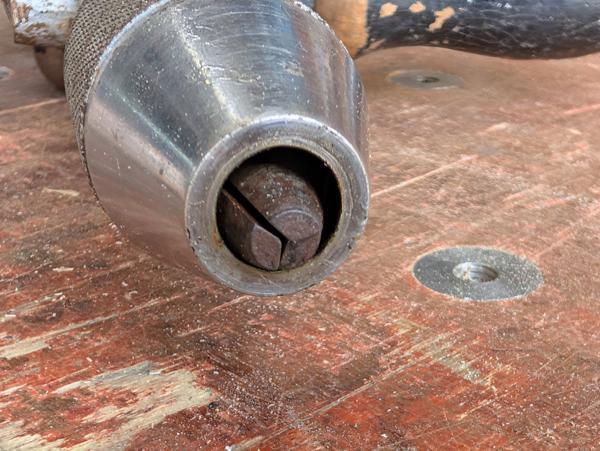
2026-05-22-04-saggy-jaws_600.jpg


Despite that, it is possible to get a drill bit into the jaws and then they grip just fine:
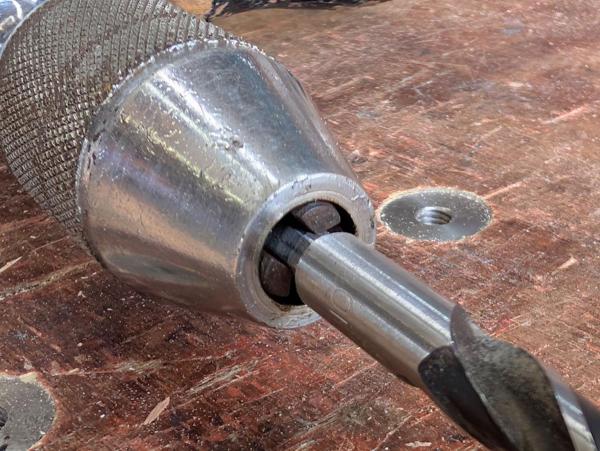
2026-05-22-05-jaws-grip-okay_600.jpg


I did a few quick tests and the drill works well in either speed setting (changed by swapping the rear handle to the other crank and then swapping the front handle so it doesn't get in the way):
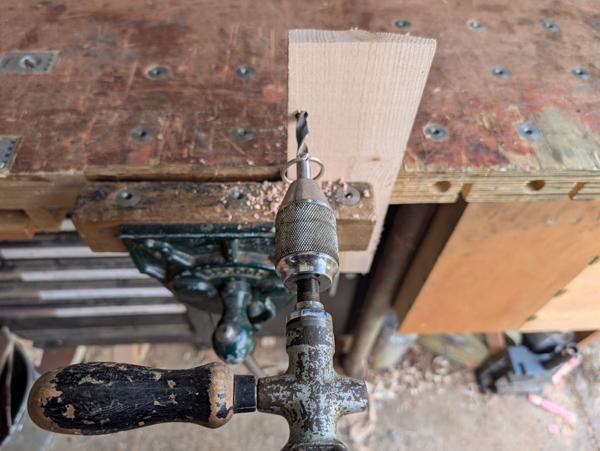
2026-05-22-06-drill-works_600.jpg


It's much nicer to use than the other sort of hand drill, which I've always found a bit too wobbly (due to the way you have to grip the rear handle) to get good results.

The first job with the chuck was to dismantle it. The rear part of the chuck body unscrews. I think this is intended to be done with a pin spanner, but it was loose enough that I could undo it simply by gripping the two parts and rotating:
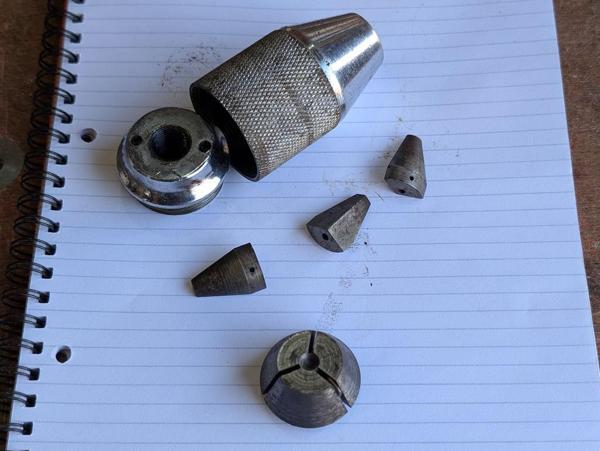
2026-05-22-07-dismantled-chuck_600.jpg


If you look closely at the component at the bottom of the photo, you'll see there's a spring in there (it wasn't attached to the jaw, just loose in the body). This is what the spring looked like when removed:
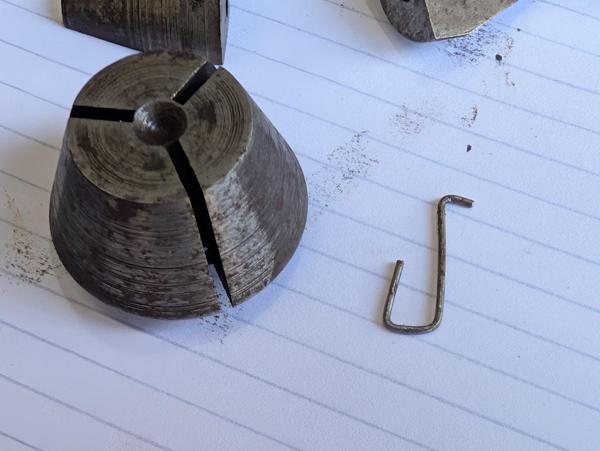
2026-05-22-08-one-spring_600.jpg


I was really pleased to find that as it gave me some important clues as to how the spring mechanism works. After trying it in quite a few different orientations, I eventually figured out that it goes into the base piece like this...
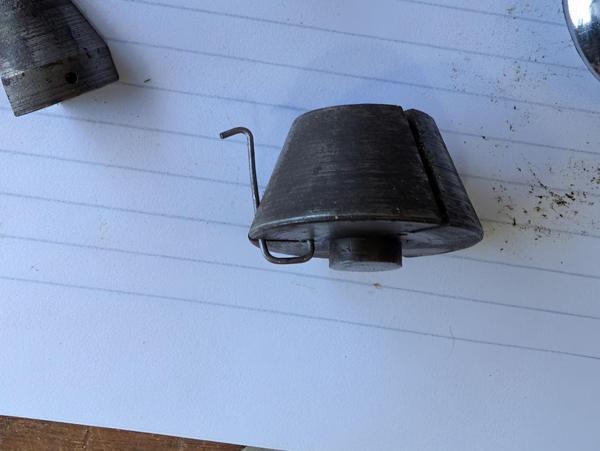
2026-05-22-09-how-spring-fits_600.jpg


... and then the jaw fits over the hook on the end like this:
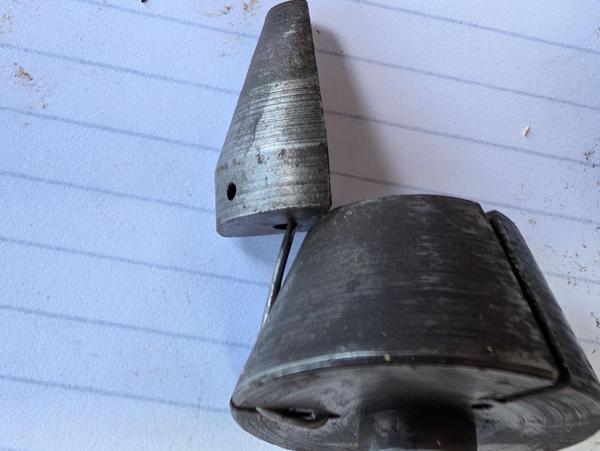
2026-05-22-10-how-jaw-fits-on-spring_600.jpg


I measured the spring...

2026-05-22-11-spring-dimension_600.jpg


... and then dug out my collection of piano wire to find the closest size I had:
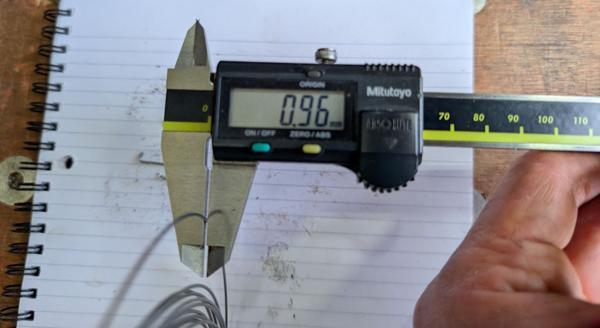
2026-05-22-12-piano-wire-dimension_600.jpg


With pliers and side cutters, I could bend the piano wire into approximately the right shape:
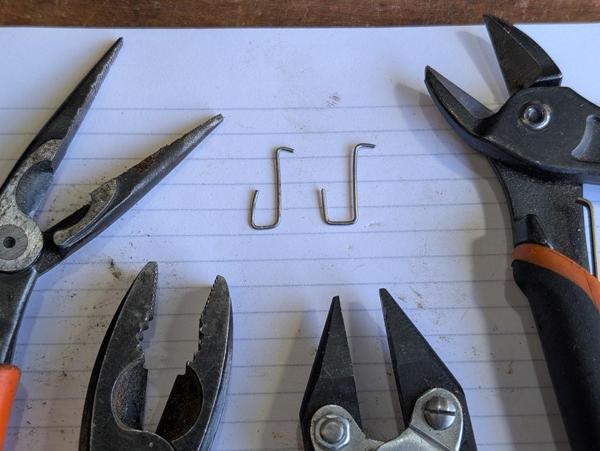
2026-05-22-13-first-go-at-a-spring_600.jpg


I ended up having quite a few goes at spring making, gradually refining the shape until I'd properly figured out how it was supposed to work:
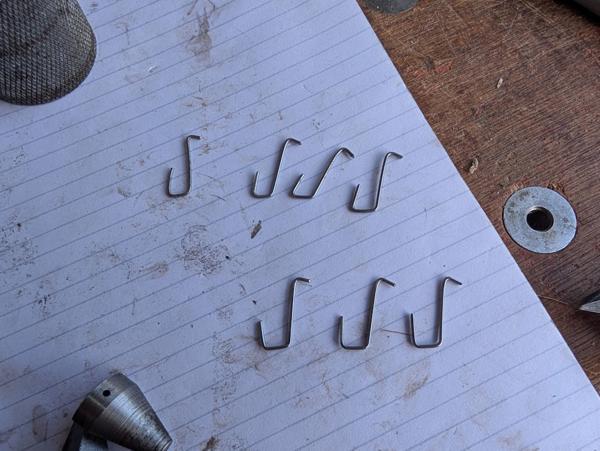
2026-05-22-14-lots-more-goes_600.jpg


The size of the spring is quite important, especially the length of the longest section. If that section is too short the jaw body doesn't clear the top of the lower part. If it is too long, the jaw will tend to lean in at the top, closing up the opening rather than springing apart as intended. The other dimensions are less important: the short tip needs to be long enough to go into the jaw but not so long that it pokes out the side; the bottom of the U shape needs to be about the same as the opening at the bottom of the base piece and the leg at the end can be pretty much any length without issue.

While the jaws were out, I gave them a clean up with some Scotchbrite. This gives a sort-of before-and-after view:
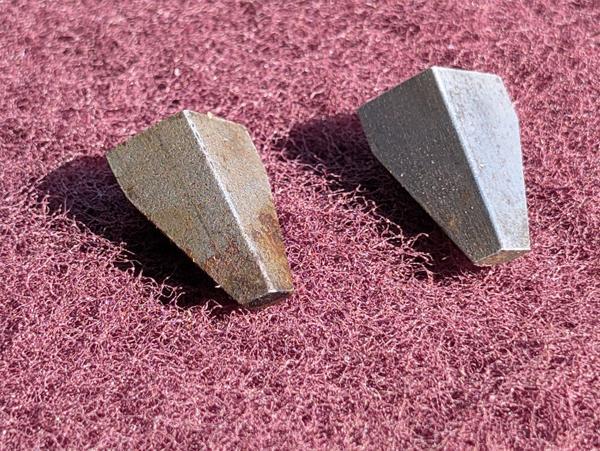
2026-05-22-15-cleaned-up-jaws_600.jpg


With the chuck reassembled (rather a lot of times as I tweaked the shape of the springs), the jaws now spring apart properly:
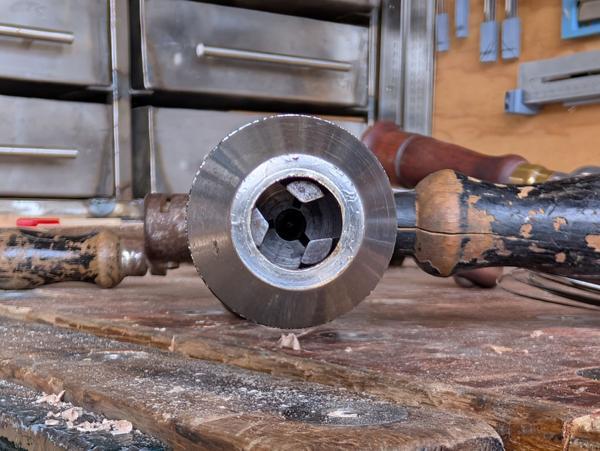
2026-05-22-16-jaws-spring-apart-properly_600.jpg


The last job on the chuck was to use a brass brush on a variable-speed angle grinder to clean up knurl, which had quite a bit of rusty pitting but now looks like this:
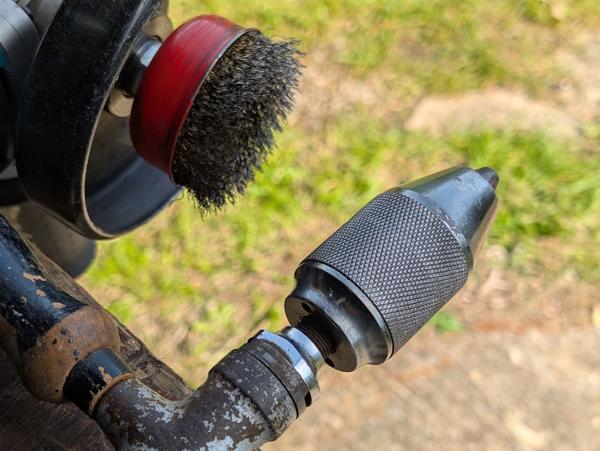
2026-05-22-17-cleaned-up-chuck-knurl_600.jpg


More to follow...
 
Following with interest - as I came across mine a few weeks back 👍. In need of some attention... bit of rust removal... repaint job... etc. Seem to recall buying it way back when I was 18+... 1979~80...
 

Attachments

  • 20260522_154038.jpg
    20260522_154038.jpg
    202.1 KB · Views: 3
  • 20260522_154030.jpg
    20260522_154030.jpg
    306.4 KB · Views: 3
  • 20260522_154020.jpg
    20260522_154020.jpg
    270.2 KB · Views: 3
Following with interest - as I came across mine a few weeks back 👍. In need of some attention... bit of rust removal... repaint job... etc. Seem to recall buying it way back when I was 18+... 1979~80...

That looks very similar to mine. It's interesting to see the name badge (which had long since gone on mine).
 
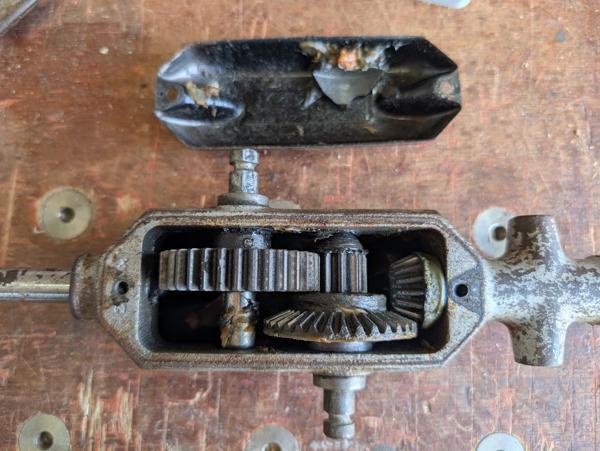
Next up was to work on the body. It's probably fine but I'd quite like to refresh it a bit. The first thing to do was to take a cover off and have a look inside:

2026-05-22-18-cover-off_600.jpg


The remaining bits of paint and as much rust as possible got removed with the wire brush as before:

2026-05-22-19-wire-brushing-body_600.jpg


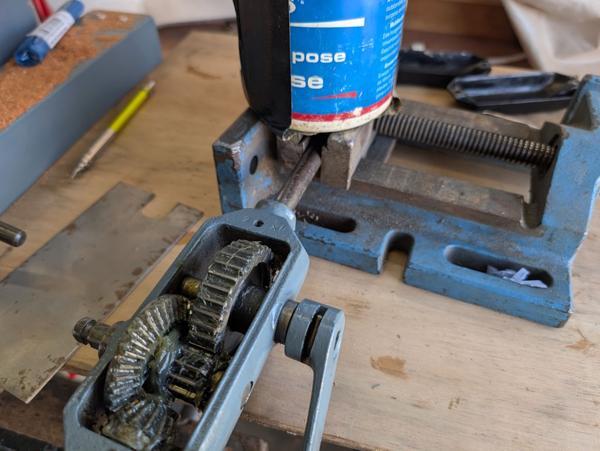
You may notice that I've removed the nut that retains the threaded shaft. Doing so wasn't enough to allow me to remove the shaft (but it was enough for to allow all the individual ball bearings to fall out all over the bench 🤦‍♂️). Everything seems to be held into the body very firmly. Although I can't be sure, I think they've used lots of grub screws or the equivalent but peened over the ends to prevent them ever coming out again. For example:
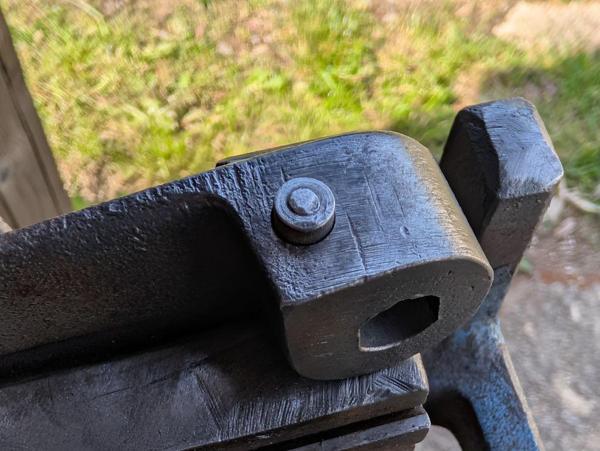
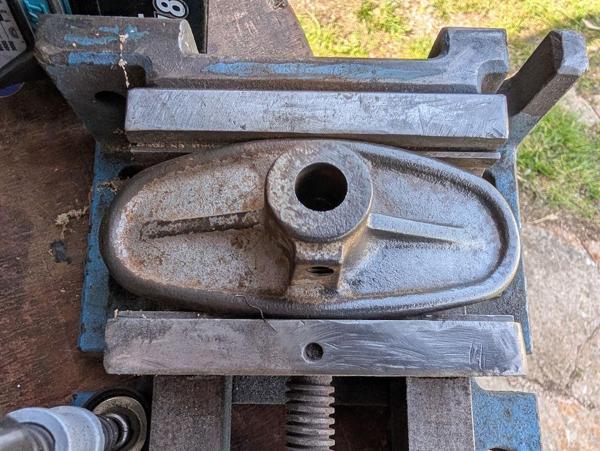
2026-05-22-25-not-designed-for-disassembly_600.jpg


The next photo shows the breast pad after I'd wire brushed half of it. This hopefully gives a reasonably good before and after view:

2026-05-22-20-before-and-after-wire-brushing-pad_600.jpg


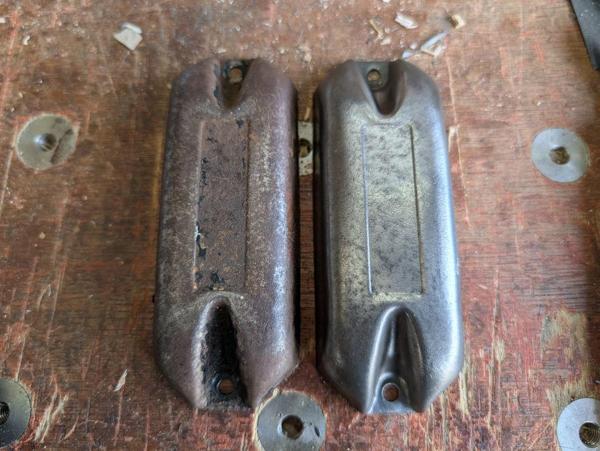
Similarly the two covers, one wire brushed and one just about to be:

2026-05-22-21-before-and-after-wire-brushing-covers_600.jpg


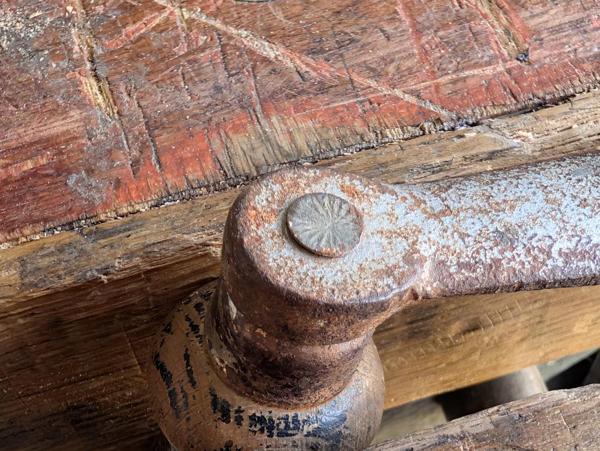
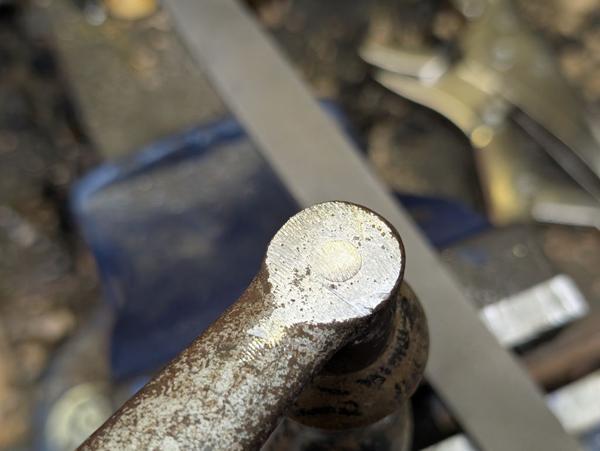
The handle on the rotating arm was held in with a peened shaft:

2026-05-22-22-peened-handle_600.jpg


I initially tried to reduce the diameter enough with careful sideways filing, but in the end I just filed it down flush:

2026-05-22-23-filed-down-for-removal_600.jpg


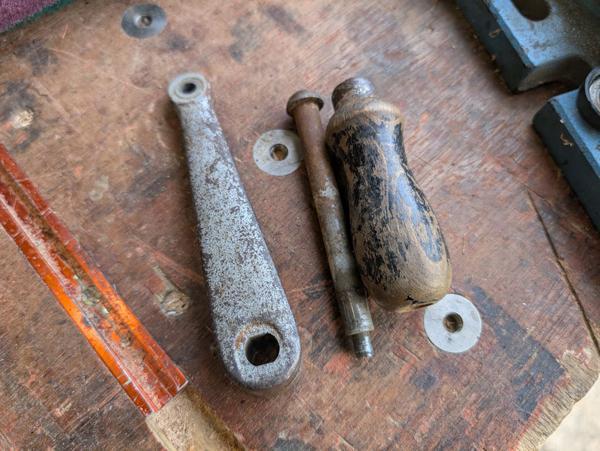
I'll probably make a new shaft for it as that seems the easiest option. Here are all the bits that make up the handle:

2026-05-22-24-handle-bits_600.jpg


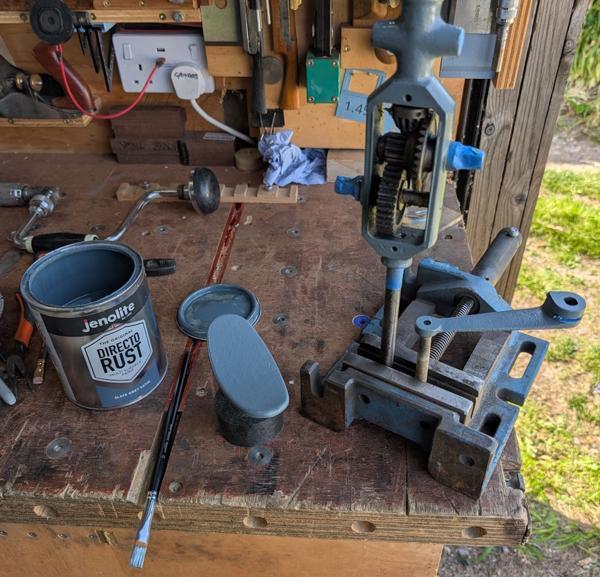
With everything dismantled as much as I could, it was time for a bit of painting (one of my least favourite jobs). Anyone who feels restorations should always be done with the original paint colour should look away now - being true to the original has never been something I've considered important.

The covers got hung from the washing line on some steel wire and spray painted black. All the other bits got painted with the only metal paint I had, which is a bluey-grey colour sold as "Slate Grey Satin" left over from when I made the cabinet for my heat treatment oven. I masked off what I could but without removing all the internals my ability to protect the important surfaces was limited, so painting was just a case of being as careful as possible and hoping for the best.

2026-05-22-26-painting_600.jpg


Everything will get two or three coats and then tomorrow I'll be able to start re-assembling.
 
That looks very similar to mine. It's interesting to see the name badge (which had long since gone on mine).
I did wonder if the name badge would be of interest for you - with not seeing one on yours. May be of help near the end of the project if able to make one or get one made 🙏
 
Would you try to replicate the original paint colour to the body Al or go with what you've used at present?

Just wondering if I could put up a close up photo to show the colour to help.
 
Would you try to replicate the original paint colour to the body Al or go with what you've used at present?
I'll go with what I've used at present. I know there are lot of people who feel quite strongly about restoring stuff to its original form but it's not something that's ever been that important to me. I want it to be a well-protected (i.e. not likely to rust away) and usable tool, that's it. I got some grief on another forum when I restored a bench vice and painted it green rather than the original pale blue. I honestly couldn't care less what colour the manufacturer painted it.
 
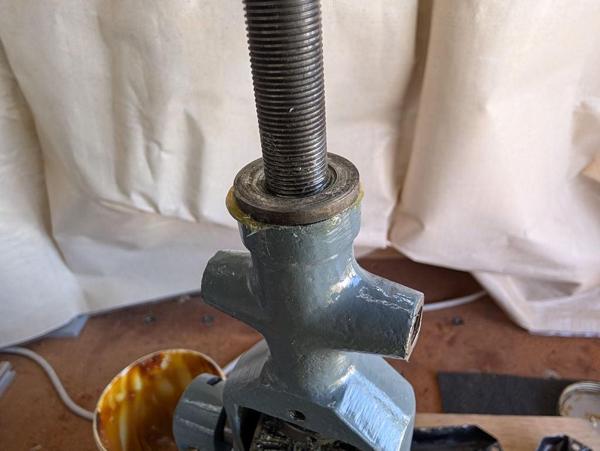
With the paint dry, it was time to reassemble the body. I mentioned in the previous post that the bearings had fallen out when I tried to remove the shaft. While I think I probably found them all, the only way to be sure would be to put them in one by one and see if there were enough to go all the way around. As I've got a cheap little set of ball bearings in a few different sizes, I decided instead just to replace them all with new ones.

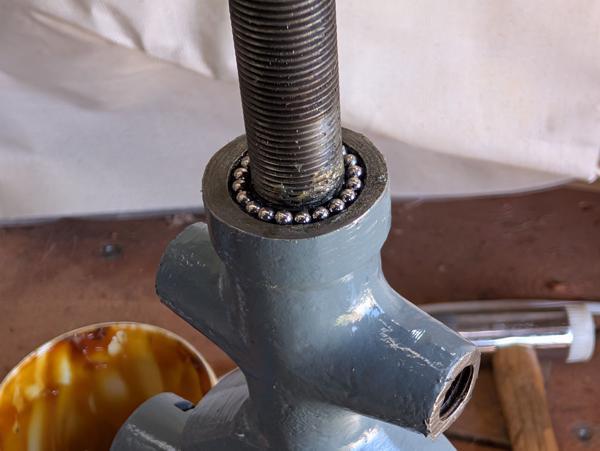
The original bearings were 2.2 mm diameter. My set had 2 mm and 2.5 mm as options so I thought I'd try the 2.5 mm ones first. After smearing a very small amount of grease into the track (just enough to help the bearings stay put), I placed them one-by-one into the track until they went all the way around:

2026-05-23-01-ball-bearings_600.jpg


More grease was then smeared over the top and then the bearing washer plonked down on top:

2026-05-23-02-bearing-washer_600.jpg


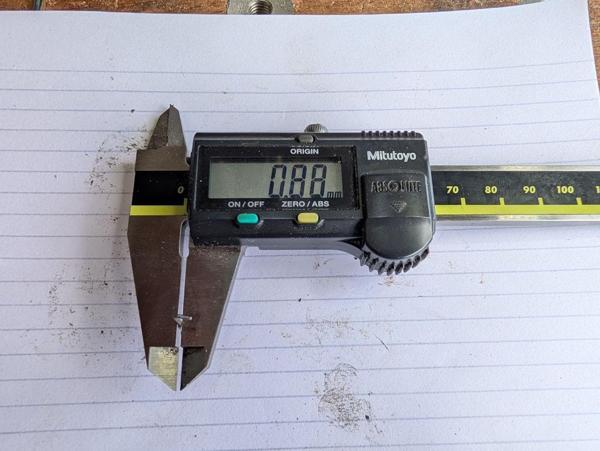
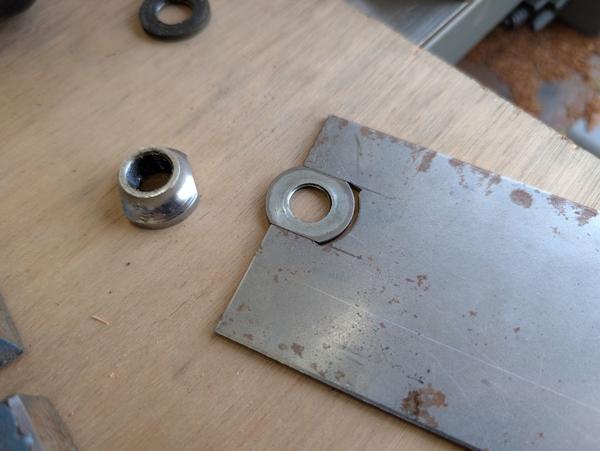
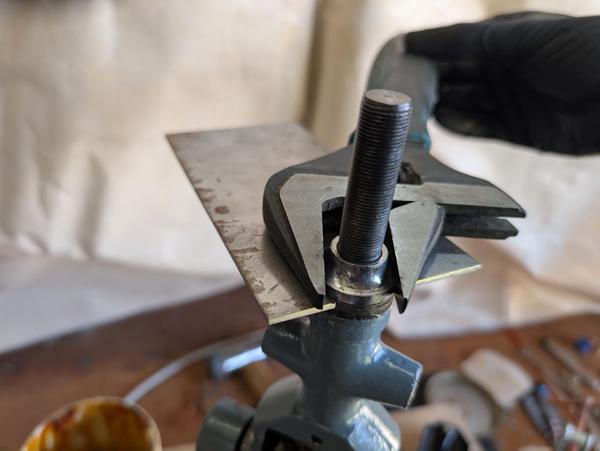
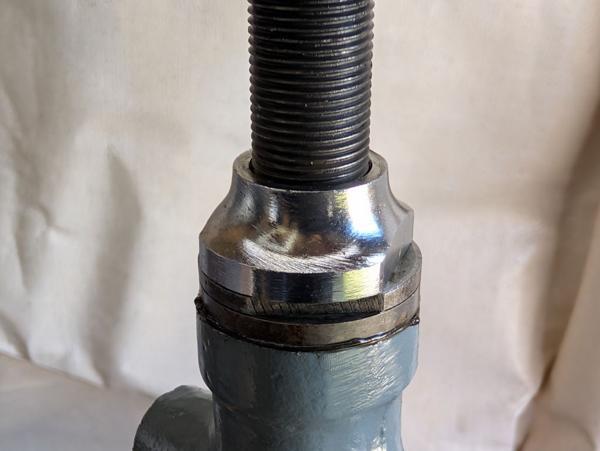
To retain and preload the bearing, there are two nuts that go on the threaded shaft. One of these is very thin. I was able to undo it by just undoing them both together until they were far enough away from the bearing washer to fit a spanner onto the thin one but to tighten them I needed a way to grip the thin one in place. The thin nut is only 2.4 mm thick, so I grabbed a bit of 2 mm steel and cut a notch in it with a hacksaw and a half-round file:

2026-05-23-03-custom-spanner_600.jpg


This photo shows the two spanners in use:

2026-05-23-04-two-spanners_600.jpg


It took a few goes to get it nicely adjusted. It would have been a lot easier with three hands: one on each spanner and one on the crank handle to stop the shaft rotating!

This photo of the assembled bearing shows why the thin spanner was needed:

2026-05-23-05-assembled-bearing_600.jpg


Now it was time to grease the gearbox. I scraped out as much of the old black and gritty grease as I could and then slathered on some new stuff:

2026-05-23-06-grease_600.jpg


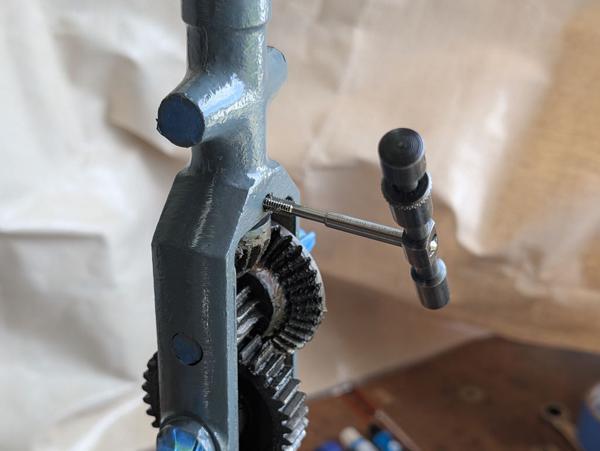
The covers for the gearbox were held on with Phillips or possibly Pozidrive head screwdrivers (it's hard to be tell as they're quite rusty). I'm not a fan. I'd hoped that I'd be able to get the two shafts out of the ends of the casting and then cut new threads in the cross holes. Despite it having proven to be beyond me to remove the shafts, I decided to have a go at re-tapping them anyway. The original threads are either BSF 3/16-32 or UNF #10-32. Those two threads have a major diameter of just under 5 mm and a thread pitch of 0.79 mm. That's close enough to M5 (which has a 0.8 mm pitch) that you can just run an M5 tap into the hole and convert it:

2026-05-23-07-earlier-tapping-m5_600.jpg


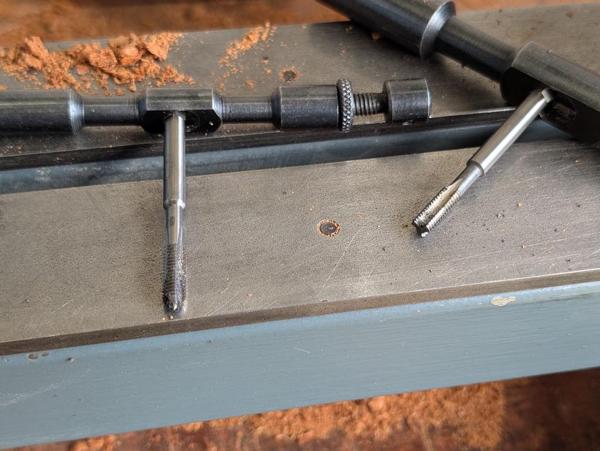
As I couldn't go all the way through (due to the shaft still being present), I used two taps. The first was a bottoming tap (usually called a plug tap in the UK but I avoid the term as the US use plug tap to mean a second tap). The other one was also a bottoming tap, but one that I'd ground the tip off to allow it to get as deep as possible:

2026-05-23-08-two-taps_600.jpg


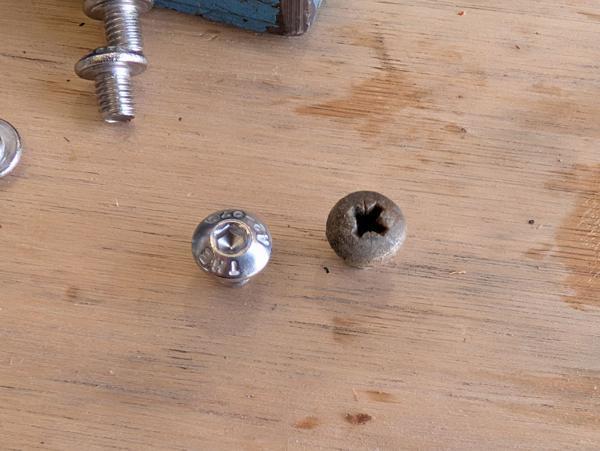
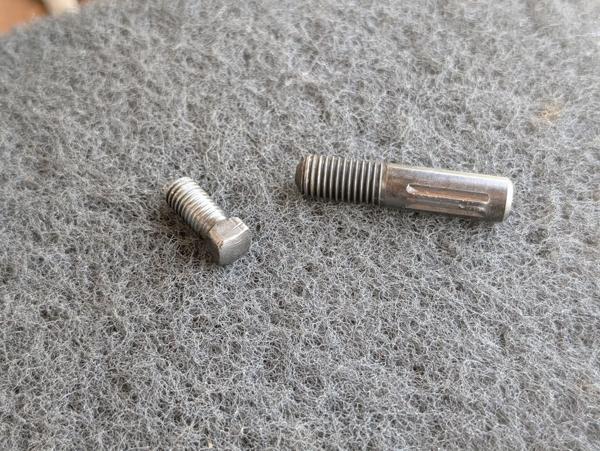
The new screws are stainless M5 × 6 mm hex socket button screws, here's one next to the old screw:

2026-05-23-09-old-and-new-screws_600.jpg


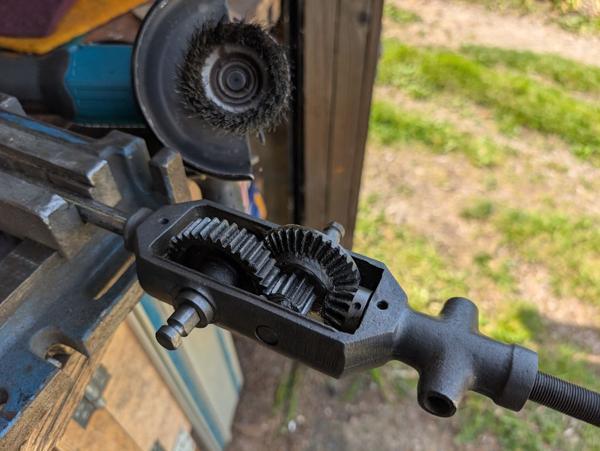
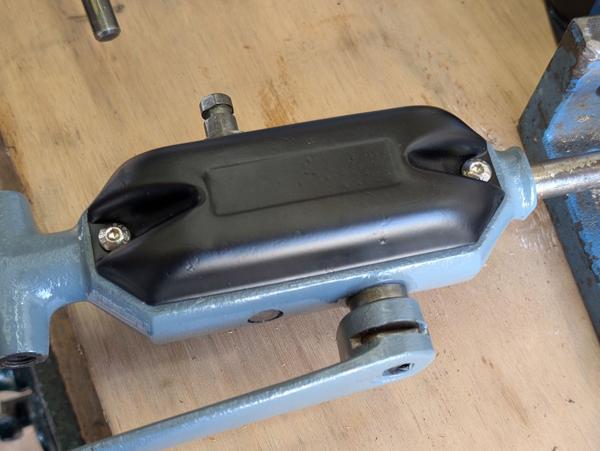
With the holes tapped M5 and some nice button screws to hold the lid in place, I could finish assembling the body:

2026-05-23-10-lid-fitted_600.jpg


Next up is to make some new handles.
 
This drill is getting more authentically "Continental" at every stage!

I can see that future maintenance will be much easier, but does it work ok with metric drill bits? 😏
 
The chuck type has a name, and patent.

Bod1.
Nice find!
I'd not looked at Wictor's site since he deleted all the good articles he used to gather and didn't realise there was still some original research on there.
(The previous/next page buttons still work, despite the missing graphics.)
 
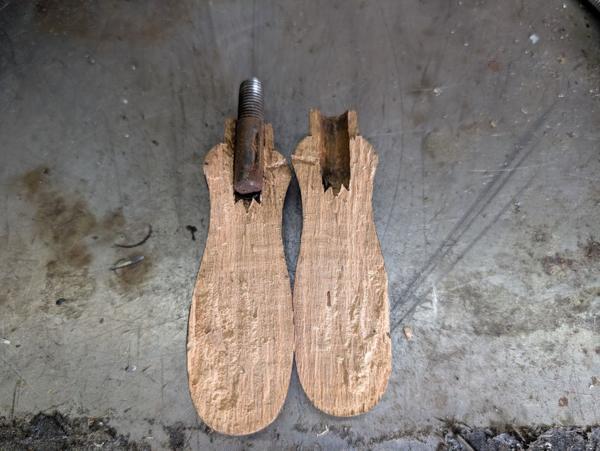
The first handle to deal with was the front one, which screws into one of two holes in near the chuck. This handle had a crack in it, so it seemed like the easiest way to get the threaded shaft out was to stick a screwdriver into the crack and split it in half:

2026-05-23-11-split-handle_600.jpg


The screw got cleaned up with a wire brush. While I was at it, I also cleaned up the square-headed screw that holds the breast pad in place:

2026-05-23-12-cleaned-up-screws_600.jpg


I'd wondered about replacing the breast pad screw with a cap screw, but I don't see it as something that'll ever need to be undone again so I decided to just leave it as-is.

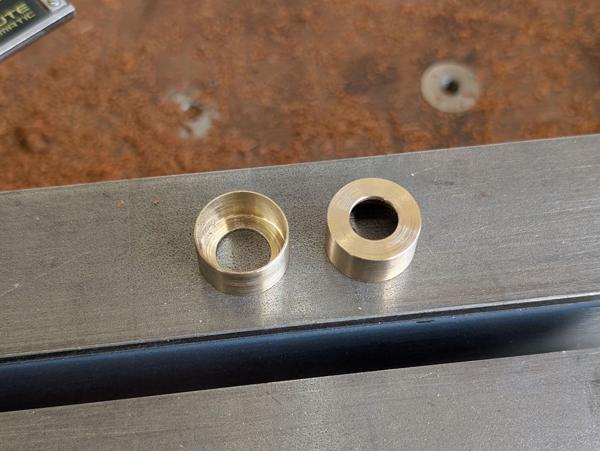
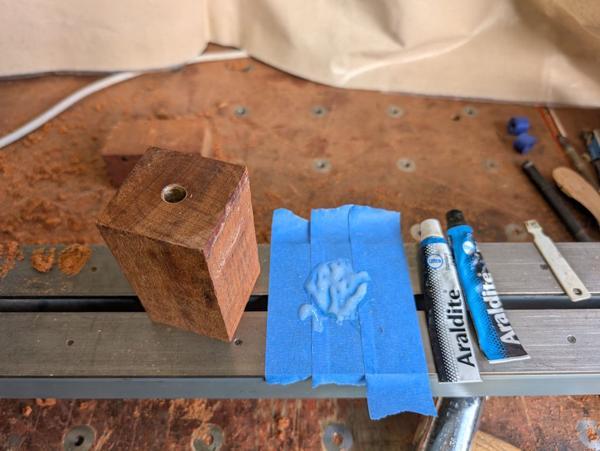
I used the metal lathe to make a couple of ferrules out of 20 mm brass bar:

2026-05-23-13-two-ferrules_600.jpg


They both have a 19 mm bore (made with an end-mill for a flat bottom). The one for the front handle has a 10 mm through hole (for the 9.5 mm / 3/8" shaft), the one for the crank handle has a 12 mm through hole.

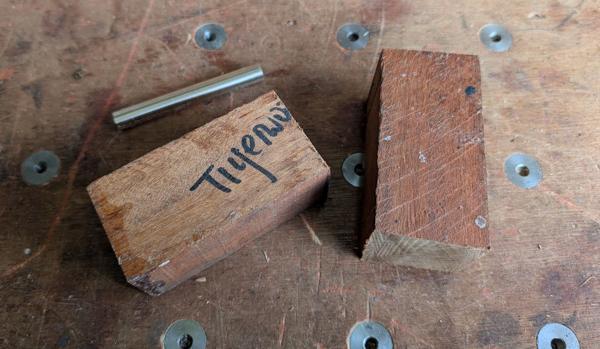
I had a bit of tigerwood left over from when I made my screwdrivers. I decided to use that for the two handles, so I cut the blank in half:

2026-05-23-14-two-tigerwood-blanks_600.jpg


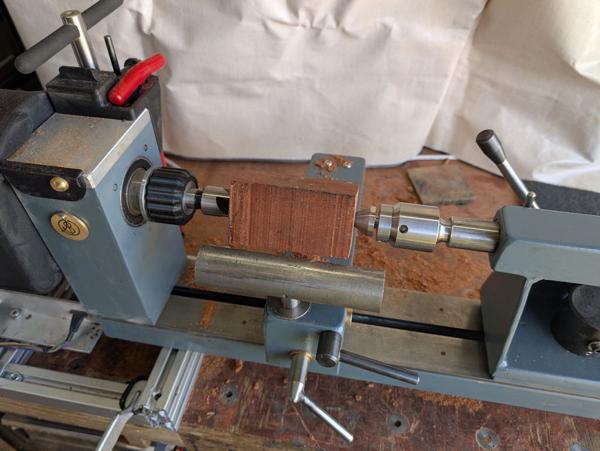
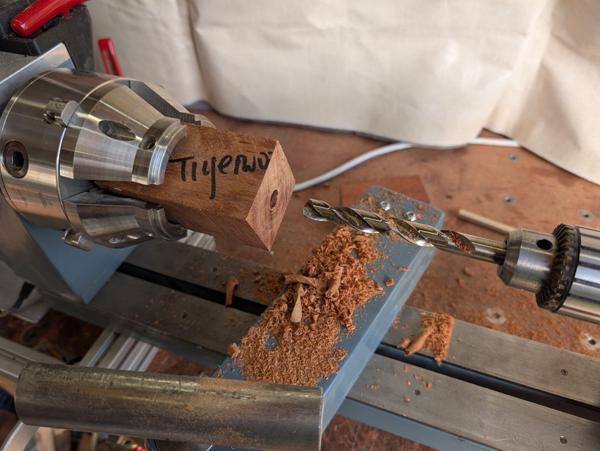
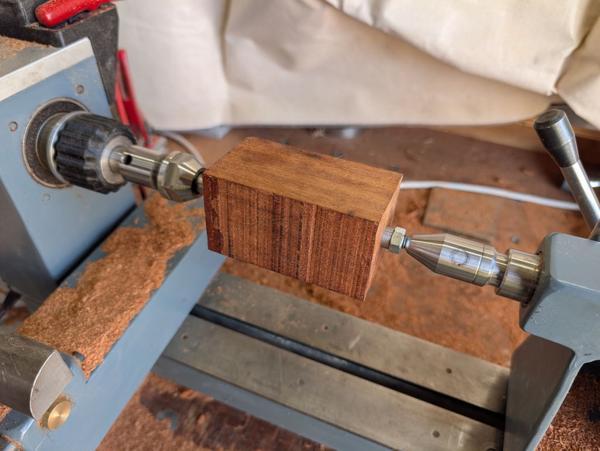
For the front handle, I held the blank in a chuck and drilled a 9.5 mm (3/8") blind hole in the end. I then mounted it between centres, using a live tailstock centre pressed into the drilled hole and a conventional drive centre at the other end:

2026-05-23-15-setup-for-turning-after-blind-drilling_600.jpg


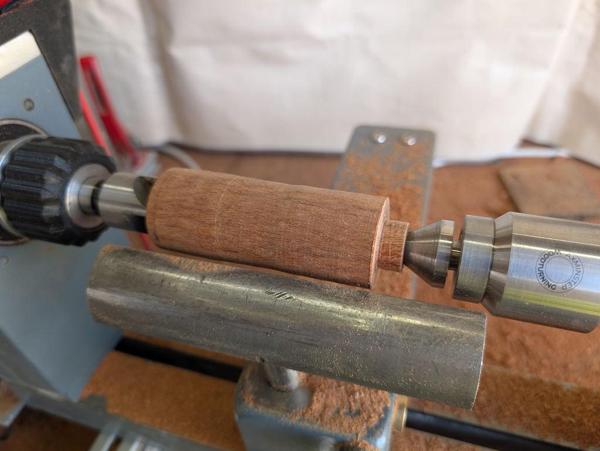
Most of the wood then got turned into chips with a roughing gouge. A spindle gouge turned the end down to be a good fit in the ferrule's hole:

2026-05-23-16-roughed-round-and-end-turned-to-size_600.jpg


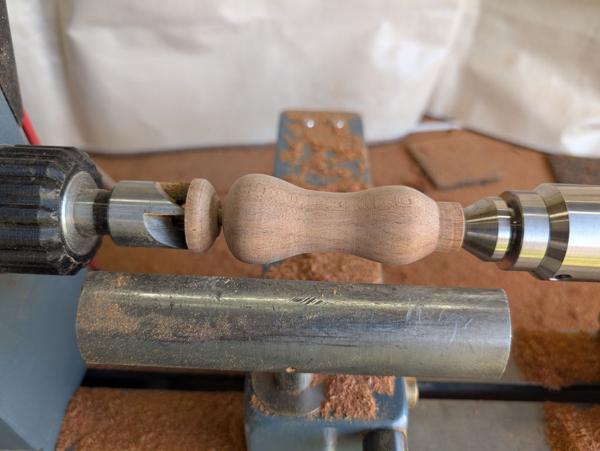
More spindle gougery and a bit of sanding made it into something roughly handle shaped:

2026-05-23-17-shaped_600.jpg


After parting off, I sanded the end...

2026-05-23-18-end-sanded_600.jpg


... and then the ferrule and screw got daubed in epoxy and whacked into the hole:

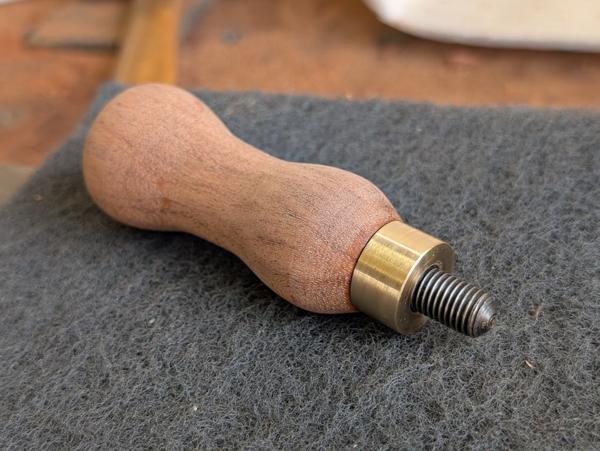
2026-05-23-19-ferrule-and-screw-epoxied-in_600.jpg
 
The original rear handle was a loose fit on the steel shaft (the one I had to file down to break the peened fit). The handle is drilled through and the drilled wooden surface runs on the steel shaft. I decided to do the new rear handle slightly differently by having a brass sleeve glued into the handle and the brass can run on the steel bar.

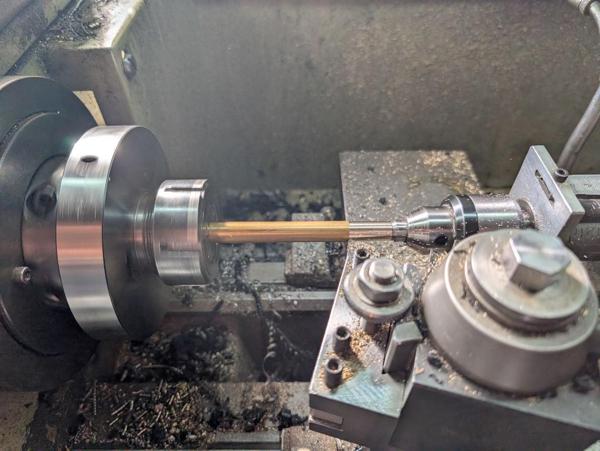
I didn't have any brass tube of a sensible size, so I just sacrificed a bit of 12.7 mm (1/2") brass bar, drilling it through 10 mm and then turning the outside down to 12 mm:

2026-05-23-20-turning-brass-tube_600.jpg


I drilled the tigerwood blank through 12 mm on the lathe...

2026-05-23-21-drilling-through_600.jpg


... and then epoxied the tube into the blank before leaving it overnight to set:

2026-05-23-22-epoxied-in-tube_600.jpg


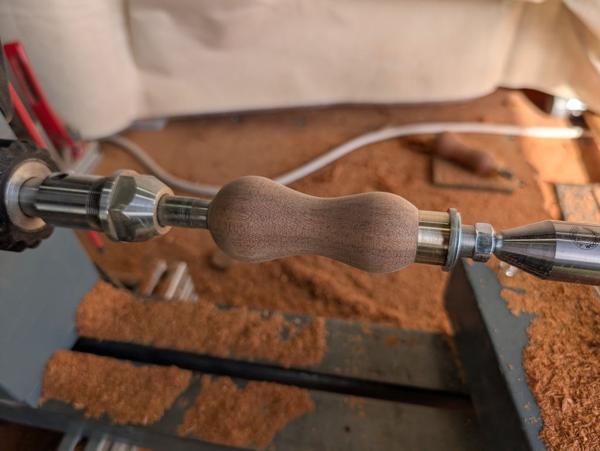
I had planned to turn the handle using my pen turning mandrel as it's a similar concept: a brass sleeve glued into a wooden body that then needs turning down. I was convinced I'd remembered correctly that the shaft on the pen mandrel was 8 mm diameter, so I made a couple of stainless steel bushes with a 10 mm outer diameter and an 8 mm bore. When I came to offer it all up to the pen turning mandrel, I found that the shaft was actually 6.2 mm (probably intended as a loose 1/4"). The pen mandrel uses an ER20 collet to hold the shaft and I've got a set of ER20 collets in lots of sizes, so rather than remaking the bushes I decided to just make a new 8 mm shaft (just some 8 mm EN1A bar with a centre drilled in the end and a short section tapped M8):

2026-05-23-23-setup-for-turning-second-handle_600.jpg


That got turned down with roughing gouge, spindle gouge and skew chisel. After turning the end shape, I fitted the ferrule with epoxy and clamped it in place with some washers so I could turn the rest of the handle to suit the ferrule without worrying about waiting for the glue to dry:

2026-05-24-01-turned-rear-handle_600.jpg


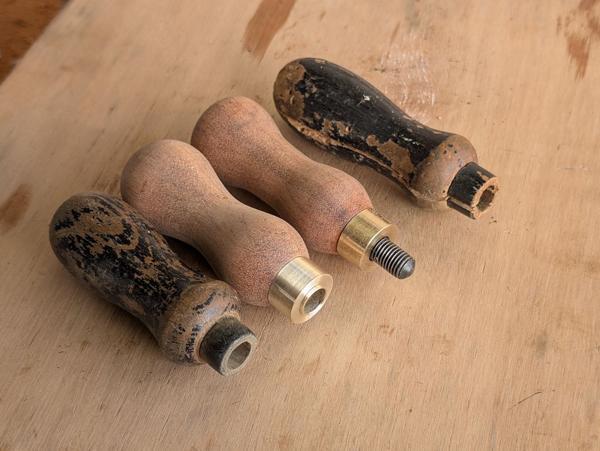
The new handles next to the ones they replace:

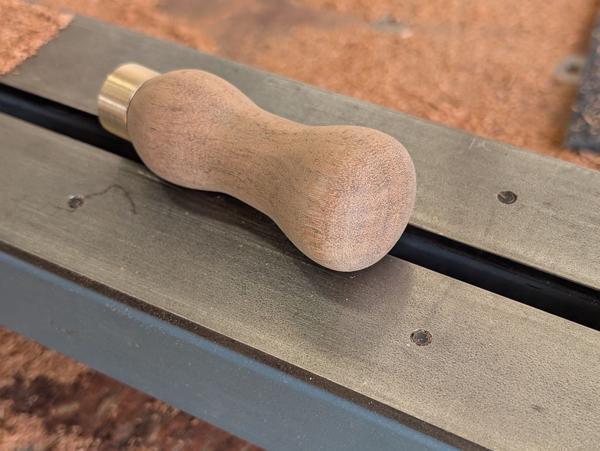
2026-05-24-02-old-and-new-handles_600.jpg


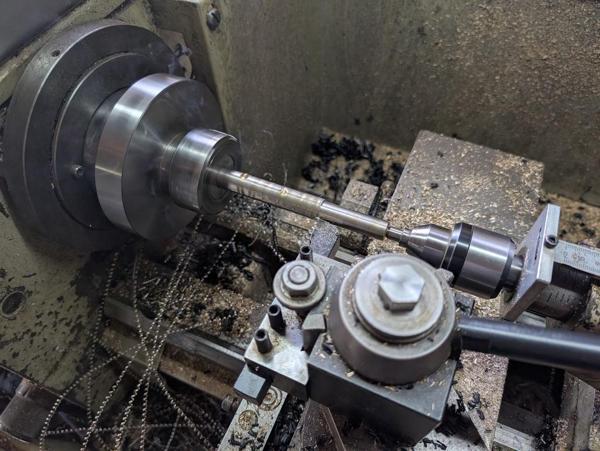
As I'd filed the end of the old handle shaft down, I needed to make a new one. It started life as a bit of 16 mm 303 stainless steel bar, which I turned down to 10 mm for most of its length:

2026-05-23-steel-shaft-01-turning-down_600.jpg


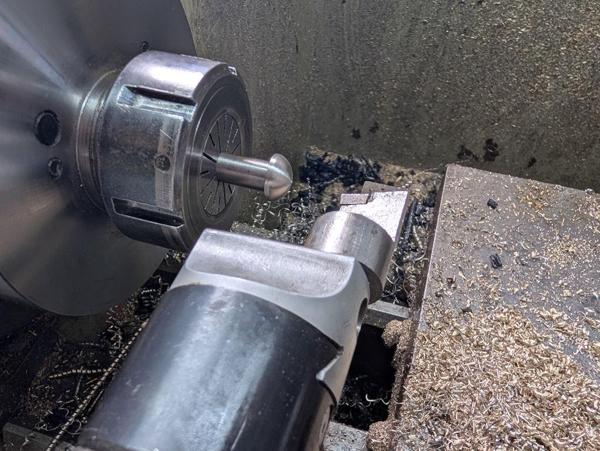
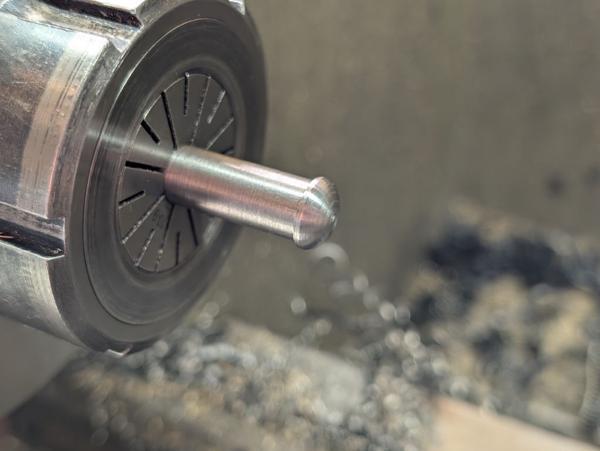
After turning it over and remounting in a 10 mm collet, I used my home-made ball turning attachment to round the end off:

2026-05-23-steel-shaft-02-ball-turning_600.jpg


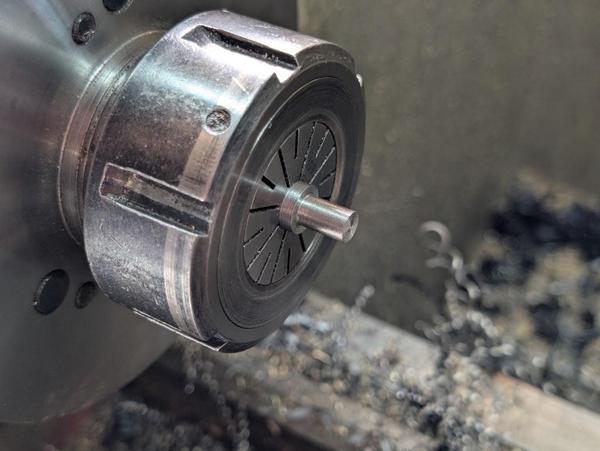
After measuring the length of the tube in the wooden handle and the hole in the crank arm, I turned the end down such that the 10 mm section was about half a millimetre longer than the tube and the end bit was 1 mm longer than the crank arm thickness:

2026-05-23-steel-shaft-03-small-end_600.jpg


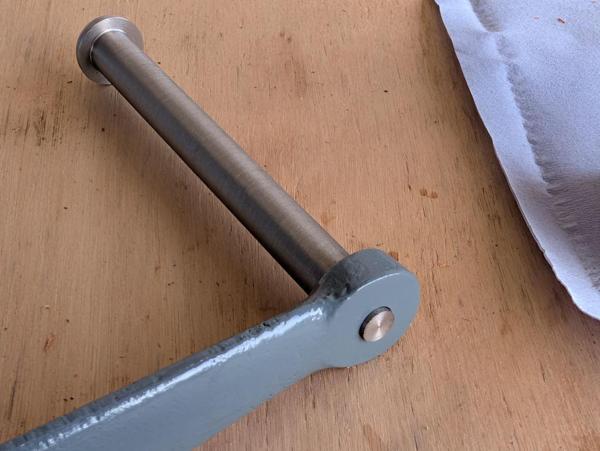
A test fit of the shaft in the crank arm:

2026-05-23-steel-shaft-04-steel-shaft-test-fit_600.jpg


After trying it with the handle, I decided the domed end (which I'd sized to match the original) didn't look right on the new handle, so it went back in the lathe to have a smaller head turned:

2026-05-23-steel-shaft-05-reduced-head-size_600.jpg


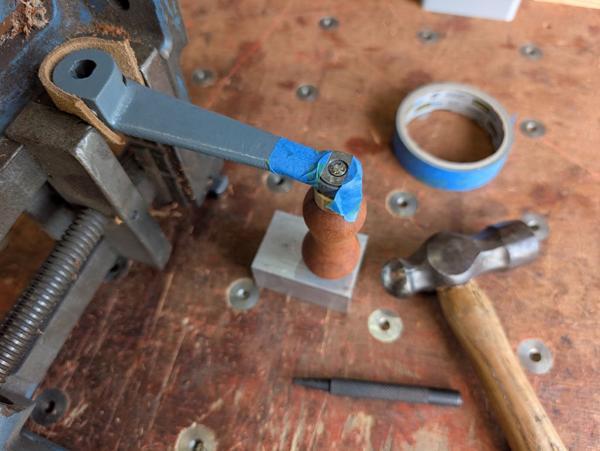
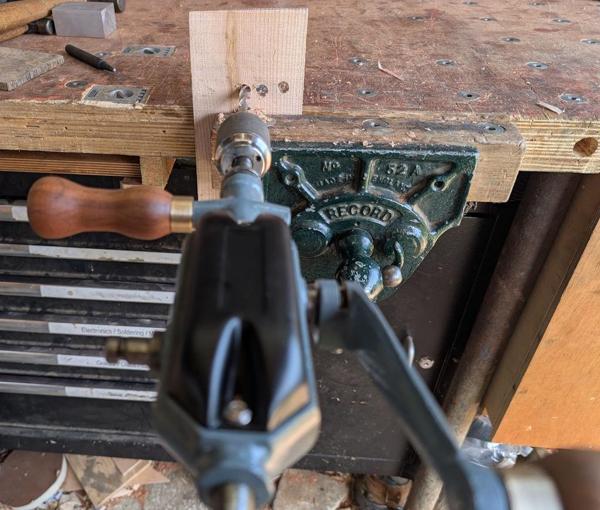
After oiling the handle with Chestnut Hard Wax Oil, I fitted the shaft into the handle, placed the crank arm over the shaft end and used this set-up for peening:

2026-05-24-03-set-up-for-peening_600.jpg


The crank arm is loosely held (in some leather) in the vice just to stop it all falling over and to give me two hands free. The aluminium block underneath gives a base that is fairly resilient but deforms more easily than the end of the shaft (and hence shouldn't damage it). The washer is just taped in place with masking tape and means I can hit quite hard without worrying too much about missing and denting the crank arm.

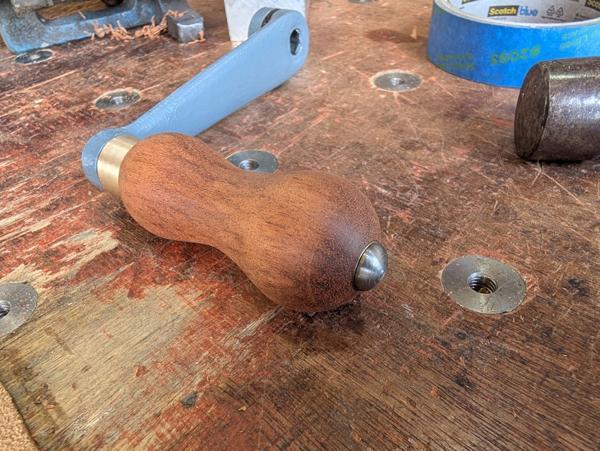
The finished crank arm:

2026-05-24-04-fitted-handle_600.jpg


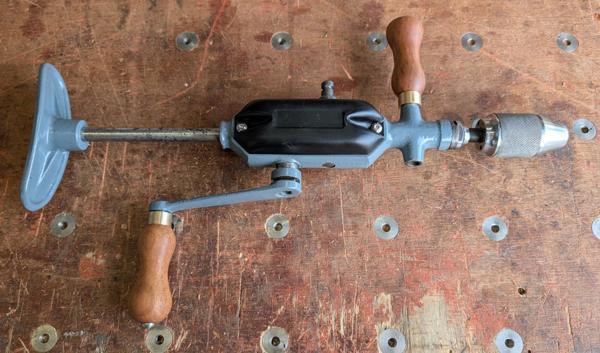
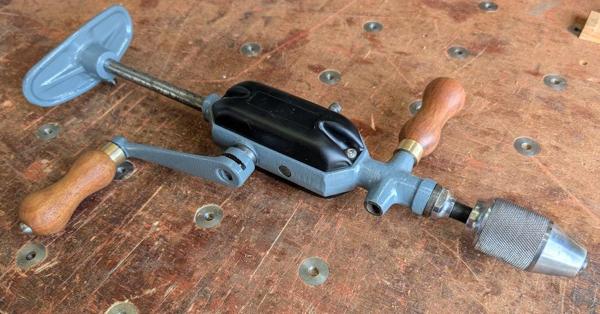
With that, the drill renovation is complete:

2026-05-24-05-finished_600.jpg


As a reminder, this is what it looked like as bought:

2026-05-24-drill-as-bought-on-its-own_600.jpg


Just in case there was any doubt, I've confirmed it still works:

2026-05-24-07-still-works_600.jpg


Another view of the finished drill:

2026-05-24-06-another-view_600.jpg


Thanks for reading.
 
Excellent job. It's not a rare collectable, it's a common tool of minimal monetary value. You've added some sensible upgrades (eg the inner brass sleeve) and renewed the chuck springs. It all looks neat, tidy and reliable. Definitely good for many years to come.

But I bet you have a good cordless electric drill or two as well... How are you going to share the jobs fairly between them?! 😃
 
Excellent job. It's not a rare collectable, it's a common tool of minimal monetary value. You've added some sensible upgrades (eg the inner brass sleeve) and renewed the chuck springs. It all looks neat, tidy and reliable. Definitely good for many years to come.

Thanks Andy

But I bet you have a good cordless electric drill or two as well... How are you going to share the jobs fairly between them?! 😃

I'm sure I'll find a way. After all, how do you manage to share all the planing jobs between those in your vast collection? :)
 
After all, how do you manage to share all the planing jobs between those in your vast collection?
With difficulty! And I'm sure they squabble amongst themselves when I'm not there...😟
 
Back
Top