• Hi all and welcome to TheWoodHaven2 brought into the 21st Century, kicking and screaming! We all have Alasdair to thank for the vast bulk of the heavy lifting to get us here, no more so than me because he's taken away a huge burden of responsibility from my shoulders and brought us to this new shiny home, with all your previous content (hopefully) still intact! Please peruse and feed back. There is still plenty to do, like changing the colour scheme, adding the banner graphic, tweaking the odd setting here and there so I have added a new thread in the 'Technical Issues, Bugs and Feature Requests' forum for you to add any issues you find, any missing settings or just anything you'd like to see added/removed from the feature set that Xenforo offers. We will get to everything over the coming weeks so please be patient, but add anything at all to the thread I mention above and we promise to get to them over the next few days/weeks/months. In the meantime, please enjoy!

Building wooden cart wheels

kirkpoore1

Old Oak
Joined
Jul 21, 2014
Messages
1,165
Reaction score
227
Location
O'Fallon, Illinois
I'm building a cart for the medieval group I'm in, so I decided to try building some wooden spoked wheels for it. The cart will have two wheels, and I certainly could have bought them for not too much money ($90 each plus shipping), but I prefer not to be a checkbook artisan even if my methods are more 1940's than 1490's.

Anyway, I started with a book. "Wheelwrighting, A Modern Introduction", by Bruce & Joyce Morrison, written about 2004. It is very much focused on making "modern" wooden wheels, modern being late 19th century and onward with cast hubs, bent wood rims, and steel or rubber tires. I was going for turned all-wood hubs and sawn felloes (rim pieces). In addition, as far as I can tell, iron tires were not prevalent in the MIddle Ages, though the Romans had them and of course they were around later. So I pieced together various sections of the book to find out what I needed. On to the pictures:

IMG_5312.JPG
Traditional hubs were made of elm because the interlocked grain was resistant to splitting. I don't have any elm but have lots of sycamore (Platanus occidentalis) which is weaker but also interlocked. I glued up blanks to make elongated cubes about 5" across, and turned them to hubs about 4-1/2" long and 3-1/2" across. After marking the radial lines to locate the spokes, I mortised the holes with a 1/2" chisel set.

IMG_5314.JPG
Mortised hub. I later turned the ends down to give a more traditional look.

IMG_5319.JPG


IMG_5320.JPG
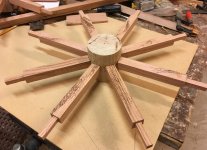
Spokes set into the hub. They don't fit flush since the ends were cut on the tenoner. I eased the ends a little with a big gouge to let them fit closer.


IMG_5321.JPG
A woodworking friend was in town for a few days helping me. To mortise the felloes, he suggested using a cutoff exterior piece from the felloes as a jig. This let me slide the felloe side to side and still get it lined up at the right spot under the chisel. The hold-downs wouldn't work though, so we cut up some aluminum plates and bolted them to the fence. A tapered stick jammed under on held all secure when mortising.


IMG_5322.JPG
A different angle, with a better look a the limit lines.


IMG_5323.JPG
An hour and a half of fitting and only one pic. The felloes were set on the spokes, the edges of the tenons marked, then the rim mortise cut and the fellow put in place. A ratcheting strap helped is pull the rim tight and let us see where the rim needed to be cut between two felloes to make it fit better. This job calls for experience or two people. Each spoke goes through its felloe, and I flare out the mortises on the outside edge. We then put a slit in the inside of tenon, and after the felloe was driven home and adjusted, we wedged each tenon to keep them on.

After everything was in place and temporarily clamped, I drilled diagonally through the joint of each felloe and drove in a glue covered dowel to bridge the joint. I went with two 3/8" oak dowels in each joint, put in at opposite angles. This is the one area where I really deviated from the book, and I hope it holds up.
IMG_5324.JPG
Drilling out the hub. This was the size limiter--how big a wheel could I get under the drill press. Final diameter was about 19". The rim is also sycamore (again, I have lots of big pieces), and the spokes are red oak. The rim is sitting on a couple of pieces of 2x4 scrap so that the drill will be perpendicular to the rim, not to the hub. This will keep the wheels from looking like they're wobbling. The hub is lightly supported, but if it's cut cock-eyed it won't cause the axle hole to go in crooked.


IMG_5325.JPG
In this picture you can see some of the wedged tenons and the dowels fastening the wheel.

MHLH8292.JPG
And from the side. It came out pretty well--probably beginners luck. The second wheel is assembled too, and seems to be almost as good when you check the spoke shoulders against hub or rim.

Next up will be to turn an axle and then build the actual cart.

Kirk
 
Excellent Kirk! I follow a cart build on Youtube at the moment, which is great fun.

My only comment is that your spokes look a little straight and uniform, and could do with some spokeshaving. Aside from that I just want to see the cart they are going on.
 
Mike G":32ixw8rd said:
Excellent Kirk! I follow a cart build on Youtube at the moment, which is great fun.

My only comment is that your spokes look a little straight and uniform, and could do with some spokeshaving. Aside from that I just want to see the cart they are going on.


Mike, you're perfectly right, of course. But these are intended as prototypes for working out how to build a wheel, so I was mostly concerned with getting the structure right. Once I've got that down I'll make them less clunky.

I will look up that youtube video and see how it goes. Thanks...

Kirk
 
Andyp":17a470py said:
I cant see how the four pieces that make up the rim are joined together. Am I missing something?

Andy, the four rim pieces (felloes) are joined end-to-end by the diagonally placed 3/8" dowels I mentioned. Normally this would also be reinforced by a metal tire, but as I said I'm not going that way on this (besides not being very medieval, I have no capacity for blacksmithing and for the amount of use this will get it won't really be necessary).

Kirk
 
kirkpoore1":3gsiymsr said:
Andyp":3gsiymsr said:
I cant see how the four pieces that make up the rim are joined together. Am I missing something?

Andy, the four rim pieces (felloes) are joined end-to-end by the diagonally placed 3/8" dowels I mentioned. Normally this would also be reinforced by a metal tire, but as I said I'm not going that way on this (besides not being very medieval, I have no capacity for blacksmithing and for the amount of use this will get it won't really be necessary).

Kirk

Thanks Kirk, sorry I did miss that.
 
This will be an interesting project Kirk I look forward to seeing your progress, my wife & I saw this cart at a stately home back in February


B7D9194D-3C03-45B4-9E90-C08FCC0F7725.jpeg

CCD71744-DD4D-444C-A1F8-4FEF84568402.jpeg

I took some photos as she would like me to build her one on a smaller scale, I’d wondered on the wheel construction so your wip will be a handy reference when I get round to it.
 
I suppose styles changed over the years, this is one my Great Grandfather made in about 1850 ( he was a Wheelwright)

de74cedb6e3d36cede69ea63bc209904.jpg

0fed37e76825fe0b604973b24c293f06.jpg


And this by my father a model of a Monmouthshire Wagon:

38c81fe136131bc6b375bf0a4e8acca3.jpg
 
Rod":srg3yig1 said:
I suppose styles changed over the years, this is one my Great Grandfather made in about 1850 ( he was a Wheelwright)

de74cedb6e3d36cede69ea63bc209904.jpg

0fed37e76825fe0b604973b24c293f06.jpg


And this by my father a model of a Monmouthshire Wagon:

38c81fe136131bc6b375bf0a4e8acca3.jpg

Rod, wagon wheels are actually an extremely complex subject when you get down to the actual work. I think a good comparison would be chairs--a lot of different styles and a lot of minute details that need to be mastered to learn the actual job. I'm sure your great-grandfather would laugh at my effort, but he no doubt took years to get fully trained, like any skilled trade.

Still, I think mine is a decent first effort. :)

Kirk
 
Here's the second one after I pulled the pic off my phone:

IMG_5342.JPG
Here it is still clamped while the dowel glue dries.


IMG_5344.JPG
Drilling the center hole. I used every inch and more of this forstner bit. To get the last quarter inch, I had to drop the bit most of the way out of the chuck.


IMG_5345.JPG
The wheels side by side. I think one of them is a trifle larger.


Kirk
 
Hi Kirk,

I have also been researching wheel making for anglo-saxon and viking carts. So some comments and questions:

Yes it is correct that the romans has very advanced wheel technology, with roller bearings inside the hubs and iron rims, they also used modern (for me this is anything after 1200AD) construction with tennoned spokes which are in compression under load, these wheels always have 2 spokes per felloe and usually 5 6 or 8 sawn fellows, only 4 on very small wheels. The main reason for more fellows is that it reduces the grain weakness of a large 90 degree change in direction.

After the romans left we lost the technology for the roman wheel and this was reinvented in the 1200s and here are lots of manuscript images from the 1400s showing the wheel construction. This wheel construction really requires an iron rim as when the spoke is in compression the felloe cannot move but at the top of the wheel the felloe is vulnerable to lifting off the spokes.

By the 1700s wheel design (bearings, dished wheels etc) had equalled the roman designs again and the very slender bent wood rims with small numbers of felloes appear again.

So what happens between the romans leaving and the 1200s, the vikings and saxons have an alternate evolution of wheel design. Several examples of viking wheels have been excavated and the AS manuscripts show similar wheels. They are always 6 sawn felloes which are much more massive than a modern (or roman) wheel and the spokes appear correspondingly small.

wheel.jpg

This is an exact copy of the oseberg cart wheel from Norway. While superficially it looks similar to a modern wheel it works in a very different way. The hub is a massive solid block of wood (this one is elm) the spokes are straight dowels (no tenons) and the spoke holes in the felloes go all the way through to the outside rim. There is no iron or glue in the wheel it is completely self locking when completely assembled. Loading the wheel does not compress the spokes as in a modern wheel but attempts to bend them sideways. The unloaded felloe at the top of the wheel cannot lift off. In fact I assembled a prototype for this wheel and could not disassemble it without sawing through half the spokes.

This design seems to be used around 700-1000AD when the manuscript drawings show the felloes decreasing in depth possibly as a slow evolution to the modern wheel.

I was surprised that you drilled the axle hole at the end, it is normal (and the only way to make a wheel true on a pole lathe) to drill the axle hole first, then turn the hub on a mandrel , then you know the wheel will run true on the axle without a big wobble as it rotates.

Having made a few of these in the workshop we are progressing to making one at a show using pole lathe, axes and spoon augurs for the drilling, we start the weekend with a long of green oak and hope to finish with a wheel.

Sorry for the long essay!
 
Agreed. thanks for the lesson

Stargazer":1w85f2zk said:
...

...
This is an exact copy of the oseberg cart wheel from Norway. The unloaded felloe at the top of the wheel cannot lift off. In fact I assembled a prototype for this wheel and could not disassemble it without sawing through half the spokes.

I am intrigued to know how it was assembled being as it was so hard to take apart.
Stargazer":1w85f2zk said:
Having made a few of these in the workshop we are progressing to making one at a show using pole lathe, axes and spoon augurs for the drilling, we start the weekend with a long of green oak and hope to finish with a wheel.
I'd love to watch that.
 
Andyp":3vuom8t9 said:
Agreed. thanks for the lesson


I am intrigued to know how it was assembled being as it was so hard to take apart.

I'd love to watch that.

I am hoping somebody if going to take some pictures.....I will be unable to as I will be demonstrating to the public.

Here is are two pictures:

View attachment wheel2.tiff

The first is the reconstructed Oseberg cart

wheel1.jpg

second is a partial wheel dug up in Denmark (I think) showing the pegs between the felloes, the fact that the spokes are dowels that pass right through the felloes and were split and held in with wedges at the rim.

To assemble you start with all 6 felloes and a single spoke for each felloe drive the spoke through the felloe then into a hole in the hub but with all 6 felloes too far out so they cannot join up, then tap the felloes radially inwards until the joining pegs all line up and start to interlock then complete the radial tapping. At this point all 6 spokes should be firmly in the hub and the felloes are fully joined together. At this point you can move the wheel around, roll it, spin it on an axle and it is a solid unit but can still be tapped with a mallet outwards to dismantle. If you want to lock the wheel, simply drive in the remaining 6 spokes though the second hole in each of the felloes all the way into the hub, the wheel components will lock solid and at this point it is extremely difficult to remove. The final step is to trim off the spokes at the rim and and knock a wedge into the endgrain of the spoke.

This procedure is quite different to a modern wheel where you assemble all the spokes into the hub, then use a special tool to flex alternate spokes so that the much narrower felloe can be eased onto the tenons of the spokes.
 
Ian:

That's great info on the Viking-era wheels. I had never considered the advantage of driving the second spoke of a felloe into place after assembly. I hope your event went well and you had good weather.

I have not made a detailed study of medieval wheels. I knew about the Oseberg cart, but was aiming for a later era. As I'm sure you know, most illustrations of everyday objects before the 14th century are crude in the extreme. By the 14th & 15th century the illustrated wheels certainly look more "modern", but even then it's hard to be sure on details in most cases, and there are few positively dated surviving examples.

Anyway, my cart is now pretty much done. Here are a few pictures:
NFNZE0873.JPG

IMG_5376.JPG

IMG_5384.JPG

IMG_5443.JPG

IMG_5446.JPG

IMG_5447.JPG

IMG_5451.JPG

The cart bolts together. Except for the axle, I put T-nuts into the frame so that I wouldn't need to worry about chasing down a bag of nuts and washers when assembling it on site.

I used a couple of 15th century illustrations of wagons as a model for the sides. These had vertical members (sticks?) that extended about the wagon rail and gave spots to hang buckets and bundles off the sides of the wagons. Some wagons seemed to have wicker sides, and the dowels I used would allow that. The front and back of the cart lift off. You can see how the tops overlap notches in the sides' top rails. The ends also have a couple of tapered dowels which fit into holes in the deck.

Yes, that's a bell. Yes, it's really loud. No, I don't know if anybody mounted bells on medieval wagons, but I need it for an event coming up in a couple of weeks. When not in use the bell comes off and will get stashed in my tent.

Anyway, I hope you all enjoy detour away from furniture and machinery. :)

Kirk
 
Just a thought on your comments about spokes acting in compression, Kirk. That is obviously true in an entirely wooden wheel, and in a wheel in which the spokes are loose tenoned into hubs and felloes, but it is absolutely not true in modern steel and wire wheels, such as bicycle wheels, wire car wheels, motorbike wheels, pram wheels etc. In all those cases, the spokes act in tension. In effect, the bike and rider hangs from the top of the wheels, and if you were to "ping" the spokes of a bike with someone sitting on it, you would get a higher note from those at the top than those at the bottom of the wheel. The same is true of ferris wheels and the London Eye, but in reverse, in that the weight of all the wheel and passengers hangs off the hub by spokes at the bottom in tension.

Incidentally, if you were to draw-bore peg the spokes of an iron-tyred cart or carriage wheel into the rim and the hub (if that were possible), you would achieve the same ends (albeit the pegs probably wouldn't last long). The spokes could then be made much thinner, as tensile forces are taken by much thinner members than are compressive forces. The reason that cart wheel spokes are so comparatively thick, and cycle spokes so thin, is this difference in the direction in which the forces flow through the two wheels. In effect this is like the difference between a suspension bridge and a post-and-beam bridge.
 
Back
Top