• Hi all and welcome to TheWoodHaven2 brought into the 21st Century, kicking and screaming! We all have Alasdair to thank for the vast bulk of the heavy lifting to get us here, no more so than me because he's taken away a huge burden of responsibility from my shoulders and brought us to this new shiny home, with all your previous content (hopefully) still intact! Please peruse and feed back. There is still plenty to do, like changing the colour scheme, adding the banner graphic, tweaking the odd setting here and there so I have added a new thread in the 'Technical Issues, Bugs and Feature Requests' forum for you to add any issues you find, any missing settings or just anything you'd like to see added/removed from the feature set that Xenforo offers. We will get to everything over the coming weeks so please be patient, but add anything at all to the thread I mention above and we promise to get to them over the next few days/weeks/months. In the meantime, please enjoy!

Calculating spring back when laminating.

RogerM

Nordic Pine
Joined
Jul 21, 2014
Messages
880
Reaction score
133
Location
South Devon
I’ve just been laminating up some ash strips to make an apron for my sunburst table, and I read around a bit to see how much you have to allow for spring back, never having done this before, and came across an interesting formula.
springback                 001.jpg

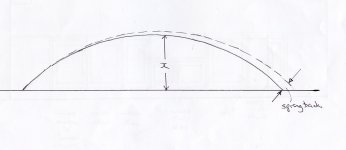
The expected springback is :-

Spring back = x divided by the number of laminations (squared).

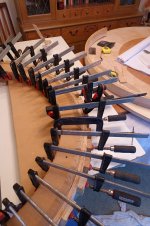
The distance “x” is the amplitude of the bend, and not necessarily the radius - unless you are laminating up a semicircle. In my case the distance “x” was 35cms. I started with 6 laminations of 4mm ash to get an apron 24mm thick, so the expected spring back was 35/36 = 1cm as near as dammit. I used cascamite for the laminations …
DSC07205.jpg

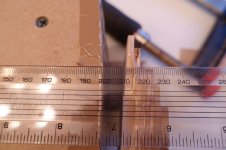
...and the resulting spring back was 11mm.
DSC07201.jpg

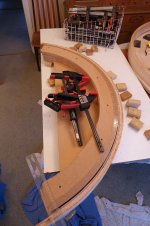
If I use 8 laminations of 3mm to get the same 24mm apron, the resulting springback should be 35/64 = 5.5mm. This is what I got :-
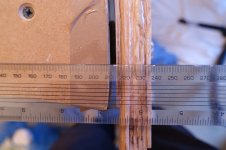
DSC07207.JPG

DSC07206.jpg

Seems to work pretty well. This should make it easy to build an allowance in to the bending former so that you end up with the curvature you want after spring back. Hope this might be of use. :)
 
I think your springback calculator is the same as one that Scrit (is he still around) gave me many years ago when I cold formed some curved backs for tripp trapp like chairs

s = r / p**2

Where:

s = spring back at edge of curve
r = rise of form in centre, e.g. the distance from the centre of the form to the highest point of the curve
p = number of plies


Must you have zero springback before you attach the apron on the table? Surely the glue would hold such a small gap.
 
Andyp":b1370n0e said:
I think your springback calculator is the same as one that Scrit (is he still around) gave me many years ago when I cold formed some curved backs for tripp trapp like chairs

s = r / p**2

Where:

s = spring back at edge of curve
r = rise of form in centre, e.g. the distance from the centre of the form to the highest point of the curve
p = number of plies


Must you have zero springback before you attach the apron on the table? Surely the glue would hold such a small gap.
Looks like the same formula. In my case, the minor springback is not anything more than of academic interest, but I've allowed for it anyway, and it's good to see that it works in practice. I think I will be drawing a circle on the underside of the table, attaching blocks to the inside of the line, and then screwing the apron to it through these blocks. But it's aways nice to understand the issues as there may be times when absolute precision is required.

Sent from my ONEPLUS A5010 using Tapatalk
 
I've got a spring-back question, but of a rather different nature. I have a project coming up in which I'll be edge-joining strips of wood which may be 40x4mm, or 100x4mm. They are destined for a long sweeping curve (radius varies, it isn't based on a circle). Gluing them in-situ would be laborious, because I'd have to leave each one to dry before doing the next. Making them up on the flat might be a lot easier, as I could do the whole thing at once.

If I make them up flat, then bend the whole thing, the glue lines would be bending too. What do the panel think of the risks of this? Am I going to find glue-line failures?
 
Mike,

I'd stay away from the glues that go off glass hard such as cascamite family and stick (ha!) with pva types that have a little flex in them.

Is this panel going to be made from differing woods? if so I think this is the biggest risk with a varying radius bend ensuring the different timbers dont want to follow a different curve and stress the joints as a result.

Are the strips going to be a mixture of width or simply all 40mm or all 100mm? I can visualise differing widths behaving differently especially on the tighter radii.

Is this going to be visible from both sides? if not, any chance of a stabilising layer of bendy ply going on first, curved to form a support which then can have the show timber panel glued to it.

Depend on the overall size can you vacuum bag it onto the frame/former whatever?

Maybe some trial runs even?

Hope this helps the thought processes.

Bob
 
If commercial ply bends, to a certain extend, with a resin glue, why shouldn't home made ply bend?
 
Mike - from what you describe, I'm visualising strips glued edge to edge and then bent across the grain? I guess it depends on how acute the curve will be. If it's just a gentle flexing, then you may get away with what you describe. However, if the bend is at all tight I think you'll either need to glue to a bendy substrate as described by Bob, or to "cooper" it around a former in some way. Just my opinion, and worth what you've paid for it :lol:
 
9fingers":5vzds3d7 said:
I'd stay away from the glues that go off glass hard such as cascamite family...
Bob

Although Cascamite (and similar) have their disadvantages, I was always under the impression that a glue that sets glass hard is desirable for laminating 'cos there's less chance of huge springback. A laminate done with PVA glue with 'give' ought to have greater springback than an identical one done with Cascamite, if my logic is correct.
I've done a little bit of laminating and haven't had enormous issues with using Cascamite, though it is horrible stuff to use. Interestingly, the Everbuild D4 stuff that I use do sayeth on the bottle that it's good for laminating, I think - Rob
 
Rob. My reading of mikes query was that his proposal is far from normal laminating where I agree any sort of glue should be fine.
He wants to bend post glueing and hence my suggestion of glues with a bit of give in them

Rogers interpretation of bending across the grain was not one that I thought of. This seems fraught to me as the areas in the region of the joints will be less flexible than the rest of the wood and it will not bend uniformly as well as stressing the joints. Gut feel is that the will have to have a substrate.

Bob
 
The bend will be along the grain. Think of a cedar strip canoe and you get the idea, albeit mine will be flat in one dimension, and bent along the length (as if the canoe had vertical sides, but still curved along the length of the boat). This definately not laminating in the way the OP is, and Bob has read my intentions correctly.

The area involved is something like 3.6m x 1.5m, so vacuum forming would be a bit of a test, even supposing I had the kit. The tightest radius is about 600mm, so it's not tight.The strips would all be 40ish mm wide, or, in another project, all 100ish wide. It will only be seen from one side, but I'm trying to avoid having a substrate.
 
Thanks for the clarifications Mike.
Are we talking all the same timber?
What timber is it?
I assume you are bending the 3.6m axis and leaving the 1.5m straight. Not at all sure it matters other than for my mental picture :D

On a 600mm radius bend of 4mm thick stock, the outer will be stretched by 2/600 or ~0.3% and the inner will be compressed by a similar %. The neutral axis will stay put and won't be far off from the centre for the wood
So the creep on the glue will have to accommodate that stretching and compression.

Bob
 
Forgive the "brain fade" but are we talking about a solid sheet, 3.6m x 1.5m and 4mm thick after the components, which are 40mm wide, have been glued edge to edge? So will this be attached to some sort of framework? What will hold it in position?

I wouldn't be frightened of vacuum bagging if you have the pump. It's "easy peasy" to make a large bag from a sheet of heavy guage polythene. The difficult bit would be building the former around which it will be bent.

Thought of the day. "It's easy to be wise. Just think of something stupid to say, and then don't say it" :eusa-think:
 
RogerM":1nt2weaa said:
Forgive the "brain fade" but are we talking about a solid sheet, 3.6m x 1.5m and 4mm thick after the components, which are 40mm wide, have been glued edge to edge? So will this be attached to some sort of framework? What will hold it in position?

I wouldn't be frightened of vacuum bagging if you have the pump. It's "easy peasy" to make a large bag from a sheet of heavy guage polythene. The difficult bit would be building the former around which it will be bent.

Thought of the day. "It's easy to be wise. Just think of something stupid to say, and then don't say it" :eusa-think:


FWIW My current mental picture is of ~ 38 strips 3.6m long x 40mm wide x 4mm thick, edge glued into a sheet 1.5m x 3.6m x 4mm thick

I'd be looking at putting construction veneers onto a 3mm ply sheet especially if the design can be adapted to a 5' x10' sheet.

Bob
 
RogerM":u6l7f2xx said:
Forgive the "brain fade" but are we talking about a solid sheet, 3.6m x 1.5m and 4mm thick after the components, which are 40mm wide, have been glued edge to edge? So will this be attached to some sort of framework? What will hold it in position?

Exactly that, Roger.

I wouldn't be frightened of vacuum bagging if you have the pump...............

There's the problem.
 
9fingers":kih4vkhp said:
Are we talking all the same timber?
What timber is it?

Cedar.

I assume you are bending the 3.6m axis and leaving the 1.5m straight.

Correct.

On a 600mm radius bend of 4mm thick stock, the outer will be stretched by 2/600 or ~0.3% and the inner will be compressed by a similar %. The neutral axis will stay put and won't be far off from the centre for the wood
So the creep on the glue will have to accommodate that stretching and compression.

That's the issue.
 
Roger, my experience of lams and forms is 0% spring back using 2.4mm lams and Titebond 3 adhesive.

I used to steam the lams first and then clamp them up in the form; leave until dry and then straight on to glue assembly. My biggest lot was 16 staggered lams creating an overall width of 600mm and thickness of approximately 19mm over a half-circle dia of 800mm - no spring back at all. 8-)
 
Pinch":3pqrv87p said:
Roger, my experience of lams and forms is 0% spring back using 2.4mm lams and Titebond 3 adhesive.

I used to steam the lams first and then clamp them up in the form; leave until dry and then straight on to glue assembly. My biggest lot was 16 staggered lams creating an overall width of 600mm and thickness of approximately 19mm over a half-circle dia of 800mm - no spring back at all. 8-)

Interesting. Based on a chord of 600mm of a circle with a diameter of 800mm, the distance X from the chord to the circumference will be about 135mm. With 16 laminations, 135/16(squared) = approx 0.5mm. That's as near to nil as makes no difference at my level. :lol: I'm sure a bit of steaming would reduce that to nil. I didn't steam my laminations at all.
 
RogerM":ymmmbpnp said:
Pinch":ymmmbpnp said:
Roger, my experience of lams and forms is 0% spring back using 2.4mm lams and Titebond 3 adhesive.

I used to steam the lams first and then clamp them up in the form; leave until dry and then straight on to glue assembly. My biggest lot was 16 staggered lams creating an overall width of 600mm and thickness of approximately 19mm over a half-circle dia of 800mm - no spring back at all. 8-)

Interesting. Based on a chord of 600mm of a circle with a diameter of 800mm, the distance X from the chord to the circumference will be about 135mm. With 16 laminations, 135/16(squared) = approx 0.5mm. That's as near to nil as makes no difference at my level. :lol: I'm sure a bit of steaming would reduce that to nil. I didn't steam my laminations at all.

Ah right... jolly good :lol: :lol:

:text-bravo:

I never used calcs. My point was steaming 2.4mm lams before gluing - I never had any issues no matter the curve or how many lams.

Edit: I forgot to mention, I did trial run this when I was woodworking; same form etc, one without steam and the other with. The difference was staggering.

:obscene-drinkingcheers:
 
Back
Top