• Hi all and welcome to TheWoodHaven2 brought into the 21st Century, kicking and screaming! We all have Alasdair to thank for the vast bulk of the heavy lifting to get us here, no more so than me because he's taken away a huge burden of responsibility from my shoulders and brought us to this new shiny home, with all your previous content (hopefully) still intact! Please peruse and feed back. There is still plenty to do, like changing the colour scheme, adding the banner graphic, tweaking the odd setting here and there so I have added a new thread in the 'Technical Issues, Bugs and Feature Requests' forum for you to add any issues you find, any missing settings or just anything you'd like to see added/removed from the feature set that Xenforo offers. We will get to everything over the coming weeks so please be patient, but add anything at all to the thread I mention above and we promise to get to them over the next few days/weeks/months. In the meantime, please enjoy!

Captive fasteners

fuse

Sapling
Joined
Sep 4, 2025
Messages
250
Reaction score
198
Location
Herefordshire UK
Name
Martin
LOCATION
Uk
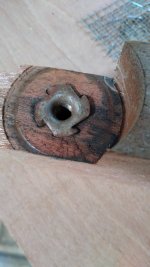
Is there a way to remove these without damaging them so they can be re- deployed ?
I have some brass ferrules that screw into them but they're witworth thread so virtually irreplaceable.
IMG_20260427_151354223.jpg
 
They would usually have the screw come in from the underside. Those little spikes prevent the insert from turning.

Could you not fashion something so that the screw enters from the top in the photo and pulls the insert out as you screw it, a bit like how a bearing puller works?
 
You could make the equivalent of a bearing-puller quite easily. Two pieces of board with a hole in each. one the size of your screw thread, the other the overall size of the fastener. Glue them together concentrically. The put it over the fasterner, insert you bolt and tighten away, it should just pull out.
S
PS Malc beat me to it!
 
The wood can be split open and scrapped - my inner hooligan didnt think of that

Id like the fasteners out unscathed.

I assume they just hammer in to a bore ( soft pine)?
 
Slide hammer will pull them out the only thing is the thread would be hard to match. A flat screwdriver will probably work you need some protection like a wallpaper scraper between the wood and screwdriver.

Pete
 
I use them fairly often. They're rarely tight from the side that your photo shows: a flat bladed screwdriver gently applied under the flange should loosen them.

Whitworth thread is far more common than you might think, in the form of American UNC (Unified National Coarse). The thread diameters and thread pitch are the same, but UNC has sharply triangular thread form, whereas Whitworth is slightly rounded on the 'hills' and in the 'valleys' (that makes it slightly stronger, actually).

I keep stock of 3/8" and 1/4" UNC thread bolts, for photographic and audio use (3/8" is used on mic stands and professional tripods, and 1/4" is stills camera thread, usually). Nowadays cameras and fittings are actually UNC but they were originally Whitworth.

If a UNC bolt is tight (i.e. your spiked nut won't accept it), just take the sharp 'hills' down slightly by spinning the bolt against emery cloth in a battery drill or similar. The bottom of the thread form (i.e. nearest the centreline) shouldn't matter.

If you want me to send you one of each (3/8" and 1/4" UNC) PM me.
 
If the hole is all the way through the timber which it should be if the fasteners are being used correctly then a stud or bolt screwd in from the back, a few light hammer blows and they pop out undamaged. I've done it many times. If you dont have the correct theaded bolt then one slightly oversize can still drive them out without damaging the thread.
 
Back
Top