
-
Hi all and welcome to TheWoodHaven2 brought into the 21st Century, kicking and screaming! We all have Alasdair to thank for the vast bulk of the heavy lifting to get us here, no more so than me because he's taken away a huge burden of responsibility from my shoulders and brought us to this new shiny home, with all your previous content (hopefully) still intact! Please peruse and feed back. There is still plenty to do, like changing the colour scheme, adding the banner graphic, tweaking the odd setting here and there so I have added a new thread in the 'Technical Issues, Bugs and Feature Requests' forum for you to add any issues you find, any missing settings or just anything you'd like to see added/removed from the feature set that Xenforo offers. We will get to everything over the coming weeks so please be patient, but add anything at all to the thread I mention above and we promise to get to them over the next few days/weeks/months. In the meantime, please enjoy!
You are using an out of date browser. It may not display this or other websites correctly.
You should upgrade or use an alternative browser.
You should upgrade or use an alternative browser.
Chairs - Done!
- Thread starter NickM
- Start date
duke
Old Oak
Nice NickM, neat use of the open crest rail. And the feeler gauge method to fine tune the shoulder I will use in the future.
NickM
Old Oak
Yes, tapping them down is good enough for testing the fit, but when it comes to fitting the crest rail and then gluing them in, it really needs to be clamped.Very interesting, Nick. I'm unsure as to why you needed that fancy clamping arrangement. Could you not just tap the (free) top end of the bars with a mallet/ rubber hammer?
You can't really clamp between the crest rail and the seat because the clamping pressure isn't really in the right direction. It tends to just bend the back bars rather than push them home into the mortise.
I'd hoped not to have to make the clamping arrangement, but quickly realised how effective it would be.
NickM
Old Oak
I said I'd a bit more about fitting the back bars into the crest rail. Here it is...
It's a similar process the fitting them at the bottom. However, the big difference is the bars are no longer independent of one another. For example, if you get 5 out of 6 of the bars fitting perfectly at the top, it's not the one with gaps which needs to be adjusted. It's the other 5! This can make it a very frustrating process.
To start off, i use the cut away crest rail to do the first fit. I make a knife mark on the four corners of the bar where it meets the dummy rail and join the dots from there. Here's the cut away rail again:

Having marked the shoulder line, I then add the depth of the tenon parallel to the shoulder line and saw off the waste to that line:

Then I clean up the end and layout the tenon:

Shaping the tenons is the same process you've already seen.
It's then a case of putting the crest rail on followed by each leg before clamping up. This is where you find out how close you are. There are normally a few gaps.


Then it's a case of finding the biggest gap and using a feeler gauge equal to that gap to scribe new shoulder lines. Chiselling accurately to those shoulder lines should give gap free joints. Having to do that process more than once would be a pain but I've avoided it so far. There seems to be enough wriggle room in the crest rail joinery (dominos) to pull the crest rail down to take up the gaps. The dominos could also be adjusted if necessary to give a bit more adjustment.
It's a similar process the fitting them at the bottom. However, the big difference is the bars are no longer independent of one another. For example, if you get 5 out of 6 of the bars fitting perfectly at the top, it's not the one with gaps which needs to be adjusted. It's the other 5! This can make it a very frustrating process.
To start off, i use the cut away crest rail to do the first fit. I make a knife mark on the four corners of the bar where it meets the dummy rail and join the dots from there. Here's the cut away rail again:
Having marked the shoulder line, I then add the depth of the tenon parallel to the shoulder line and saw off the waste to that line:
Then I clean up the end and layout the tenon:
Shaping the tenons is the same process you've already seen.
It's then a case of putting the crest rail on followed by each leg before clamping up. This is where you find out how close you are. There are normally a few gaps.
Then it's a case of finding the biggest gap and using a feeler gauge equal to that gap to scribe new shoulder lines. Chiselling accurately to those shoulder lines should give gap free joints. Having to do that process more than once would be a pain but I've avoided it so far. There seems to be enough wriggle room in the crest rail joinery (dominos) to pull the crest rail down to take up the gaps. The dominos could also be adjusted if necessary to give a bit more adjustment.
NickM
Old Oak
Because I like to make work for myself, I decided it would be a good idea to shape the back bars.
I am adding a subtle taper (they're a bit wider at the top) and fully rounding over the edges.
The taper is subtle because I'm constrained by the size of the tenon. I can take 2mm of each side at the bottom:

It's then a case of hand planing to those lines trying to keep the edges as square as possible to the faces.
The round over is a lot more work! I've used a faceting approach to do this. the guidelines are like this and they give a half octagonal profile:

There are a lot of lines, but it's quite quick to measure out some pencil marks and then mark the lines using your finger as a fence.
Spoke-shaving to the correct lines gives the half-octagonal profile:


From there. I set the spokeshave for a lighter cut and just make increasingly smaller facets. Finally, I finish off with sandpaper:

The fronts of these bars are sort of book-matched, but this is the only set like that.
To give me the opportunity for more spokeshaving, I've also added a curve to the bottom edge of the seat rail:


Gluing up the chair back is done in 3 stages. 1. Gluing the bars into the seat rail. 2. Gluing the crest rail on. 3. Gluing the legs on. At stages 1 and 2, I dry fit all of the components together to make sure the parts being glued are in the right position. This is the position after step 2:

You can see that I've done some work on the edges of the crest and seat rails before the glue up. It's not really possible to do that afterwards. Similarly, before gluing the legs on, I add a roundover on the inside edges of the legs. It's around 4mm radius at the seat and feathers out up and down the leg from there:

The third chair back is now glued up so I'm half way on those. I've got one more set of back bars ready to go so I should be able to complete the fourth chair back this week. In the meantime, I'm thinking about the rebate for the seats - trying to decide what shape it should be before I make templates for cutting it.
I am adding a subtle taper (they're a bit wider at the top) and fully rounding over the edges.
The taper is subtle because I'm constrained by the size of the tenon. I can take 2mm of each side at the bottom:
It's then a case of hand planing to those lines trying to keep the edges as square as possible to the faces.
The round over is a lot more work! I've used a faceting approach to do this. the guidelines are like this and they give a half octagonal profile:
There are a lot of lines, but it's quite quick to measure out some pencil marks and then mark the lines using your finger as a fence.
Spoke-shaving to the correct lines gives the half-octagonal profile:
From there. I set the spokeshave for a lighter cut and just make increasingly smaller facets. Finally, I finish off with sandpaper:
The fronts of these bars are sort of book-matched, but this is the only set like that.
To give me the opportunity for more spokeshaving, I've also added a curve to the bottom edge of the seat rail:
Gluing up the chair back is done in 3 stages. 1. Gluing the bars into the seat rail. 2. Gluing the crest rail on. 3. Gluing the legs on. At stages 1 and 2, I dry fit all of the components together to make sure the parts being glued are in the right position. This is the position after step 2:
You can see that I've done some work on the edges of the crest and seat rails before the glue up. It's not really possible to do that afterwards. Similarly, before gluing the legs on, I add a roundover on the inside edges of the legs. It's around 4mm radius at the seat and feathers out up and down the leg from there:
The third chair back is now glued up so I'm half way on those. I've got one more set of back bars ready to go so I should be able to complete the fourth chair back this week. In the meantime, I'm thinking about the rebate for the seats - trying to decide what shape it should be before I make templates for cutting it.

Dr.Al
Old Oak
Thanks for sharing so much detail of the process. I'm really enjoying this thread.

Ditto!
I'd have been tempted to try out quite a few different spokeshaves if I was attempting anything like your chairs - but I expect you have taken a rigorous approach of sticking to one good one. What's your tool of choice for all this lovely hand shaping?
I'd have been tempted to try out quite a few different spokeshaves if I was attempting anything like your chairs - but I expect you have taken a rigorous approach of sticking to one good one. What's your tool of choice for all this lovely hand shaping?
NickM
Old Oak
I think I've done it all with a flat soled Stanley (a 151??). None of the curves are tight enough to need the round soled version. I only needed to grab the round bottomed one because to use the blade in it having worn out the one in the flat soled version! The worn out blade was new to me a few years ago and I'd extended the holes once to try to get a bit more out of it.Ditto!
I'd have been tempted to try out quite a few different spokeshaves if I was attempting anything like your chairs - but I expect you have taken a rigorous approach of sticking to one good one. What's your tool of choice for all this lovely hand shaping?
duke
Old Oak
Amazing Nick, the thought and work you have done on these chairs is excellent.
NickM
Old Oak
Not that tempted now I know this method works. Doing it by myself, I worry the glue will lock everything up before all the back bar joints are all pulled up. It takes a bit of time to assemble the clamping arrangement. I'm not in a hurry and, in any case, I can get on with other things between each gluing phase.Are you not tempted to glue the legs on at the same time as gluing the rails to the bars?
NickM
Old Oak
I'd like a bit of advice on how to go about cutting the seat rebates.
Using the side rail as example, this is the template I've made:

The shaded area shows the contact point between the rail and the template. It's c.15mm for most of the length,
This is the rail:

The area to the right of the pencil line (again, c.15mm for most of the length) needs to be removed down to a depth of c.12mm.
This is the template on the rail:

This is the rail on the template:

The basic options are to use the template to guide a flush cutting router bit, or to use the template to draw a line to work to with hand tools (or, I suppose, a combination of those.
Routing seems the best option, but I've got some concerns (partly borne out of a general dislike of routers after my finger got bitten by one when trying to template rout the rear legs for these chairs...):
1. How to attach the template to the rail? Masking tape/super glue trick seems too dodgy for me especially with so much wood to remove which I find can put more force on the workpiece if the cutter digs in (see the next point). I'm really scared of the template moving (as well losing a finger!). One option I'm wondering about is to have two small 'fingers' (not mine ) attached to the template (potentially remaking the template with the fingers in place) and to screw through those into the waste wood I'm removing. I'd be left with two matching 'fingers' of waste on the rail which I could then remove using hand tools. Any better options I'm missing?
2. How to approach the routing given how much wood there is to remove. Is the best approach to take shallow cuts all the way into the template and then gradually increasing the depth of cut (by moving the guide bearing up/down the template)? That seems better than starting off at full depth and ('manually') trying to take lighter cuts gradually moving in towards the template. I guess another option would be to remove most of the wood by hand (see below) before routing.
3. How to deal with grain direction. Inevitably some of these (probably all knowing my luck) will involve me cutting against the grain. Any good ideas?
4. Router table (1/2" router) or handheld (1/2" or 1/4").
I'm open to doing these by hand, but this is oak and there's a lot of wood to remove, curves to deal with etc. so would be time-consuming. Chisels seems to be the only option but am I missing something?
Thanks in advance for any help!
Edit: I think someone (PAC1) suggested the possibility of gluing up the front end of the chair and routing the whole thing at once. For various reasons, that might not be possible, but I don't think it really affects the questions above in any case.
Using the side rail as example, this is the template I've made:
The shaded area shows the contact point between the rail and the template. It's c.15mm for most of the length,
This is the rail:
The area to the right of the pencil line (again, c.15mm for most of the length) needs to be removed down to a depth of c.12mm.
This is the template on the rail:
This is the rail on the template:
The basic options are to use the template to guide a flush cutting router bit, or to use the template to draw a line to work to with hand tools (or, I suppose, a combination of those.
Routing seems the best option, but I've got some concerns (partly borne out of a general dislike of routers after my finger got bitten by one when trying to template rout the rear legs for these chairs...):
1. How to attach the template to the rail? Masking tape/super glue trick seems too dodgy for me especially with so much wood to remove which I find can put more force on the workpiece if the cutter digs in (see the next point). I'm really scared of the template moving (as well losing a finger!). One option I'm wondering about is to have two small 'fingers' (not mine
) attached to the template (potentially remaking the template with the fingers in place) and to screw through those into the waste wood I'm removing. I'd be left with two matching 'fingers' of waste on the rail which I could then remove using hand tools. Any better options I'm missing?2. How to approach the routing given how much wood there is to remove. Is the best approach to take shallow cuts all the way into the template and then gradually increasing the depth of cut (by moving the guide bearing up/down the template)? That seems better than starting off at full depth and ('manually') trying to take lighter cuts gradually moving in towards the template. I guess another option would be to remove most of the wood by hand (see below) before routing.
3. How to deal with grain direction. Inevitably some of these (probably all knowing my luck) will involve me cutting against the grain. Any good ideas?
4. Router table (1/2" router) or handheld (1/2" or 1/4").
I'm open to doing these by hand, but this is oak and there's a lot of wood to remove, curves to deal with etc. so would be time-consuming. Chisels seems to be the only option but am I missing something?
Thanks in advance for any help!
Edit: I think someone (PAC1) suggested the possibility of gluing up the front end of the chair and routing the whole thing at once. For various reasons, that might not be possible, but I don't think it really affects the questions above in any case.

Malc2098
Sequoia
Nick, I've had a big router table with a 1/2' router fitted to it of a long time, but I felt it was too big and powerful for the small necks of the ukulele that I make. So I bought a cheap Chinese cast aluminium table insert and use my cordless 1/4" machine for that sort of work. I find a way of fitting them to my bench vice.
I find passing the work over the mini router table to be more stable than passing a handheld router over the work. And I still take several passes before the bearing meets the template.
I also have confidence in the masking tape/CA sandwich which I almost exclusively use for securing the workpieces to the CNC spoilboard. BUT I have found that both the tape on the workpiece and the template or spoilbaord must be burnished before applying the CA glue. I have a piece of wood with the arris slightly rounded over for this job. The only time I didn't was the only time the workpiece moved under the movement of the spindle cutter.
You can always try this method out with your template and a piece of plywood.
I find passing the work over the mini router table to be more stable than passing a handheld router over the work. And I still take several passes before the bearing meets the template.
I also have confidence in the masking tape/CA sandwich which I almost exclusively use for securing the workpieces to the CNC spoilboard. BUT I have found that both the tape on the workpiece and the template or spoilbaord must be burnished before applying the CA glue. I have a piece of wood with the arris slightly rounded over for this job. The only time I didn't was the only time the workpiece moved under the movement of the spindle cutter.
You can always try this method out with your template and a piece of plywood.

Mike G
Petrified Pine
I think hot-melt glue is your answer, Nick. It gets a really good hold, but is relatively easily removed afterwards by prying, or you could re-heat. I would definitely, definitely have the cutter in a router table as this would prevent any suggestion of tipping the router, and you could get a good grip with both hands well clear of the cutter. Obviously this means a shallow cutter with the follower-bearing at the base. Someone linked to some like this a few months ago, and I have one. It works well.
The one variable with hot glue is its thickness, which would mean your depth of rebate could vary somewhat. This might mean doing the bulk of the work with the template, but the final pass after it's been removed. If you're not used to hot-melt glue, it cools very quickly. Your open time is seconds, so you need your ducks in a row when you start the job, or you need to warm your timber to slow things down a bit.
The one variable with hot glue is its thickness, which would mean your depth of rebate could vary somewhat. This might mean doing the bulk of the work with the template, but the final pass after it's been removed. If you're not used to hot-melt glue, it cools very quickly. Your open time is seconds, so you need your ducks in a row when you start the job, or you need to warm your timber to slow things down a bit.
I'm not going to attempt any thoughts on how to do the routing, but here's a thought from the sidelines.
We only have one chair with a drop-in seat. It's this old one, which I think was made as an office chair. The seat pad is about 490mm wide at the front and 390mm wide at the back.
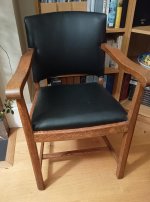
But the rebates are very shallow. Only a scant 6mm at front and sides, with nothing at the back, but with quite large corner braces. So I wonder if you could simplify your rebating job by removing less wood? Of course, that would affect the visible width of the chair rails and possibly make them look heavier than you want, but I thought I'd mention it just in case.
(The chair in question is obviously much more utilitarian than yours but it does seem to have survived intact, with no sagging on the seat, which I am pretty sure just has a simple oak frame topped with plywood, all concealed under cloth and leatherette. I don't know why it looks stained white under there.)

We only have one chair with a drop-in seat. It's this old one, which I think was made as an office chair. The seat pad is about 490mm wide at the front and 390mm wide at the back.
But the rebates are very shallow. Only a scant 6mm at front and sides, with nothing at the back, but with quite large corner braces. So I wonder if you could simplify your rebating job by removing less wood? Of course, that would affect the visible width of the chair rails and possibly make them look heavier than you want, but I thought I'd mention it just in case.
(The chair in question is obviously much more utilitarian than yours but it does seem to have survived intact, with no sagging on the seat, which I am pretty sure just has a simple oak frame topped with plywood, all concealed under cloth and leatherette. I don't know why it looks stained white under there.)
NickM
Old Oak
Thanks Mike. I hadn't thought of that. I'll give that a try on a practice piece.I think hot-melt glue is your answer, Nick. It gets a really good hold, but is relatively easily removed afterwards by prying, or you could re-heat. I would definitely, definitely have the cutter in a router table as this would prevent any suggestion of tipping the router, and you could get a good grip with both hands well clear of the cutter. Obviously this means a shallow cutter with the follower-bearing at the base. Someone linked to some like this a few months ago, and I have one. It works well.
The one variable with hot glue is its thickness, which would mean your depth of rebate could vary somewhat. This might mean doing the bulk of the work with the template, but the final pass after it's been removed. If you're not used to hot-melt glue, it cools very quickly. Your open time is seconds, so you need your ducks in a row when you start the job, or you need to warm your timber to slow things down a bit.
I'm coming to the view that the router table is the way to go.
spb
Nordic Pine
I'll agree with Mike, unsurprisingly, and add that to address the against-the-grain problems you can do your initial waste removal down to depth with masking tape wrapped around the guide bearing. That will take you a fraction away from the final line, and then when you remove the tape you'll have a tiny amount of material to remove in the last pass. That's often enough to get a decent surface finish even when the grain isn't co-operating.
duke
Old Oak
I have used a good two way carpet tape for a few templates and used my router table.
NickM
Old Oak
That's a great tip. ThanksI'll agree with Mike, unsurprisingly, and add that to address the against-the-grain problems you can do your initial waste removal down to depth with masking tape wrapped around the guide bearing. That will take you a fraction away from the final line, and then when you remove the tape you'll have a tiny amount of material to remove in the last pass. That's often enough to get a decent surface finish even when the grain isn't co-operating.
NickM
Old Oak
Thanks. I've tried that before and found it too strong. It was too hard to get it off!I have used a good two way carpet tape for a few templates and used my router table.
HOJ
Sapling
I do a bit of template work with routers and also the spindle moulder, but with regards routing, and I don't know if this would work in your circumstances, I make my templates in an L shape form by fixing another piece to the templates back edge, I then use clamps across the faces leaving the template top face clear for the router to run along, I also attach a wider base to the router, usually a piece of Perspex, which gives more support to the router base, rather than it tottering un supported.
With regards router cutters and cutting, I have 2 methods, 1: using the same diameter bearing cutters but in different lengths in order to give me the increase in the cutting depth incrementally, rather than taking too much off at one time but this method does mean swapping cutters out as I progress to a deeper cut, but you get to a point that the next cutter length will reference off the previous pass, so the template is no longer required, or 2: using a guide bush, and a straight cutter, and adjusting the plunge depth, but this does mean the template has to be made to account for the offset, and be used until the finished depth is achieved, my preference is method 1 as I find it more accurate to make the template in the first place.
I have also tried and used sticky stuff as an option but found it to be a bit of a lottery, more so if you need to replicate fairly close positioning on multiple items, and then the faff of cleaning up after, that's why I generally try to use an L shape type template as it always back references of a face.
With regards router cutters and cutting, I have 2 methods, 1: using the same diameter bearing cutters but in different lengths in order to give me the increase in the cutting depth incrementally, rather than taking too much off at one time but this method does mean swapping cutters out as I progress to a deeper cut, but you get to a point that the next cutter length will reference off the previous pass, so the template is no longer required, or 2: using a guide bush, and a straight cutter, and adjusting the plunge depth, but this does mean the template has to be made to account for the offset, and be used until the finished depth is achieved, my preference is method 1 as I find it more accurate to make the template in the first place.
I have also tried and used sticky stuff as an option but found it to be a bit of a lottery, more so if you need to replicate fairly close positioning on multiple items, and then the faff of cleaning up after, that's why I generally try to use an L shape type template as it always back references of a face.
NickM
Old Oak
Thanks. Some good food for thought there.I do a bit of template work with routers and also the spindle moulder, but with regards routing, and I don't know if this would work in your circumstances, I make my templates in an L shape form by fixing another piece to the templates back edge, I then use clamps across the faces leaving the template top face clear for the router to run along, I also attach a wider base to the router, usually a piece of Perspex, which gives more support to the router base, rather than it tottering un supported.
With regards router cutters and cutting, I have 2 methods, 1: using the same diameter bearing cutters but in different lengths in order to give me the increase in the cutting depth incrementally, rather than taking too much off at one time but this method does mean swapping cutters out as I progress to a deeper cut, but you get to a point that the next cutter length will reference off the previous pass, so the template is no longer required, or 2: using a guide bush, and a straight cutter, and adjusting the plunge depth, but this does mean the template has to be made to account for the offset, and be used until the finished depth is achieved, my preference is method 1 as I find it more accurate to make the template in the first place.
I have also tried and used sticky stuff as an option but found it to be a bit of a lottery, more so if you need to replicate fairly close positioning on multiple items, and then the faff of cleaning up after, that's why I generally try to use an L shape type template as it always back references of a face.
NickM
Old Oak
I think I've come up with a method for cutting the rebates that I'm happy with. This is the set up:

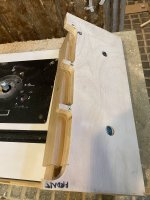
As you can see, the template is screwed to the rail, with the screws going into the waste. I debated using one of the options for gluing the template on, but I like the extra security of screws and not having to clean up glue/masking tape.
I made the template extra big to make it more stable and to keep my hands further away from the router bit. The plastic knobs keep my hands where they should be!
I take lightish cuts (depth/height-wise) - about 4 passes for the 12mm depth of the rebate.
This is what I end up with:

The 'tabs' where the template was screwed on are easy enough to remove. For the two central ones, I can saw the bulk of it out and then pare down with a chisel.
The end one is a bit different:

As well as giving me another place to screw (it's a bit close to the edge but is just about OK), I was also nervous about breaking the edge where it feathers out. A bit of sawing and some chiselling/gouge sorts this out. The reason for the curve here is purely aesthetic. I wanted the seat shape to flow around the back corners from the side rail into the curve of the back rail. There will be a little corner to cut out of the seat for rear legs, but I think the overall shape of the seat looks better with the curve.
I'm pleased with the finish I'm getting off the router. A couple of gentle passes with a scraper is enough to remove the minor tool marks you can see in the above photo.
I did a dry assembly of the chair to see what it looked like:


There are a few gaps I need to sort out (I think the angles are very slightly off, but I don't think it will be too hard to adjust).
You'll see that I haven't rebated the tops of the front legs yet. The reason for that is that I need to angle the tops of the legs to match the downward slope of the side rails. Currently there is a step down from the front leg to the side rail to accommodate the angle. I think I'll have to do that once the chair is glued up. I can then make a template to rout the rebate in the legs using a trim router. If I cut the rebate now using the 'flat' top of the leg as the reference point, the rebate wouldn't match up with the side rail.
(Thinking aloud now) I think the only other decision I need to make before I get the glue out again is what shaping I should do on the outside edge. The general plan is to do a heavy round over (e.g. 10mm radius). If that will run all the way to the back legs, I need to do at least some of that round over before I glue on the side rails. An alternative is for the round over to peter out as it gets to the back. If I do that, I could do the round over after gluing everything up, but it might still be easier to do some of it before assembly.
As you can see, the template is screwed to the rail, with the screws going into the waste. I debated using one of the options for gluing the template on, but I like the extra security of screws and not having to clean up glue/masking tape.
I made the template extra big to make it more stable and to keep my hands further away from the router bit. The plastic knobs keep my hands where they should be!
I take lightish cuts (depth/height-wise) - about 4 passes for the 12mm depth of the rebate.
This is what I end up with:
The 'tabs' where the template was screwed on are easy enough to remove. For the two central ones, I can saw the bulk of it out and then pare down with a chisel.
The end one is a bit different:
As well as giving me another place to screw (it's a bit close to the edge but is just about OK), I was also nervous about breaking the edge where it feathers out. A bit of sawing and some chiselling/gouge sorts this out. The reason for the curve here is purely aesthetic. I wanted the seat shape to flow around the back corners from the side rail into the curve of the back rail. There will be a little corner to cut out of the seat for rear legs, but I think the overall shape of the seat looks better with the curve.
I'm pleased with the finish I'm getting off the router. A couple of gentle passes with a scraper is enough to remove the minor tool marks you can see in the above photo.
I did a dry assembly of the chair to see what it looked like:
There are a few gaps I need to sort out (I think the angles are very slightly off, but I don't think it will be too hard to adjust).
You'll see that I haven't rebated the tops of the front legs yet. The reason for that is that I need to angle the tops of the legs to match the downward slope of the side rails. Currently there is a step down from the front leg to the side rail to accommodate the angle. I think I'll have to do that once the chair is glued up. I can then make a template to rout the rebate in the legs using a trim router. If I cut the rebate now using the 'flat' top of the leg as the reference point, the rebate wouldn't match up with the side rail.
(Thinking aloud now) I think the only other decision I need to make before I get the glue out again is what shaping I should do on the outside edge. The general plan is to do a heavy round over (e.g. 10mm radius). If that will run all the way to the back legs, I need to do at least some of that round over before I glue on the side rails. An alternative is for the round over to peter out as it gets to the back. If I do that, I could do the round over after gluing everything up, but it might still be easier to do some of it before assembly.
Cabinetman
Sequoia
- Joined
- Oct 11, 2020
- Messages
- 5,376
- Reaction score
- 1,098
- Location
- Lincolnshire Wolds + Massachusetts
- Name
- Ian
Most impressive, are they comfortable?
NickM
Old Oak
I don't know! The prototype seemed OK so hopefully they'll be alright!Most impressive, are they comfortable?

Steve Maskery
Old Oak
That looks absolutely fantastic, Nick, most very excellent.
S
S
NickM
Old Oak
I haven't done any woodworking for the last two+ weeks but have made some progress on the chairs since my last post.
One big milestone is that I FINALLY finished gluing up all of the back bar laminations and have now assembled all of the chair backs.
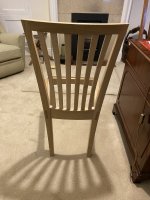
The other milestone is that the first chair has been glued up.
With the exception of one small gap in a joint, it went well:


The next task is to rout out the seat rebate on the top of the front legs:

I've made a template which I can clamp on and then use with a bearing guided bit in a trim router to cut the rebate. It needs some modification but has enough surface to fully support the router so as to avoid any tipping. I'll post some photos of the set up when I use it.
This is a close up of the gappy joint. It's annoying but not too bad really. I think the problem was that my clamping arrangement didn't give good enough access to the back of the joint (wedged through tenon) to allow me to hammer in the wedges whilst it was fully clamped. I had to take a clamp off to knock the wedges in, and I think that might have pushed the tenon out very slightly. It seemed OK when I did the dry run but I obviously didn't fully think it through.

On the plus side, I was very happy with the through tenons. No gaps at all!

The jobs left to do on this chair are:
One big milestone is that I FINALLY finished gluing up all of the back bar laminations and have now assembled all of the chair backs.
The other milestone is that the first chair has been glued up.
With the exception of one small gap in a joint, it went well:
The next task is to rout out the seat rebate on the top of the front legs:
I've made a template which I can clamp on and then use with a bearing guided bit in a trim router to cut the rebate. It needs some modification but has enough surface to fully support the router so as to avoid any tipping. I'll post some photos of the set up when I use it.
This is a close up of the gappy joint. It's annoying but not too bad really. I think the problem was that my clamping arrangement didn't give good enough access to the back of the joint (wedged through tenon) to allow me to hammer in the wedges whilst it was fully clamped. I had to take a clamp off to knock the wedges in, and I think that might have pushed the tenon out very slightly. It seemed OK when I did the dry run but I obviously didn't fully think it through.
On the plus side, I was very happy with the through tenons. No gaps at all!
The jobs left to do on this chair are:
- rout the rebate in the legs
- round over the top of the legs
- make and fit corner braces
- make the seat base (12mm ply)
- finishing
- upholstery
Dr.Al
Old Oak
If that's what you call a gappy joint, you're not allowed to visit my house 
NickM
Old Oak
Well there's definitely a gap but it's certainly not the worst joint I've ever done either!If that's what you call a gappy joint, you're not allowed to visit my house
Cabinetman
Sequoia
- Joined
- Oct 11, 2020
- Messages
- 5,376
- Reaction score
- 1,098
- Location
- Lincolnshire Wolds + Massachusetts
- Name
- Ian
Minimal and won’t be seen, we all beat ourselves up and point out the defects in our work, wonderful old friend of my parents said the same to me years ago, and he was dead right, keep shtum!
I love the way these chairs are turning out, all credit to you Nick.
I love the way these chairs are turning out, all credit to you Nick.
I too think you could cut yourself some slack there!
I reckon that the "gap" will disappear when you put some finish on. (I've seen cracks in old planes disappear with a rub of linseed oil.)
Or look at some older chairs - such as Rob's in this thread -

 www.thewoodhaven2.co.uk
and see how much natural crud accumulates in the corners, even in a clean and tidy house.
www.thewoodhaven2.co.uk
and see how much natural crud accumulates in the corners, even in a clean and tidy house.
I reckon that the "gap" will disappear when you put some finish on. (I've seen cracks in old planes disappear with a rub of linseed oil.)
Or look at some older chairs - such as Rob's in this thread -
What stripper?
Our old dining room chairs are solid teak, (now approx 40yo) finished with an acid catalyst lacquer. They need re-upholstering but I'm also thinking about re-finishing them at the same time and will obviously need to strip off the old lacquer. When we had a marine aquarium some years ago, the...
www.thewoodhaven2.co.uk
duke
Old Oak
I'll take that gap any day, nice looking chair Nick.
Mike G
Petrified Pine
Great stuff Nick. Yeah...clamping curved tapering stuff whilst banging in wedges: great fun!
I wonder if for the next chair you might find a way of doing the shoulders of the seat rebate in the front legs prior to assembly. You're left with a tricky router job now, but if you had got the shoulders sawn, it would be a very quick and easy job with a gouge.
I wonder if for the next chair you might find a way of doing the shoulders of the seat rebate in the front legs prior to assembly. You're left with a tricky router job now, but if you had got the shoulders sawn, it would be a very quick and easy job with a gouge.

I can’t imagine that anyone else will notice that gap.
NickM
Old Oak
Thanks Mike. I'll see how this one goes with the router. It should be easy enough once I've made the template and found a way of clamping it on securely, but I'll consider other options if it doesn't go well. Fingers crossed...Great stuff Nick. Yeah...clamping curved tapering stuff whilst banging in wedges: great fun!
I wonder if for the next chair you might find a way of doing the shoulders of the seat rebate in the front legs prior to assembly. You're left with a tricky router job now, but if you had got the shoulders sawn, it would be a very quick and easy job with a gouge.
NickM
Old Oak
First woodwork since mid December today. It was cold in the workshop but it was good to get back into it.
This is the template I made for routing the rebate in the front legs:


As you can see, the "keyhole" shape of the template gives lots of support for the little router.
The rebate came out well (ignore the wonky pencil line!). This is it before any cleaning up.
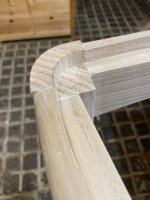
I also blended in the roundover around the corners of the chair:


It makes a big difference to the look of the chair.
This is the template I made for routing the rebate in the front legs:
As you can see, the "keyhole" shape of the template gives lots of support for the little router.
The rebate came out well (ignore the wonky pencil line!). This is it before any cleaning up.
I also blended in the roundover around the corners of the chair:
It makes a big difference to the look of the chair.
Dr.Al
Old Oak
That looks really smart.
I don't think my obsessive nature would cope with one jig marked "top" and the other marked "up"
I don't think my obsessive nature would cope with one jig marked "top" and the other marked "up"