• Hi all and welcome to TheWoodHaven2 brought into the 21st Century, kicking and screaming! We all have Alasdair to thank for the vast bulk of the heavy lifting to get us here, no more so than me because he's taken away a huge burden of responsibility from my shoulders and brought us to this new shiny home, with all your previous content (hopefully) still intact! Please peruse and feed back. There is still plenty to do, like changing the colour scheme, adding the banner graphic, tweaking the odd setting here and there so I have added a new thread in the 'Technical Issues, Bugs and Feature Requests' forum for you to add any issues you find, any missing settings or just anything you'd like to see added/removed from the feature set that Xenforo offers. We will get to everything over the coming weeks so please be patient, but add anything at all to the thread I mention above and we promise to get to them over the next few days/weeks/months. In the meantime, please enjoy!

Cheap wood for workbench

Windows

Old Oak
Joined
Jan 25, 2022
Messages
1,433
Reaction score
433
Location
Cumbria & West Kent
Based on some quick research (and a spreadsheet), it seems like CLS 2x4 studs (actually 38mm x 89mm x 2.4m) is in general the cheapest source for non-treated wood without a bunch of defects that would be suitable for building a workbench. Does anyone have a different source or format that I should consider? Thanks.
 
I've had some very good CLS but only by going to select in person. Normally I'd avoid the sheds but one advantage is that rarely does anyone object to you picking over the stock (and yes I do restack the discarded stuff and leave the pile as neat as i found it!).
Bear in mind the waste in ripping off the rounded edges either as reduced thickness or width. Trivial to do on a table saw or planer but quite labour intensive for the hand tool wallahs.

Bob
 
Are you considering using it for the top?
Most cls these days is fast grown & really quite soft, if it was for the top I’d be looking at unsorted red wood as it’s not that much more expensive & would be much more durable, use the cls for the frame.
 
Windows":1hp1bh0c said:
.... Does anyone have a different source or format that I should consider? Thanks.

Define cheap. Try Andersen's in Carlisle. What sizes are you after ? I do have some unsorted surplus to requirements. Your call.
 
my bench is made from CLS from a big box.

I didn't take the round edges off till the top was glued up, then I planed it all flat.

the front of the bench is cls with the long side vertical for 6-8 pieces, the rear about 4 bits with 3 bits the other way in the middle.
I didn't take the round of the underside at all.

legs are 2 bits of cls glued together with through a through mortise for the cross braces and they are a through mortise to the top with wedges.
there are now screws in the bench at all.
it's at least 8 years old if not older and it's still going strong.

The bench by David Rees, on Flickr
 
novocaine":1lgkdguh said:
my bench is made from CLS from a big box.

I didn't take the round edges off till the top was glued up, then I planed it all flat.

the front of the bench is cls with the long side vertical for 6-8 pieces, the rear about 4 bits with 3 bits the other way in the middle.
I didn't take the round of the underside at all.

legs are 2 bits of cls glued together with through a through mortise for the cross braces and they are a through mortise to the top with wedges.
there are now screws in the bench at all.
it's at least 8 years old if not older and it's still going strong.

The bench by David Rees, on Flickr
That bench I just did had legs like that but no M&T’s just a few halving joints and about 200 screws lol. I did the meaty bit of the top out of cls on edge then planed level with 18 mm ply, Second one I’ve built like this over here and very pleased with the result no bounce whatsoever and I can chop joints on it to my heart‘s content.
 
Windows":2x23rqxg said:
Based on some quick research (and a spreadsheet), it seems like CLS 2x4 studs (actually 38mm x 89mm x 2.4m) is in general the cheapest source for non-treated wood without a bunch of defects that would be suitable for building a workbench. Does anyone have a different source or format that I should consider? Thanks.

Just a little caution with those dimensions. CLS varies from supplier to supplier, but around here is is generally 5mm smaller than the metric equivalent of the old imperial sizes. So, ex 4x2s are about 95 x 45mm.

One of the down sides of CLS is that some of it has been murdered in a kiln, leaving it brittle and incredibly prone to splitting. Also, the rounded-over arises make marking for joints etc quite difficult. They also force the wholesale removal of a face if you attempt to join pieces together to form a worksurface.

If I were building a bench from scratch I would probably check out the price of beech. I would also look at second hand timber.
 
Good call, Mike.

W E Holden Laith Mills are a good bet.
 
Plus1 for Beech, steamed Beech- usually German is very uniform and available in 3 inch thick slabs, last time I bought some it was pretty competitive compared to most other hardwoods. My son has just acquired some old joists from a demolition 2.5“ x 10 and solid Pitchpine, really nice stuff.
 
There are different schools of thought on bench top material. I have used beech topped ones but in many of the pro Joinery shops I've worked in they have been some kind of pine (parana quite often as it was available in wider dimensions). Some people feel that being beech it will be harder/more durable or more stable perhaps leading to it being flatter for longer which holds some truth.(if you think a bench is ever going to be properly flat!) It is obviously heavier which is an advantage. But it will cost you quite a bit and the title of your post contradicts that.
On the other hand, some work along the idea that a softer top is a little more yielding and therefore more pleasant to work on. I think most people work using a sacrificial board for delicate work or some kind of protective device (timber sections faced with foam/carpet) or whatever anyway.
I go with the second idea. My current bench is 60mm pine (not even high quality redwood) Personally I prefer the feel of it, and if I want to knock the odd big panel pin into it for some odd work holding set up then I can do so without feeling bad! an occasional scrape/sand and its all good.
What is important as you know, is big sections and big proper joinery.
I would say that CLS glued up side on would be pretty decent once you have cut the radii of off one edge.
Oh and a split top is a definite!
 
My two pennyworth:

If using CLS, design the frame so that you can pop some dense concrete blocks in the base. Most workbenches are top heavy and jiggle about too much.

A workbench is just a table. The key is make it big enough and rigid enough. Doesn't much matter what it is made of as it will get knocked about. I would not use CLS though. B&Q had a load on recently and it was pretty good - I was easily able to get about 20 straight lengths. It's VERY knotty though and a lot of the knots are sappy, and I would find that a pain on a bench.

You could make the top really cheaply out of a few layers of sheet material, glued together. Easy to put on a sacrificial track saw top. Just lately I've tended to do exactly that and make a really large bench (8 by 4) so I can do tracksaw and assembly work.

Really thick sturdy legs, especially near the vice are good. CLS tends to be very light. I would be tempted to make the legs from oak railway sleepers on a cheap bench.
 
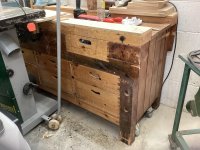
97FA1590-DFDB-4B64-8BA6-172D4E887DE5.jpegThe main reason for using CLS seems to be that it’s ready planed. The frame and main members of a workbench can be made in sawn timber without problem, only the top surface needs to be loaned true, flat and smooth.
The photo shows my bench made over fifty years ago from joinery grade redwood my late father had set aside as firewood. At the time I only had hand tools and no assess to machines, the original design had an open front an a shelf at the bottom. The drawers and planed top timbers are later replacements"/ additions made at later times when I became better equipped.
Why not leave the CLS on the shelf and set a good standard by the use good materials for your bench and the things you make on it. The glassy knots and general poor appearance tell us that it’s intended for use as studding and other out of sight jobs.
I’m convinced that many people abandon woodworking as a hobby after trying to make a project using the rubbish timber sold by the DIY sheds.
 
For context, it looks like studding works out at about £30 per cubic foot, whereas sawn European beech looks to be over £50 per cubic foot. (Both inc VAT). Let me know if this doesn't sound right.

Also, my perspective is shaped by a good experience getting a 2x4 from Travis Perkins before the lockdown - tight grained and few knots. Not sure if their current stock or anyone else's will live up to that though.

Doug, yes, I was considering using it for the top.

Roger, thanks for the offer, but once again I find myself doing woody things in the South.

Steve, I would love to build such a bench for £100. What's the secret? I like the details in your video.

Adrian, I'd been considering concrete blocks or other weight, but more for when I was thinking I might be better off souping up the workmate and saving a few more quid.

Everyone else, thanks for all the informative and diverse perspectives and for showing your benches!
 
Windows":9z42w6v1 said:
Steve, I would love to build such a bench for £100. What's the secret? I like the details in your video.

Sadly, I think the secret is to buy it before Covid hits...

I don't know how much it would cost today, but it still has to be one of your cheaper options. If I were to make it again there are a few things I'd change, detailed in that video, but not very many.

One of the many things I love about it is the range of clamping options. Today I had to hold a sub-assembly and I could wrap it around the bench top simply by lifting out one of the panels. I actually laughed when I found how well that worked.
 
Windows":3mf2f34q said:
For context, it looks like studding works out at about £30 per cubic foot,
At the moment I’m buying planks 5.4m x 225mm x 38mm sawn unsorted redwood at £19.12 a length including vat so from the sounds of it cheaper than cls
 
Windows":jrd3e7cy said:
.....

Roger, thanks for the offer, but once again I find myself doing woody things in the South.

....

Are you not up here then? Too much rain for you ? :lol: Can't say I blame you.
 
Windows":1fwhoq9k said:
For context, it looks like studding works out at about £30 per cubic foot, whereas sawn European beech looks to be over £50 per cubic foot. (Both inc VAT). Let me know if this doesn't sound right.

There's a ridiculous demand for CLS and other construction timbers at the moment as the whole continent is putting up houses like crazy, so it's actually more expensive at the moment than some much better timbers unless you're buying bulk. Unsorted redwood is £18 a cubic foot or thereabouts depending on where you get it. If I was you, I would personally ring up some local joinery firms and ask if they've got any in stock and whether they'd be willing to shove it through their planer moulder, which will cut out a lot of the labour. Bear in mind, typical sizes bought in are 9" wide and the centre inch is usually of no use as it will have heart shakes running down the length so it may be best to have 4" ripped off each side, it should plane to 90mm x 45mm cleanly.

Working with CLS in any more capacity than cutting it to length and screwing it together is a miserable experience, I'd much rather spend a bit more and have a much nicer timber to work with.
 
I'm confused. Are you saying that this is a bench to be used elsewhere - ie down South - and not up here ? If so them why not say so up front ? That way you won't get pointless (from my point of view) suggestions such as going to Andersens.
 
Yes, Roger. My apologies. I am currently researching a workbench to be constructed and used in Kent. I will probably also build and use a separate workbench in Cumbria. The Kent bench is “now” and “certain”. The Cumbria bench is “later” and “high likelihood”. The Cumbria bench is also dependent on the cost of the Kent bench and other experience gained from building it. Cumbria knowledge is always useful to me, but I certainly recognise that poorly specified questions can be annoying. Thanks for your understanding in these difficult times as I lob random & vague questions at the good citizens of the Haven. Just know that I never expect a response and every answer received is read closely, considered, and filed away for future use.
 
Windows":32x722uc said:
Are you buying industrial quantities, Doug?

Not at all, there’s only me though I do buy a fair amount of timber & it is an account but I would have thought it shouldn’t be that much more expensive as a cash buyer :eusa-think:

Looking at Dave’s photos of his bench that’s the kind of CLS I used to get years ago with nice tight growth rings though he does say it’s 8 years old. The CLS I get now a days & what I referred to in my first comment has growth rings up to 6-7mm apart, the surface often feels slightly furry & as I’ve said is quite soft.
 
That is a new scaffold bench board Roger. £80. Wickes sell the boards (no metal ends or with ends for a bit more as you wish) for £18 less the 10% trade discount. That low bench looks to be one board worth of material. Surely a rather expensive way to acquire wood?
 
AJB Temple":3dcvazy0 said:
That is a new scaffold bench board Roger. £80. Wickes sell the boards (no metal ends or with ends for a bit more as you wish) for £18 less the 10% trade discount. That low bench looks to be one board worth of material. Surely a rather expensive way to acquire wood?

All I was trying to do was introduce a bit of lateral thinking, Adrian.
 
Folks are going to get bored with me constantly saying this…..

Watch Facebook marketplace for cheap , often free dining tables.
I have never actually parted with money for one, but have acquired three this year for the cost of a six mile maximum round trip each.
The legs tend to be solid, often the tops are faced chipboard but you can get lucky and get laminated tops.
 
The tips on 2nd hand wood are great. Thanks much.

The 6mm growth ring, furry wood sounds awful. I’ve got a small offcut from that one 2x4 I picked up and it’s got one growth ring at about 2mm and the rest are ~1mm or less. It’s obviously given me a misleading impression of what to expect.
 
Windows":3ijeqkci said:
Yes, Roger. My apologies. I am currently researching a workbench to be constructed and used in Kent. I will probably also build and use a separate workbench in Cumbria. The Kent bench is “now” and “certain”. The Cumbria bench is “later” and “high likelihood”. The Cumbria bench is also dependent on the cost of the Kent bench and other experience gained from building it. Cumbria knowledge is always useful to me, but I certainly recognise that poorly specified questions can be annoying. Thanks for your understanding in these difficult times as I lob random & vague questions at the good citizens of the Haven. Just know that I never expect a response and every answer received is read closely, considered, and filed away for future use.
My two euros. At the end of the jour, it doesn't really matter a toss what you build it from; as Adrian has said, it's only a table. There are two crucial things you must take into consideration though; the first is mass. I seem to recollect that the Schwarz in his tome TAT mentioned that once it gets to around 200kg+ or so, it's not going to go anywhere regardless of what you do on it. The second is is to prevent 'racking' when in use and most easily cured by gluing and screwing a thick bit of ply onto the back.
Apart from that, use whatever's convenient (and cheapest :D ), make a top out of some layers of mdf (+ sacrificial top) or and old fire door and if needed, use some concrete paving slabs on the underframe to add the necessary mass.
There are some beautiful benches 'out there', but they are all super heavy and don't rack. Whatever else you add to the basic construction is 'fancy waiscoats' :lol: - Rob (tongue in cheek)
 
A friend made a very nice bench from plywood. He has a table saw but used a track saw to cut down the boards into the lengths/widths to make up the bench. I think he got the plans of the interweb. It was then glued and had mortices made by missing bits out when laminating. I have no idea how the price compares to real wood in the current climate.

I have three benches, a rough one I made about 50 years ago from second had scaffold boards, one inherited from FIL (very old and very low) and one given to me by the friend with the plywood bench after he bought it from gumtree or similar, stripped the vice and stops off for his plywood bench and gave me the rest. All of which are useless as they are covered in stuff and surrounded with stuff during the reorganisation of my garage, which has been going on for over a year, leaving me using a workmate.
 
As the satisfied owner and user of a very low cost bench built in-situ over 30 years ago, I'll add just one extra point.

The cheapest way to prevent racking, bouncing and any other movement is to fix your bench to a solid floor. In my case this was done simply by adding some blocks of wood screwed horizontally onto the bottoms of the legs, then down into the floor. Plus a couple of steel brackets where I wanted the space left clear.

I've never felt the need to haul huge lumps of expensive hardwood down to the workshop as an "upgrade."
 
If you want to go down the recyling and cheap route, it is worth looking on the bay, gumtree and local auctions for lowish chests of drawers. Cut the feet off if necessary. These often go for a song and provide a sturdy box for tools and the structure for the bench. Easy to fit a sheet top to this, extended where needed for vices etc. Might need to add a couple more legs but this is easy enough.

When I make my last bench, for fine work, it is going to be a fancy bench, as I have never had one! It might be a decade before I get to that. Currently my wife has set me to work fitting out a dressing room. Plus we are just upcycling some massive planters, ex Pizza express. 120cm high and 2m long. We have acquired for free 5 of them. Just need painting. Endless jobs :shock:
 
I'd love a much posher bench if I had the space for it, but if you want a really cheap option to get a really solid bench, find a local scaffolder and ask if they have any old rusty scaffold tubes they don't need any more. I bought 10-ish off a scaffolder for about £10 and each one was long enough to cut into several legs.

The legs support the front of the bench, the back of the bench sits on (and is screwed to) a lump of CLS that's bolted to the wall. To fix the legs to my benches (and to the floor) I bought some aluminium round bar of a diameter to fit loosely in the end of the scaffolding bar. I drilled through the aluminium for a screw hole to screw into bench / floor and cross-drilled & tapped the aluminium to accept a cap screw through a hole drilled in the side of the scaffolding bar. The hole in the scaffolding bar was a bit over size so that the position of the hole didn't need to be too accurate.

It was very easy to do (I made the first bench before I bought a lathe or pillar drill, so no special tools required) and if you position the workpiece over the top of one of the legs, you've got a very robust base regardless of what the top is made of (mine is three sheets of B&Q 18 mm plywood, bought before plywood got expensive!).

Definitely not the fancy option and I'm itching to replace it with a posher bench when I've got the space for one, but as a cheap and effective bench it's not a bad thing to consider.
 
In addition to fixing to the floor, fixing to the wall is an excellent way of preventing racking.
My benches are made from 18mm ply vertical sheets every two feet to create storage cavities for drawers or wheel out machines, a 4x2 support frame on top and ex lab bench tops heavy lino topped mdf. A design copied from "Norm" so will clearly be rubbished on principle by many but it does work and gives a rigid bench at pretty low cost.

See the last minute or so of this video from the master(!?) https://www.youtube.com/watch?v=C9LEU2nFhGA

and from 9:15 in part 2 https://www.youtube.com/watch?v=GdDQpIaikHg.

For some other do's and don'ts you could always don your safety glasses and watch both videos throughout!!

Bob
 
Adrian, by the time you make your perfect bench, you won't need it any more!

I built mine in the first week of moving in to our house and have been very glad of it ever since.

In your defence, reusing discarded stuff can be very sensible. My wood turning lathe sits on top of an old kitchen cabinet, suitably beefed up with extra bits of board and fixed to the wall.
 
You are dead right Andy. I do actually have a Jansens (? - some Swedish thing - had it for 20 years at least) beech bench (medium size) in my proper workshop, but I hardly use that room. I have a much bigger antique carpentry bench in my temporary workshop in the house (former kitchen) but the vices on that are worn out. The bench I have used most is actually three metal adjustable heavy duty trestles, with 4 or 5 sheets of thick material on top (doubles as storage) and a sacrificial sheet of MDF on top of that which is now covered in tracksaw tramlines. That was in the room now used as a larder next to the new kitchen. I need the tools and some sort of bench close to where I am working.

This is a fully portable bench and dead handy when I dealing with making and assembling large drawers, or sanding big bits of oak (can also use the trestles minus the board. The metal trestles also have a hook thing to take piece of CLS or whatever at each side to improve rigidity. This has convinced me that bigger is most definitely better when it comes to benches. In an ideal world my next one will have a moderate table saw built in flush. Unfortunately, when I migrate back to my proper workshop, it's too narrow to allow the big bench idea and I am so sick of building that another shed is out of the question.

As some of you are aware, I have some oak knocking about, and so if I actually make a bench it will have 6" or 8" oak posts as legs, and a 4" thick oak top with a maple or wenge edging.
 
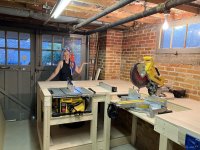
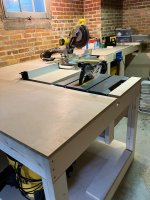
You could do a lot worse than look at the way I constructed the r/h half in "modern type bench with inset saws" cls bolted to the wall, cls doubled up for legs - you can form joints easily by missing bits out, 4or5 lengths stood on edge and screwed and glued together to form the front benchtop where all the work gets done, planed flat and then a sheet of 18mm ply on top. It’s very sturdy solid and fairly cheap to make, easy to form a well or keep it flat.
Pls don’t be put off that I said it cost $800 as its 14ft long with a 6’x4’ lump at one end.
A93667B3-6F30-4695-897C-9B2555B0255C.jpeg
D63517FE-B593-4DAF-B43A-0A75D1B61534.jpeg
It’s the bit at the far end on the second photo.
 
Back
Top